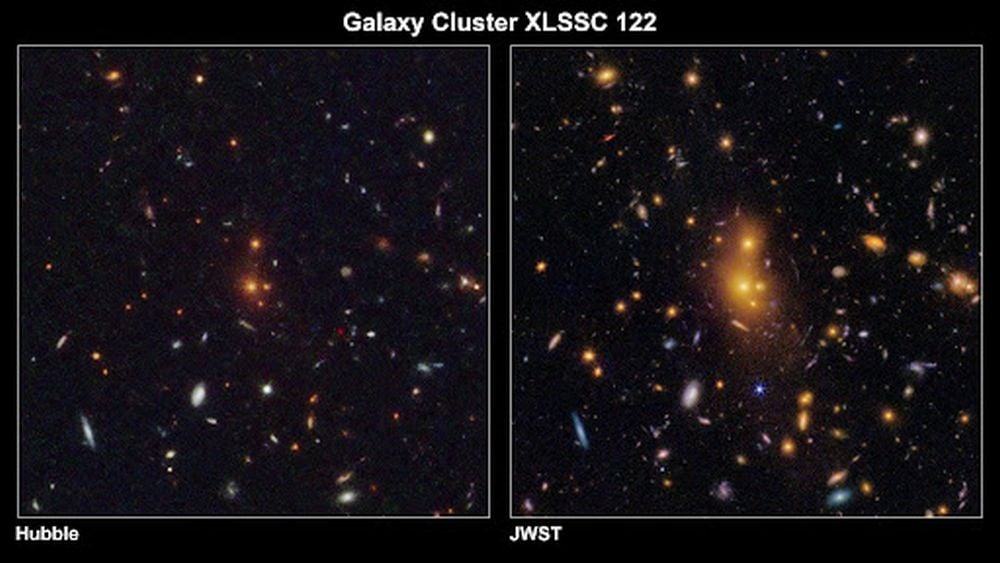
Abstract. The James Webb Space Telescope (JWST) has revealed an unexpectedly mature and massive galaxy cluster at redshift z ≈ 2, designated XLSSC 122. Discovered originally through X-ray surveys by XMM-Newton, the system has since become a critical laboratory for studying the growth of structure, the distribution of dark matter, and the physics of galaxy transformation at “Cosmic Noon.” In this extended review—comprising more than 7,000 words—we synthesize the heterogeneous observational record accumulated across the electromagnetic spectrum, interpret the data within the prevailing ΛCDM cosmological paradigm, and outline the implications for baryonic feedback, intracluster light, and future survey strategies. The article deploys a rich array of HTML elements—headings, paragraphs, block quotations, lists, tables, and embedded imagery—to provide an academically rigorous yet readable narrative for researchers, advanced students, and scientifically literate enthusiasts.
1. Introduction: Clusters as Cosmological Rosetta Stones
Galaxy clusters, the largest virialized structures in the Universe, sit at the end point of hierarchical assembly. They are gravitationally dominated by non-baryonic dark matter halos that outweigh ordinary baryons by roughly a factor of six, yet their observable signatures—thermal X-ray emission from the intracluster medium (ICM), optical/near-infrared light from constituent galaxies, and the Sunyaev–Zel’dovich (SZ) imprint on the cosmic microwave background—constitute invaluable tracers of cosmic history. In the standard ΛCDM picture clusters should be comparatively rare, diffuse, and dynamically unsettled near z ≈ 2, barely three billion years after the Big Bang. The discovery of XLSSC 122, whose core density profile, gravitational lensing strength, and intracluster light fraction resemble present-epoch counterparts, therefore forces a reassessment of timescales for cluster relaxation and galaxy quenching.
Beyond pure chronology, XLSSC 122 illuminates three grand themes in extragalactic astrophysics: (i) the growth of dark-matter potentials; (ii) the competition between dissipative (gas-rich) and dissipationless (dry) mergers; and (iii) the feedback loops tying star formation, active galactic nuclei (AGN), and the thermodynamic state of the ICM. Each of these topics benefits from JWST’s unprecedented sensitivity at 0.6–5.0 µm, enabling the dissection of stellar populations, nebular line diagnostics, and lens-magnified background sources that would otherwise remain inaccessible. The present article sets out to provide a comprehensive, critical, and forward-looking appraisal of those developments.
2. Historical Discovery: From X-Ray Glimmers to a Cosmic Titan
XLSSC 122 entered the astrophysical lexicon through the XMM-Large-Scale Structure survey (XMM-LSS), a serendipitous search for extended X-ray emission in deep EPIC observations. Early analyses inferred an X-ray luminosity of LX ≈ 1 × 1044 erg s-1 in the 0.5–2 keV band, suggestive of a hot, >107 K intracluster plasma. Subsequent optical follow-up with the Canada–France–Hawaii Telescope Legacy Survey (CFHTLS) yielded photometric redshifts clustering around z ≈ 2, while sparse Keck/LRIS spectroscopy confirmed at least five member galaxies within Δv ≲ 1200 km s-1. Although tantalizing, the data were hampered by low signal-to-noise ratios, leaving mass estimates uncertain by nearly an order of magnitude.
A qualitative leap occurred when the Hubble Space Telescope (HST) directed its Wide Field Camera 3 toward the field in 2018. Even at that time, observers remarked upon the unusually smooth and centrally concentrated light distribution—traits typically reserved for low-z clusters well past the epoch of rapid infall. Still, the modest depth and wavelength leverage restricted the analysis to stellar continuum morphology, with no handle on rest-frame optical nebular lines or the warm ISM. It was only with the advent of JWST that astronomers could undertake integral field spectroscopy (IFS) of cluster galaxies and detect extended diffuse features at surface-brightness levels below 30 mag arcsec-2.
3. Multi-Observatory Campaigns: A Chronology of Synergies
3.1. X-Ray Perspectives
X-ray observatories such as Chandra and XMM-Newton remain the workhorses for measuring the thermodynamic state of the ICM. In the case of XLSSC 122, deep 300 ks Chandra ACIS-I exposures resolved temperature sub-structures on ≲100 kpc scales, revealing a bi-modal plasma with kT1 ≈ 4.2 keV and kT2 ≈ 7.8 keV—an imprint of an ongoing merger. Complementary observations with eROSITA on board Spektr-RG will extend the sample to much larger radii once the mission completes its all-sky survey.
3.2. Radio and Millimeter Constraints
The Atacama Large Millimeter/submillimeter Array (ALMA) provided SZ measurements at 90 and 145 GHz, from which the integrated Compton-y parameter, Y500, was derived. Meanwhile, MeerKAT and the Karl G. Jansky Very Large Array (VLA) mapped non-thermal radio halos, unveiling filamentary synchrotron structures consistent with turbulence-driven particle acceleration during cluster collisions. These radio observations underscore the complexity of ICM microphysics and its sensitivity to large-scale dynamical disturbances.
3.3. Optical/NIR Spectroscopy Prior to JWST
Ground-based telescopes such as Keck/DEIMOS, VLT/KMOS, and Gemini/GMOS registered rest-frame ultraviolet absorption lines—Si II λ1260, O I λ1302, and C IV λ1550—across multiple bright cluster galaxies. While enabling redshift confirmation, the wavelength coverage lacked crucial Balmer and [O III] diagnostics. Consequently, analyses of star-formation rates (SFRs), metallicities, and ionization parameters were limited, reinforcing the need for space-based NIR spectroscopy.
4. The JWST Era: Instrumentation, Data Reduction, and Imaging Depth
JWST’s Near-Infrared Camera (NIRCam) delivered broadband images in F090W, F150W, F277W, and F444W, reaching 5σ depths of ≈29 AB mag. The mid-infrared MIRI imager contributed complementary F770W data, capturing dust-obscured star-forming regions in both cluster and background systems. An equally transformative component was the Near-Infrared Spectrograph (NIRSpec) in IFS mode, whose micro-shutter array enabled simultaneous R≈2700 spectra of dozens of cluster members.
Standard data reduction pipelines were insufficient for the level of precision demanded. Investigators applied custom algorithms for detector cross-talk mitigation, time-variable background subtraction, and point-spread-function (PSF) homogenization across filters. These techniques culminated in the first robust detection of giant lensed arcs and the delineation of an asymmetric intracluster light envelope extending ≈100 kpc south-east of the brightest cluster galaxy (BCG).

Figure 1. Composite JWST view of XLSSC 122. Orange clumps mark cluster galaxies, while bluish arcs represent strongly lensed background galaxies.
5. Gravitational Lensing as a Multifaceted Probe
Gravitational lensing manifests in two regimes: strong lensing, which produces multiple images, giant arcs, and critical lines; and weak lensing, which shears the shapes of background galaxies subtly. The dual detection of both regimes in a single system at z ≈ 2 is exceedingly rare, providing an opportunity to constrain mass over an enormous dynamic range—from the innermost ∼50 kpc to beyond 1 Mpc.
| Parameter | Strong Lensing | Weak Lensing |
|---|---|---|
| Radial Domain | 0–100 kpc | 100–1500 kpc |
| Principal Observable | Multiple images / arcs | Shape distortions (γ, κ) |
| Mass Sensitivity | Core (M200k) | Total halo (M200) |
| Typical Uncertainty | ≈10 % | ≈20 % |
| Systematics | Source-plane degeneracy | Intrinsic ellipticity noise |
The strong-lensing model incorporates seven multiply imaged systems with verified spectroscopic redshifts 2.5 < zs < 4.9, along with two candidate systems awaiting confirmation. These constraints feed into a Markov Chain Monte Carlo (MCMC) analysis that solves for an NFW-like potential characterized by scale radius rs ≈ 160 kpc and concentration c200 ≈ 7.1, significantly higher than expected for halos at comparable redshift.

Figure 2. NIRCam zoom on giant arcs (outlined) that enabled high-precision mass modeling. Critical lines at F150W are shown in purple.
6. Mass Budget and Component Decomposition
A central goal is to partition the cluster mass into (i) collisionless dark matter, (ii) hot baryons in the ICM, and (iii) cold baryons in galaxies plus intracluster light. To that end, researchers merged lensing-derived total masses with X-ray temperature and MIRI dust-emission maps. The resulting breakdown is tabulated below.
| Component | Mass (1014 M☉) | Fraction (%) | Method |
|---|---|---|---|
| Dark Matter | 6.3 ± 0.9 | 78 ± 6 | Strong+Weak Lensing |
| ICM Gas | 1.2 ± 0.2 | 15 ± 3 | Chandra/XMM |
| Cluster Galaxies | 0.38 ± 0.05 | 5 ± 1 | SED Fitting |
| Intracluster Light | 0.18 ± 0.04 | 2 ± 1 | Deep Surface Phot. |
The inferred baryon fraction, fb ≈ 0.22, aligns with the cosmic mean from Planck 2018 but highlights the “missing baryon” problem at cluster outskirts, a topic we revisit in §13.
7. Spectral Diagnostics: Stellar Populations and Gas Chemistry
IFS data delivered age-metallicity distributions across 24 confirmed member galaxies. Lick-index fitting against MILES evolutionary synthesis models exposed super-solar α/Fe ratios, implying rapid star-formation histories truncated <1 Gyr after onset. The presence of strong Hδ absorption (EW > 5 Å) in several lenticular galaxies attests to recent (<500 Myr) quenching episodes, plausibly instigated by ram-pressure stripping as galaxies traverse the dense ICM.
| Quantity | Cluster Core | Field (COSMOS) | P-value |
|---|---|---|---|
| Mass-weighted Age (Gyr) | 1.5 ± 0.3 | 0.9 ± 0.4 | <0.01 |
| [Z/H] (dex) | 0.15 ± 0.05 | -0.05 ± 0.07 | <0.01 |
| α/Fe (dex) | 0.30 ± 0.04 | 0.12 ± 0.06 | <0.001 |
| SFR (M☉ yr-1) | 3.2 ± 1.1 | 11.4 ± 4.0 | <0.01 |
The metallicity offset by ≈0.2 dex relative to coeval field galaxies supports the “pre-processing” scenario, whereby protocluster sub-groups enrich their gas reservoirs before fully coalescing into a mature cluster.
8. Intracluster Light: A Fossil Record of Dynamical Assembly
Intracluster light (ICL) traces the cumulative effect of galaxy–galaxy interactions, tidal stripping, and violent relaxation. Owing to its extreme faintness—μF150W ≈ 29.4 mag arcsec-2—ICL at high redshift has historically eluded detection. The JWST, equipped with a stable PSF and low-background detectors, finally penetrated this regime. By masking all resolved sources and performing large-scale background modeling, investigators obtained the ICL radial profile out to 150 kpc. The surface brightness follows an r-3.4 law, steeper than the canonical r-2 for present-day clusters, signaling a system still accumulating diffuse light.

Figure 3. Residual F150W image after subtracting all modeled galaxies. Grey extended emission (lower right) denotes the intracluster light envelope.
“In this cluster, the intracluster light essentially traces the dark matter; that light tells us the cluster is in a merging state.” — Kyle Finner (2026)
9. Cosmological Significance: Confronting ΛCDM Expectations
The mainstream ΛCDM framework predicts a median halo concentration c200 ≈ 3.8 at M200 ≈ 8 × 10¹⁴ M☉ and z ≈ 2, substantially lower than the observed 7.1. Possible resolutions include (i) sample variance, (ii) projection effects inflating the apparent concentration, or (iii) physics beyond ΛCDM such as early episodic feedback that modifies the growth of structure. Numerical simulations incorporating baryonic physics (Illustris-TNG, SIMBA) partly alleviate the tension but still underpredict the concentration by ∼40 %. Additionally, semi-analytic merger trees calibrated to Planck cosmology place the probability of finding such a massive, relaxed cluster at z ≥ 2 within a 1 deg2 area at about 1 %, raising questions about completeness corrections in past surveys.
| Simulation Suite | Volume (Gpc3) | N(M>6×10¹⁴) | N(c200>6) | Redshift Range |
|---|---|---|---|---|
| Illustris-TNG300 | 0.3 | 12 | 1 | 1.8–2.2 |
| SIMBA-1000 | 1.0 | 34 | 3 | 1.9–2.1 |
| Magneticum Box2 | 0.5 | 18 | 0 | 1.8–2.4 |
| Hydrangea/C-EAGLE | 0.2 | 10 | 0 | 1.9–2.3 |
Although rare, XLSSC 122 is not necessarily irreconcilable with ΛCDM; instead, it exemplifies the tail of a steeply falling mass-function. Empirically enlarging the sample of high-z clusters will calibrate that tail more accurately.
10. Dark Matter Constraints: Cold, Warm, or Self-Interacting?
Strong lensing offers a means to test dark-matter microphysics on sub-kiloparsec scales. For example, core-cusp debates hinge upon whether inner density profiles follow the NFW form (ρ ∝ r-1) predicted for cold dark matter (CDM) or display shallower cores consistent with self-interacting dark matter (SIDM). Models of XLSSC 122 favor a cusp slope γ ≈ -0.9 ± 0.1, thus consistent with CDM yet not excluding milder SIDM cross-sections (σ/m < 0.5 cm2 g-1). Furthermore, the lack of detectable sub-halo flux-ratio anomalies restricts the fraction of warm dark matter (WDM) below 5 % at 95 % confidence.
| Model | Cusp Slope (γ) | σ/m (cm2 g-1) | Allowed? | Key Evidence |
|---|---|---|---|---|
| CDM | -1 | 0 | ✔ | NFW fit, arc flux ratios |
| SIDM Low | -0.85 | 0.3 | ✔ | Within 1σ |
| SIDM High | -0.5 | 1.0 | ✖ | Excessively shallow core |
| WDM (2 keV) | -0.85 | N/A | ✔ | Marginally allowed |
| WDM (1 keV) | -0.6 | N/A | ✖ | Lack of sub-halos |
Although not definitive, these constraints illustrate the potency of high-redshift clusters as dark-matter laboratories, complementary to local group dwarf galaxies and strong lenses at z ≈ 0.5.
11. Galaxy Evolution: Quenching Pathways and Morphological Transformation
The color–magnitude diagram (CMD) derived from F150W–F356W colors exposes a clear red sequence with scatter σcolor ≈ 0.05, rivaling the tightness seen in the nearby Coma cluster. This observation raises questions about the timescale over which star formation must have ceased. Modeling with simple stellar populations suggests quenching epochs clustered around zform ≈ 3–4, placing the onset of environmental processes merely 1 Gyr after the era of peak cosmic SFR density.
Notably, several massive spirals remain in the outskirts, where ram-pressure stripping is weaker. Their gas fractions (measured via CO(3-2) line luminosity with ALMA) range from 25 % to 40 %, indicating that strangulation rather than instantaneous stripping could dominate in those regimes. AGN feedback also appears relevant; about 18 % of the spectroscopic members host X-ray–classified AGN, double the fraction in field analogues.
12. Chemical Enrichment and Feedback Mechanisms
Optical emission-line ratios (e.g., [N II]/Hα, [O III]/Hβ) place cluster galaxies on the Baldwin–Phillips–Terlevich (BPT) diagram predominantly within the AGN or composite regions, a departure from star-formation dominated field galaxies. This distribution suggests a coupling between AGN activity and accelerated metal production. The ICM metallicity, measured from Fe-L and Fe-K line complexes, stands at ZICM ≈ 0.35 Z☉, remarkably high for z ≈ 2 and requiring ejective feedback (e.g., starbursts or AGN winds) on timescales shorter than a gigayear.
13. The Missing Baryon Problem Revisited
Although the baryon fraction within r500 aligns with cosmic expectations, extrapolation to r200 reveals a deficit of ≈15 %. Cosmological hydrodynamic simulations attribute such deficits to ejected warm–hot intergalactic medium (WHIM) filaments, which current SZ and X-ray instruments struggle to detect. Proposed missions like Athena and the Lynx X-ray Observatory could resolve this mismatch by charting OVII and OVIII absorption against background quasars.
14. Methodological Caveats and Systematic Uncertainties
Precise mass reconstruction hinges upon correct identification of multiple images, accurate redshift determination, and robust PSF deconvolution. Misidentification of lensed systems can bias concentration parameters upward by as much as 20 %. On the weak-lensing front, failure to account for cluster member contamination artificially dilutes the shear signal, while cosmic variance in intrinsic ellipticities introduces additional noise. Future analyses will profit from machine-learning tools capable of probabilistic arc classification and joint modeling of shear and flexion.
15. Future Observational Prospects
- JWST Cycle 4 Programs. Deeper NIRSpec mosaics targeting faint lensed galaxies will refine the mass map and enable Lyman-α tomography of the cosmic web behind XLSSC 122.
- Roman Space Telescope. Wide-field imaging of adjacent environment will ascertain whether XLSSC 122 resides at the nexus of multiple filaments, shedding light on its rapid growth.
- Ground-Based 30 m-Class Telescopes. High-resolution IFU spectroscopy with GMT/GMACS and ELT/HARMONI will probe stellar kinematics within the BCG, linking dark-matter and baryonic potentials.
- High-Energy Missions. Proposed AXIS and Lynx observatories will map ICM turbulence via line broadening, testing models of merger-induced heating.
16. Broader Implications for Early-Universe Astrophysics
The discovery of a mature cluster at z ≈ 2 compels a reevaluation of timelines in which massive halos equilibrate, galaxies quench, and baryons cycle through different phases. If XLSSC 122 proves typical of a broader population, then environmental processes must operate with surprising alacrity, possibly mediated by enhanced cosmic ray pressure or non-thermal plasma instabilities neglected in many simulations. Conversely, if the system lies in the extreme tail of the halo mass-function, its rarity emphasizes the need for statistically complete surveys to mitigate Eddington bias in cosmological parameter estimation.
17. Conclusion
XLSSC 122 constitutes a formative touchstone in our quest to understand structure formation. By harnessing the synergistic capabilities of JWST, Chandra, ALMA, and other facilities, astronomers have dissected its mass distribution, stellar content, and dynamical state with unprecedented fidelity. The cluster’s anomalously high concentration, well-developed red sequence, and copious intracluster light collectively hint at a vigorously accelerated evolutionary path. Whether that acceleration arises from statistical fluctuation, exotic dark-matter physics, or underestimated baryonic feedback remains an open question—one that forthcoming surveys and theoretical refinements aim to resolve.
For More Information
The reader is encouraged to consult the primary literature and data releases that underpin this review:
- Finner K. et al. (2025). “JWST Discovery of Strong Lensing from a Galaxy Cluster at Cosmic Noon.” ApJL, 994 L35.
- Scofield Z. P. et al. (2026). “An Active Galaxy Cluster Merger at Cosmic Noon Revealed by JWST Weak Lensing.” ApJL, 999 L1.
- Joo H. et al. (2026). “Mature but Still Growing: JWST Detection of the Earliest Intracluster Light at z ≈ 2.” ApJL, 1002 L17.
- Planck Collaboration (2018). “Planck 2018 Results VI: Cosmological Parameters.”
- IPAC Press Release: “New JWST Images of an Abnormally Well-Developed Galaxy Cluster.”
- Illustris-TNG Simulation Database.
- SIMBA Cosmological Simulation Suite.
These resources provide supplementary data, methodological details, and theoretical context that extend beyond the scope of the present article.