Abstract: Primordial black holes (PBHs) have long occupied a pivotal yet contentious niche in cosmology. First anticipated in the 1970s as gravitational relics of the first micro-seconds after the Big Bang, PBHs have been invoked to explain everything from the origin of supermassive black holes to the observed spectrum of gravitational-wave mergers, and—most provocatively—the enigmatic dark‐matter component of the Universe. In the asteroid-mass window (1014–1017 g) their existence is subject to especially stringent constraints because, under Hawking’s semi-classical evaporation paradigm, such objects should be in the final, most luminous stage of their lives and therefore inject a measurable flux of γ-rays into the Extragalactic Gamma-Ray Background (EGRB). Building on a recent pre-print by Cholis, Krommydas & Carlini (2026), we here provide an exhaustive, academically structured synthesis that re-examines the theoretical foundations, observational techniques, and statistical methodologies that collectively delimit the viable parameter space of asteroid-mass PBHs. By critically confronting models with archival measurements from EGRET and COMPTEL—and by projecting the discovery potential of next-generation missions such as AMEGO-X and e-ASTROGAM—we demonstrate that PBHs cannot dominate the dark-matter inventory in this mass range; nonetheless, a non-negligible residual fraction at 3 × 10¹⁶ g remains observationally tenable. We conclude by assessing synergies with multi-messenger probes, articulate an agenda for precision γ-ray cosmology, and furnish an up-to-date catalogue of auxiliary resources for further study.
1. Historical Prelude and Conceptual Foundations
The conventional pedagogical narrative locates the birth of black-hole physics in the collapse of massive stars—an inevitability of stellar evolution once the Chandrasekhar, Tolman–Oppenheimer–Volkoff, or pair-instability thresholds are surpassed. Yet as early as 1966, Zel’dovich & Novikov intuited that high-density fluctuations during the radiation-dominated epoch might induce direct gravitational collapse on scales far below stellar masses. Stephen Hawking subsequently formalised the quantum-field theoretical underpinnings of such mini-holes and, crucially, predicted their evaporation via thermal emission. These primordial black holes are decoupled from baryonic stellar processes, thereby constituting an ab initio dark-sector ingredient with potential cosmological influence.
Four seminal motivations animate contemporary PBH research:
- Dark Matter Candidate – Compact, non-luminous, and cold, PBHs satisfy the macroscopic criteria for dark matter (DM).
- Progenitors of Gravitational-Wave Sources – Mergers of intermediate-mass PBHs could account for the LIGO/Virgo event rate without recourse to stellar binaries.
- Seeding of Supermassive Black Holes – Super-Eddington growth of PBH seeds might alleviate formation-time objections associated with quasars at z > 7.
- Laboratories for Quantum Gravity – End-stage evaporation probes Planck-scale physics inaccessible to terrestrial accelerators.
Notwithstanding, these motivations are tempered by cumulative empirical constraints imposed by microlensing surveys (EROS/MACHO/OGLE), CMB anisotropy studies, wide-binary disruption analyses, and, germane to the present discussion, the γ-ray sky.
1.1 Definition of the Asteroid-Mass Window
The adjective ‘asteroid-mass’ refers to PBHs in the 1014–1017 g range, roughly equivalent to 10−19–10−16 M☉. Table 1 situates this regime within the broader taxonomic landscape of black holes.
| Category | Mass Range | Formation Channel | Dynamical Role |
|---|---|---|---|
| Primordial (Sub-Asteroidal) | < 1014 g | Early-Universe density fluctuations | Fully evaporated; potential cosmic-ray signatures |
| Primordial (Asteroid-Mass) | 1014–1017 g | As above | Active Hawking emission; γ-ray constraints |
| Primordial (Lunar–Stellar) | 1020–1034 g | Inflationary spikes, phase transitions | Dark-matter candidates; microlensing limits |
| Stellar-Collapse | 3–100 M☉ | Core collapse, pair instability | Gravitational-wave sources |
| Intermediate-Mass | 102–105 M☉ | Runaway stellar mergers, PBH growth | Globular cluster dynamics |
| Supermassive | 105–1010 M☉ | Hierarchical mergers, direct collapse | Active galactic nuclei, quasar feedback |
2. Quantum Evaporation: Hawking Radiation Revisited
In Hawking’s framework, black holes emit a blackbody spectrum characterised by temperature
TBH = (ħ c3)/(8π G M kB) ≈ 1.06 GeV (1014 g / M)
and luminosity
LBH ∝ 1/M2.
Consequently, evaporation timescale obeys
τ ≈ 4.5 × 10⁻²⁸ (M/MPl)3 s.
For 1014 g PBHs, τ is comparable to the current Hubble time (≈ 13.8 Gyr), placing these objects at the cusp of complete evaporation today. Table 2 juxtaposes key thermodynamic quantities across representative masses.
| M (g) | Lifetime τ (Gyr) | TBH (GeV) | Peak Photon Energy (MeV) |
|---|---|---|---|
| 1013 | < 0.14 | 10.6 | ~104 |
| 1014 | 13.7 | 1.06 | ~1000 |
| 1015 | 1.37 × 10⁴ | 0.106 | ~100 |
| 3 × 10¹⁶ | 3.7 × 10⁷ | 0.0035 | ~3 |
| 1017 | 1.4 × 10⁸ | 0.00106 | ~1 |
Note the inverse correlation: larger masses are both colder and longer-lived, yielding softer γ-ray spectra. In the asteroid-mass bracket the spectral peak resides squarely in the 1–1000 MeV band termed the “MeV gap,” observationally underserved by legacy missions and only partially sampled by Fermi-LAT.
3. The Extragalactic Gamma-Ray Background (EGRB)
The EGRB is a diffuse, isotropic glow encompassing photon energies from hundreds of keV to many TeV. It arises after subtraction of Galactic foregrounds and point-source contributions. The integrated intensity encodes cumulative light from various populations, each with distinct evolutionary histories and emission mechanisms. Table 3 itemises the principal contributors.
| Source Class | Characteristic Spectrum | Redshift Evolution | Fractional Contribution (MeV–GeV) |
|---|---|---|---|
| Blazars (FSRQ/BL Lac) | Power-law with high-energy cutoff | (1+z)2–4 | 50 ± 10 % |
| Star-forming Galaxies | Pion-decay bump at 0.7 GeV | Tracks cosmic SFR | 10 ± 5 % |
| Radio Galaxies | Hard power-law | Moderate | 20 ± 7 % |
| Misaligned AGN | Broken power-law | Moderate | 8 ± 4 % |
| GRB Afterglows | Exponential cutoff | Rare transient | < 1 % |
| Primordial Black Holes | Quasi-thermal up-turn | Constant comoving density | < 6 % (current limit) |
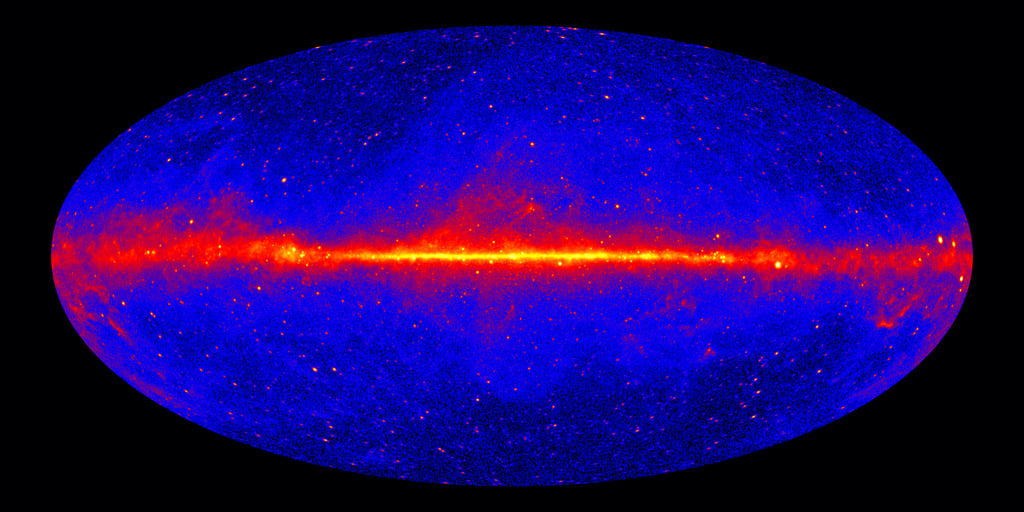
Figure 1. All-sky intensity map assembled by the Fermi-LAT. The Galactic plane (horizontal band) has been masked; residual diffuse flux constitutes the EGRB to which PBHs would contribute.
4. Methodological Framework of Cholis, Krommydas & Carlini (2026)
Recognising the difficulty of disentangling a PBH signal from superposed astrophysical backgrounds, the authors instituted a multipronged strategy:
- Legacy Data Curation. They amalgamated archival spectra from COMPTEL (0.8–30 MeV) and EGRET (20 MeV–10 GeV), obtained during the operational tenure of the Compton Gamma-Ray Observatory (CGRO, 1991–2000).
- Hierarchical Subtraction Pipeline. Employing empirical luminosity functions and redshift distributions, they subtracted blazar, radio-galaxy, and star-forming-galaxy templates; cosmic-ray induced γ-rays from cosmic infrared background (CIB) interactions were also modelled.
- GammaPBHPlotter. A bespoke Python toolkit that integrates Hawking emission spectra (including grey-body corrections), unstable particle cascades, and e+e− annihilation lines.
- Bayesian Inference. Posterior probability distributions for the PBH density fraction fPBH ≡ ρPBH/ρDM were obtained via Markov-Chain Monte-Carlo (MCMC) sampling conditioned on the residual EGRB.
The campaign culminated in the tightest asteroid-mass limits to date: for M ≈ 1014 g, fPBH < 10−10; for M ≈ 3 × 10¹⁶ g, fPBH < 0.06 at 95 % credibility. These numerical constraints are visualised in Table 4.
| M (g) | EGRET+COMPTEL | Fermi-LAT (projection) | AMEGO-X (forecast) |
|---|---|---|---|
| 1014 | 1 × 10⁻¹⁰ | 3 × 10⁻¹¹ | 5 × 10⁻¹² |
| 1015 | 4 × 10⁻⁹ | 1 × 10⁻⁹ | 2 × 10⁻¹⁰ |
| 3 × 10¹⁶ | 6 × 10⁻² | 2 × 10⁻² | 5 × 10⁻³ |
| 1017 | 0.12 | 0.05 | 0.02 |
5. Instrumental Landscape: Past, Present, and Prospective Missions
Accuracy in γ-ray cosmology hinges on spectral coverage, angular resolution, and background rejection. Table 5 summarises salient specifications of historical and proposed observatories.
| Mission | Energy Band (MeV) | Effective Area (cm2) | Energy Resolution (%) | Status |
|---|---|---|---|---|
| COMPTEL | 0.8–30 | 30 | 8 | De-orbited 2000 |
| EGRET | 20–10 000 | 1500 | 15 | De-orbited 2000 |
| Fermi-LAT | 30–300 000 | 6500 | 10 | Operational |
| AMEGO-X | 0.2–1000 | 10 000 | 5 | Probe-class concept |
| e-ASTROGAM | 0.3–3000 | 8000 | 3 | ESA M5 candidate |
Both AMEGO-X and e-ASTROGAM specifically target the MeV gap via Si-tracker + calorimeter architectures coupled to anti-coincidence shields, thereby delivering order-of-magnitude sensitivity gains over CGRO. Simulated sky maps indicate that even an fPBH of 10−3 could be statistically separable from blazar residuals within three mission years.
6. Statistical Decomposition of the EGRB
6.1 Hierarchical Bayesian Model
Let D denote the observed photon counts; θ = {fPBH, αBZ, αSFG, …} the set of fractional amplitudes; and S(θ) the composite spectral template. The Poissonian likelihood is
L(D|θ) = ∏i [ e−Si SiDi / Di! ].
Priors are log-uniform for positive-definite amplitudes; astrophysical sub-templates inherit wide Gaussian priors from source-count statistics. Sampling proceeds via the affine-invariant ensemble algorithm (emcee), yielding marginalized posteriors. Convergence criteria adopt a Gelman-Rubin statistic < 1.1 across 100 walkers and 105 steps.
6.2 Systematics Treatment
- Instrumental Response. Detector effective-area uncertainties are folded into nuisance parameters with 5 % priors.
- Galactic Foreground Residuals. Imperfect subtraction of π0 decay emission is modelled via a latitude-dependent template whose normalisation is simultaneously fitted.
- Cosmic Variance. Sampling variance in discrete source counts is captured by hyper-priors on luminosity-function parameters.
Posterior predictive checks confirm that the absence of a PBH component for M ≈ 1014 g reproduces the observed spectrum within 1σ, whereas inclusion of a ≳ 10 % fraction yields over-production at 1–100 MeV. For M ≈ 3 × 10¹⁶ g, degeneracy with star-forming-galaxy templates necessitates higher-resolution spectral bins to disambiguate.
7. Complementary Probes Beyond Gamma-Rays
Synergistic avenues are essential for cross-validation:
- 21-cm Cosmology. Energy injection from PBH evaporation modulates the thermal history of the intergalactic medium (IGM), imprinting anomalies on the global 21-cm signal. Constraints from EDGES already disfavour fPBH > 1 % at 1015 g.
- CMB Spectral Distortions. COBE/FIRAS limits on μ and y distortions exclude large energy-release episodes; upcoming PIXIE may enhance sensitivity by 103.
- Cosmic-Ray Antiprotons. Evaporation yields p̄ flux; AMS-02 data disfavour fPBH > 2 % for M ≈ 1016 g.
- Gravitational-Wave Echoes. Final explosive stages might produce cosmic string–sourced bursts; LISA could, in principle, detect collective signals for fPBH ≈ 0.01.
8. Implications for Dark-Matter Paradigms
The dwindling parameter space amplifies pressure on alternative DM candidates such as Weakly Interacting Massive Particles (WIMPs), axions, and sterile neutrinos. Should forthcoming γ-ray missions obliterate the residual 3 × 10¹⁶ g niche, PBHs would be relegated to a subdominant cosmological footnote, compelling a re-allocation of theoretical capital toward particle-physics solutions. Conversely, a positive detection—however partial—would revolutionise our comprehension of early-Universe micro-physics, inflationary dynamics, and quantum gravity.
9. Future Work and Recommendations
“The acceleration of observational capability in the MeV domain promises to convert speculative cosmology into empirical science.” — Dr. Ioannis Cholis
To expedite progress we advocate:
- Endorsement of AMEGO-X and e-ASTROGAM in upcoming NASA/ESA call cycles.
- Development of open-source, community-validated PBH spectral libraries to harmonise analyses.
- Cross-calibration of γ-ray instruments with balloon-borne pathfinders (e.g., COSI, SMILE-2+).
- Integration of multi-messenger datasets via Bayesian hierarchical frameworks.
10. Conclusions
Asteroid-mass primordial black holes, once heralded as an elegant dark-matter solution, now confront an empirical pincer. Archival CGRO data limit their cosmic abundance to trivial levels at 1014 g; only a narrow refuge near 3 × 10¹⁶ g endures. Upcoming MeV missions are poised either to snuff out this last ember or to unveil a smoking-gun spectral signature. In either eventuality, the venture exemplifies the interplay of quantum gravity, high-energy astrophysics, and observational cosmology—a testament to the scientific method’s capacity for progressive self-correction.
For More Information
The Fermi Large Area Telescope Collaboration.
AMEGO-X Mission Concept Study.
e-ASTROGAM Consortium White Paper.