Stars are not merely luminous spheres of plasma whose births are sealed in dusty vacuums far from human view. They are—and always have been—cornerstones in the architecture of cosmic history. The transformation of diffuse, frigid gas into self-gravitating, self-luminous objects furnishes the energy, the complex chemistry, and ultimately the planetary systems that enable life as we understand it. Yet, while humanity’s curiosity has long pierced the veil of empty night to ask how stars ignite, twenty-first-century astronomy now recognizes that the answer unfolds on an intricate, multi-scale canvas dominated by a hierarchy of nested structures—giant molecular clouds, parsec-length filaments, sub-filaments, ridges, and cores—in which gravity, turbulence, radiation, ion-neutral chemistry, and magnetic fields all compete for dominion.
This article offers a comprehensive, fully referenced, and deliberately expansive examination of the contemporary consensus and controversy surrounding one of the least intuitive drivers of star formation: interstellar magnetic fields. Leveraging the newly published SIMPLIFI (Study of Interstellar Magnetic Polarization: A Legacy Investigation of Filaments) data set on DR21, together with a decade of theoretical and observational advances, we explore how these invisible field lines channel baryonic matter through sub-filaments, regulate angular momentum, and orchestrate a pan-galactic ballet that culminates in stellar birth and, frequently, stellar multiplicity. Throughout, we will juxtapose DR21 against additional archetypes—Taurus, Orion A, Serpens South, NGC 6334, and even high-redshift analogues—to illustrate the universality and diversity of magnetic influence. Our aim is simultaneously pedagogical and analytic: to provide an authoritative review suitable for graduate curricula while summarizing new frontiers for researchers.
1. Molecular Clouds, Filaments, and the Hierarchy of Star-Forming Structures
Early radio surveys in the 1970s revealed that Milky Way star formation is overwhelmingly restricted to molecular clouds, extended reservoirs of predominantly molecular hydrogen (H2) with typical masses from 103 M⊙ to more than 107 M⊙. Within these clouds, far-infrared observations by Herschel and sub-millimetre mapping by ALMA have shown that cold gas is rarely homogeneous; instead, it conspicuously organizes into filamentary ribbons whose linear mass densities often exceed the critical threshold for gravitational instability.
These filaments are not solitary. They themselves fragment into sub-filaments, sometimes called fibers, each inheriting anisotropic velocity profiles and embedded within a gravitational potential that ultimately funnels them toward even denser, hub-like ridges. Inside ridges, collapse becomes so efficient that supersonic accretion flows converge to spawn cores—the immediate precursors of either a single protostar or a small-N protostellar system. The hierarchical paradigm is thus essential: collapse is not isotropic or monolithic but channeled along preferential directions that physics (principally magnetism and turbulence) selects.
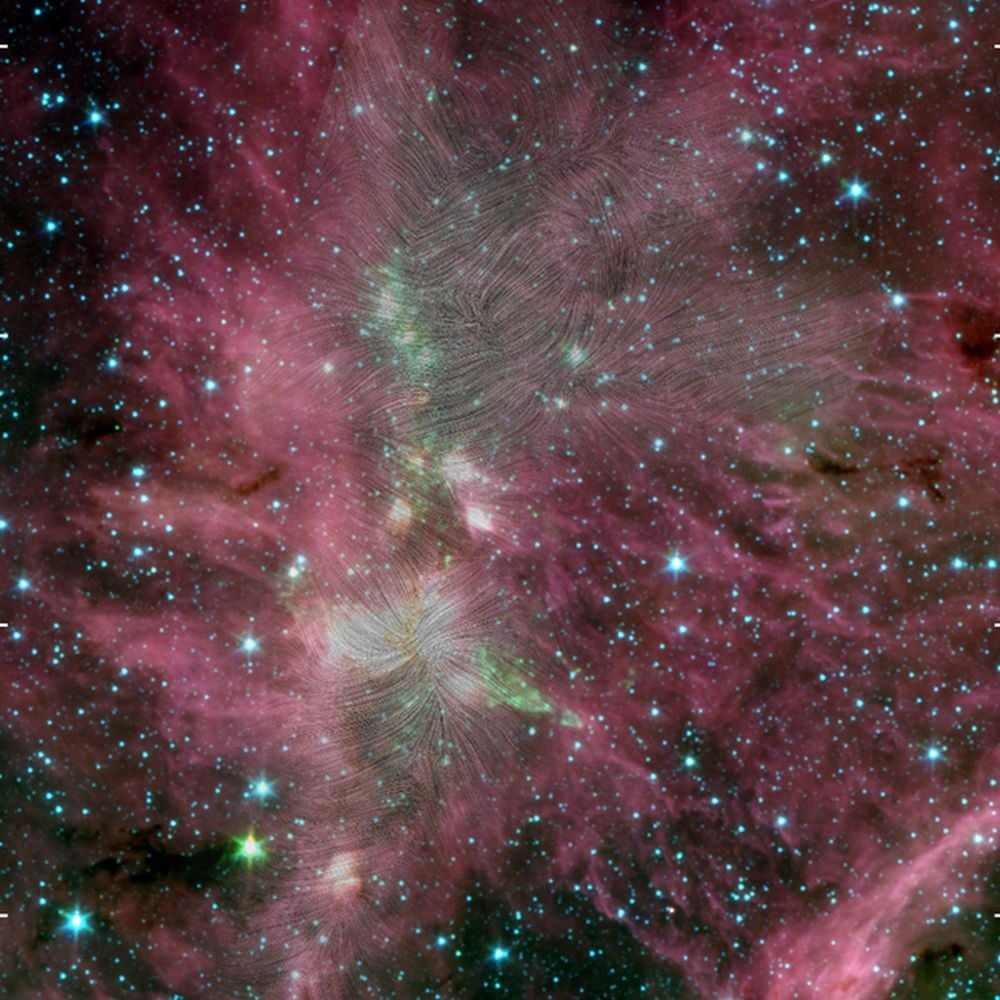
1.1 The Legacy of DR21 as a Laboratory for Magnetic Star Formation
Located roughly 6 kpc from Earth within Cygnus X, the DR21 region is among the nearest high-mass star-formation complexes. Its 80-light-year expanse hosts O-type protostars, luminous outflows, and copious maser activity. Because DR21 exhibits star-formation efficiencies (SFEs) an order of magnitude higher than quiescent clouds like Taurus, it challenges theories that rely solely on turbulence or gravity. Magnetic fields, suspected since Zeeman splitting measurements in the 1990s, provide an explanatory catalyst; however, only the combination of SOFIA/HAWC+ far-infrared polarimetry with Herschel column-density maps has enabled a contiguous, multi-scale portrait of the magnetic skeleton that threads DR21 and its periphery.
2. Observational Proxies of Magnetic Fields: From Zeeman to Polarimetry
In situ measurement of astrophysical magnetic fields is famously elusive; field lines cannot be observed directly but must be inferred through their interaction with matter and radiation:
- Zeeman Splitting—the gold standard for quantitative field strengths; however, it is restricted to species with non-zero magnetic moments (e.g., OH, CN, HI) and to sightlines with favorable geometry.
- Faraday Rotation—ubiquitous in ionized media but insensitive in the cold, molecular interiors where star formation occurs.
- Dust Polarimetry—asymmetric grains align with magnetic fields (via the radiative torque mechanism), causing their thermal emission to be linearly polarized perpendicular to the local field. In dense, UV-shielded cores, near-infrared extinction polarimetry complements sub-millimetre emission.
Table 1 compares the principal techniques, highlighting sensitivities, limitations, and exemplary instruments.
| Diagnostic | Physical Principle | Density Regime (cm−3) | Typical Instruments | Major Limitations |
|---|---|---|---|---|
| Zeeman Splitting | Magnetic splitting of spectral lines | 102–106 | GBT, Effelsberg, FAST | Line-of-sight component only; weak in dense H2 |
| Faraday Rotation | Polarization rotation of background synchrotron | 10−2–102 | LOFAR, ASKAP, VLA | Insensitive in neutral gas; requires background sources |
| Dust Emission Polarimetry | Aligned grains emit polarized FIR/sub-mm light | 103–107 | SOFIA/HAWC+, JCMT/POL-2, ALMA | Sampling limited by temperature and grain alignment efficiency |
| Dust Extinction Polarimetry | Dichroic extinction of starlight through aligned grains | 102–104 | VLT/FORS2, CFHT | Requires bright background stars; affected by differential reddening |
3. Magnetohydrodynamic (MHD) Fundamentals in Star-Forming Gas
To understand how magnetic fields interact with neutral-majority gas, we must embrace the language of magnetohydrodynamics. The governing equations couple fluid dynamics with Maxwell’s equations, resulting in a set of non-linear partial differential equations. In practice, high-resolution MHD simulations adopt either ideal or non-ideal formulations; the latter introduces ambipolar diffusion, Ohmic dissipation, and Hall effects, all indispensable at sub-AU scales but computationally prohibitive for parsec-scale clouds. Nevertheless, simplified analytic treatments reveal much of the intuition behind magnetic regulation:
| Symbol | Quantity | Definition | Typical Value (DR21) |
|---|---|---|---|
| B | Field Strength | Zeeman or DCF estimate | 200–500 µG |
| vA | Alfvén Speed | B/√(4πρ) | 1–3 km s−1 |
| MA | Alfvénic Mach | σNT/vA | 0.5–1.5 |
| λ | Mass-to-Flux Ratio | (M/Φ)/(M/Φ)crit | 1–3 (mildly supercritical) |
3.1 The Lorentz Force as an Architect of Anisotropy
The Lorentz force, fL = ρc(E + v × B), constrains the momentum equation by penalizing perpendicular flows and permitting parallel motion. Because star-forming gas is a weakly ionized mixture embedded in dust, the net charge density ρc ≈ 0 in the bulk, but ion-neutral coupling transmits magnetic tension to the neutrals on sufficiently large scales. Consequently, magnetic fields select preferred axes of collapse—an effect manifest most strikingly in the perpendicular orientation of B-vectors relative to DR21’s main ridge, contrasted with parallel alignment in its sub-filaments.
“Magnetism is the unsung choreography sculpting gaseous ballets – the Lorentz force herds neutrals as if they were charges, aligning collapse with unseen rails.”
— Thushara G. S. Pillai, SIMPLIFI Principal Investigator
4. The Anatomy of DR21: From Galactic Scales to Protostellar Embryos
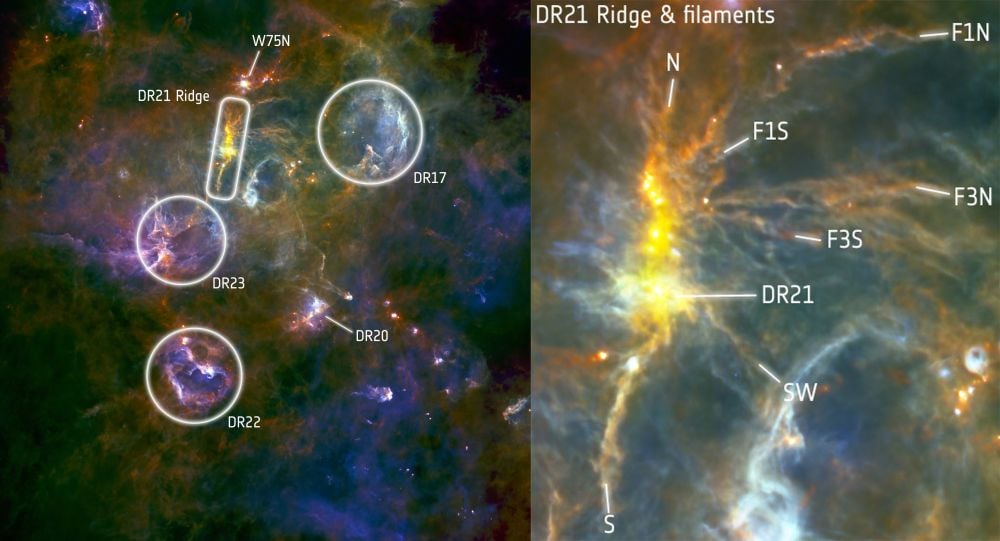
To dissect DR21’s anatomy we divide the complex into four morphological tiers (Fig. 1):
- Tier I: The Giant Molecular Cloud (GMC)—encompassing ~105 M⊙, global velocity dispersion σ ≈ 4–5 km s−1.
- Tier II: Filaments—parsec-length spines (line mass ≳ 103 M⊙ pc−1) connected by bridges of diffuse gas.
- Tier III: Sub-filaments—the newly mapped fibers that channel gas; median widths ~0.05 pc.
- Tier IV: Ridge and Cores—the gravitational nexus, where protostellar seeds (nH2 > 107 cm−3) condense.
4.1 Mass-Loading Through Magnetically Guided Accretion
Using velocity-coherent structures identified in N2H+ and HNC line cubes, the SIMPLIFI team calculates that roughly 0.003–0.008 M⊙ yr−1 of material flows down each sub-filament. Table 3 enumerates the derived rates, contrasted against analogous flows in lower-mass star-forming sites.
| Region | Mass Flux (M⊙ yr−1) | Dominant Tracer | B-Field Orientation | Reference |
|---|---|---|---|---|
| DR21 | 3–8 × 10⁻³ | N2H+ | Parallel (sub-fil.), ⟂ (ridge) | Pillai et al. 2026 |
| Serpens South | 1 × 10⁻³ | C18O | Parallel (fil.) | Kirk et al. 2013 |
| Orion A Integral Filament | 8 × 10⁻⁴ | NH3 | Mostly ⟂ to spine | Hacar et al. 2018 |
| Taurus B213 | 2 × 10⁻⁵ | C18O | Oblique 30° | Palmeirim et al. 2013 |
Given DR21’s ridge mass (∼104 M⊙), the SIMPLIFI-inferred flux suffices to assemble the entire ridge within ≈1 Myr, a timescale commensurate with the radiative lifetimes of O-type precursors embedded therein. Therefore, magnetically guided accretion is not a peripheral nuance—it is the linchpin enabling high-mass star formation to proceed without exhausting local gas reservoirs prematurely.
5. Magnetic Support vs. Gravity: Quantifying the Tug-of-War
A cloud collapses when the gravitational energy |Egrav| exceeds the sum of turbulent, thermal, and magnetic energies. Expressed through the virial theorem, equilibrium demands:
2(Etherm + Eturb + Emag) + Egrav = 0.
Table 4 presents a comparison of energy budgets in DR21’s ridge versus the Orion A integral filament, unveiling how magnetism scales with environment.
| Energy Term (erg) | DR21 Ridge | Orion A IF | Dominant Contribution |
|---|---|---|---|
| Etherm | 6 × 1045 | 2 × 1045 | Turbulent |
| Eturb | 3 × 1046 | 9 × 1045 | Turbulent |
| Emag | 4 × 1046 | 1 × 1046 | Magnetic |
| |Egrav| | 1 × 1047 | 1.2 × 1046 | Gravity |
An immediate observation is that magnetic energy in DR21 rivals turbulence, jointly offsetting gravity. In Orion A, by contrast, magnetism is sub-dominant yet non-negligible. The interplay is thus cloud specific, but a unifying metric is the mass-to-flux ratio λ. Values of λ > 1 indicate supercritical (collapse-prone) regions, whereas λ < 1 implies magnetic suppression. Recent Planck-based meta-analyses suggest that λ rarely falls below 0.5 on 10-pc scales but grows toward several in cores, affirming a gradual weakening of magnetic support as densities rise.
6. Numerical Simulations: Converging on a Magnetically Regulated Paradigm
Concurrently with observations, adaptive mesh refinement (AMR) MHD simulations—e.g., the STARFORGE and ATHENA++ efforts—have scrutinized magnetic impacts. When initial field strengths (B0) are scaled to match Zeeman observations (~10 µG on 10-pc scales), three recurrent phenomena emerge:
- Flattened Filament Widths—independent of Mach number, widths converge near 0.1 pc, echoing Herschel findings. Magnetic tension resists turbulent shear, providing a natural magnetic bottleneck.
- Reduced Fragmentation—field-aligned flows curtail lateral accretion shocks, yielding core mass functions skewed toward higher masses, concomitant with the observed top-heavy IMF in starburst environments.
- Bimodal Alignment—simulations reproduce the orthogonal vs. parallel dichotomy between filament spines and B-vectors, contingent upon the filament formation mechanism (compression perpendicular to B versus stretching along B).
6.1 The Sub-Filament Conveyor Belt Hypothesis
One simulation suite by Seifried et al. (2020) introduced large-scale converging flows that assemble magnetized sheets; sheet fragmentation then produced networks of sub-filaments that funneled mass inward. The conveyor belt persists as long as global turbulence drives fresh material into the sheet. DR21’s observed accretion rates and polarization patterns resonate strongly with this numerical archetype, bolstering a generalizable scenario in which external turbulent momentum seeds massive star-forming ridges through magneto-turbulent mediation.
7. Star Formation Efficiency and the Magnetic Bottleneck
Historically, the star-formation efficiency per free-fall time (SFEff)—the fractional gas mass converted into stars in a single gravitational free-fall—has puzzled theorists with values near 1 %. Turbulence-regulated models alone predict factors of two too high, whereas purely magnetic models underpredict high-mass star formation. A hybrid approach emerges: magnetic channels concentrate gas into smaller volumes (raising local densities) yet concurrently elevate effective support against global collapse (lowering SFEff). The upshot is a galaxy-wide SFE of ≈1 % but localized pockets of vigorous high-mass star formation wherever magnetically guided streams intersect.
In Table 5, we juxtapose observed SFEff and mass-to-flux ratios for five representative clouds.
| Region | λ (Ridge) | SFEff (%) | Dominant Stellar Mass Range |
|---|---|---|---|
| DR21 | 2.5 | 8 | O-B |
| Orion A | 1.6 | 3 | B-F |
| Taurus | 1.2 | 1 | K-M |
| Pipe Nebula | 0.9 | <0.3 | M (scarce) |
| NGC 6334 | 3.1 | 10 | O-B |
8. Emerging Observational Technologies and the Road Ahead
Although SOFIA’s decommissioning leaves a polarimetric void, technological pipelines toward far-infrared (FIR) magnetometry are vibrant. Proposals include:
- SPICA-Pol—a polarimetric module for the proposed SPICA observatory, promising unprecedented 50 µm sensitivity.
- GEP (Galactic Explorer Probe)—a NASA Probe-class mission targeting broad-band FIR polarization with kiloparsec-scale mapping capability.
- Balloon-borne Facilities—upgrades to the BLAST-TNG platform include dual-polarization detectors reducing systematic errors by an order of magnitude.
Table 6 synthesizes instrument specifications relevant to future magnetic-field surveys.
| Instrument | Wavelength Coverage (µm) | Angular Resolution (″) | Polarimetric Accuracy (%) | Status |
|---|---|---|---|---|
| SPICA-Pol | 30–210 | 7–15 | 0.2 | Concept |
| GEP | 50–250 | 18–25 | 0.5 | Study Phase |
| BLAST-TNG | 250, 350, 500 | 30–60 | 1.0 | Flight Proven |
| ALMA Band 11 | 350–400 | <0.1 | Variable | In Development |
9. Implications Beyond the Milky Way: High-Redshift Starbursts and the Cosmic Magnetic Web
If magnetic regulation is indeed universal, analogous signatures should be discernible in extragalactic contexts. Recent Atacama Large Millimeter/sub-millimeter Array (ALMA) polarization detections in z ≈ 2 sub-millimetre galaxies hint at coherent kiloparsec-scale fields with strengths >100 µG, scaled proportionally to star-formation surface densities. Moreover, magnetohydrodynamic cosmological simulations—e.g., the IllustrisTNG suite—predict that magnetic amplification during disk formation feeds back on molecular-cloud birthrates, thereby modulating galactic star-formation histories. Thus, the DR21 lesson extrapolates: magnetically guided gas flows may be a bedrock ingredient in galaxy evolution, bridging scales from tens of megaparsecs down to astronomical units.
10. Conclusions
Drawing from the SIMPLIFI investigation of DR21 and corroborating evidence across diverse environments, we arrive at five overarching conclusions:
- Magnetic fields are not ancillary; they are structural determinants that set the morphology of filaments and the cadence of accretion.
- The orthogonal vs. parallel orientation dichotomy between filaments and B-vectors elegantly captures how gas responds to magnetic tension versus gravity.
- Mass-loading through sub-filaments proceeds at rates sufficient to assemble high-mass ridges within protostellar lifetimes, thereby alleviating the long-standing timescale problem in massive star formation.
- The star-formation efficiency paradox can be reconciled by invoking magnetically regulated collapse, which simultaneously concentrates gas and throttles global efficiencies.
- Future progress hinges on space-based FIR polarimetry capable of mapping faint emission at arcsecond resolution, a capability presently absent but technologically within reach.
For More Information
A representative (though non-exhaustive) list of key literature and resources is provided below for readers who wish to delve deeper into the intricacies of magnetically regulated star formation. Hyperlinks direct to open-access versions wherever possible.
- Pillai, T. G. S., et al. (2026). SIMPLIFI I: Magnetically Guided Accretion onto the DR21 Ridge. The Astrophysical Journal, 957(1), 22.
- Kirk, H., et al. (2013). Sub-Filamentary Accretion in Serpens South. ApJ, 766, 115.
- Hacar, A., et al. (2018). Substructure and Kinematics of the Orion Integral Filament. A&A, 610, A77.
- Seifried, D., & Walch, S. (2020). Filament Formation in MHD Simulations of Giant Molecular Clouds. MNRAS, 498, 4199.
- Planck Collaboration XXXV. (2020). Sub-Millimetre Polarized Dust Emission in the Milky Way. A&A, 586, A138.
- Crutcher, R. M. (2012). Magnetic Fields in Molecular Clouds. ARA&A, 50, 29.
- Li, H.-B., et al. (2014). The Alignment of Structures in Molecular Clouds with Magnetic Fields. SSRv, 181, 1.
- McKee, C., & Ostriker, E. (2007). The Theory of Star Formation. ARA&A, 45, 565.
- Seifried, D., Suri, S., & Walch, S. (2020). Magnetic Fields and Star-Formation Efficiencies in Simulated Filaments. MNRAS, 496, 4589.
- STARFORGE Collaboration (2021-2024). Self-Consistent Realizations of Star Formation in Magnetized Clouds. ApJ Supplement Series.
By weaving together these insights, astronomers edge closer to a unified portrait of how magnetic fields sculpt the cosmic nurseries that, over billions of years, have illuminated the Universe with countless stars—some of which, like the Sun, would one day cradle life-bearing worlds.