The landscape of early-Universe research has changed dramatically over the last three decades. What began as a largely speculative field—reliant on analytic estimates and sparse indirect evidence—has evolved into a quantitatively robust discipline that fuses high-resolution numerical simulation, multi-wavelength observation, and sophisticated theoretical modeling. Among the most intensely scrutinized topics is the character of the first generation of stars, the so-called Population III (Pop III) cohort. Once regarded as a monolithic population of extremely massive, metal-free, and short-lived objects, Pop III stars are now understood to have formed in an environment rife with turbulence, filamentary flows, and feedback‐driven instabilities. The purpose of this article is to present an extended, multidisciplinary synthesis of the current state of knowledge on turbulent star formation in primordial dark-matter minihaloes, and to examine the profound implications of that turbulence for the cosmic star-formation history, subsequent chemical enrichment, and the observational strategies that guide modern telescopes. Throughout this exposition, we employ an academic tone, make extensive use of HTML semantic elements, and integrate multiple tables, blockquotes, images, and lists to facilitate readability and cross-disciplinary utility.
1. Historical Context and Conceptual Evolution
The earliest theoretical treatments of Pop III star formation—especially those published between the late 1970s and the mid-1990s—generally portrayed a smooth, largely laminar collapse of pristine gas within dark-matter minihaloes. Owing to the absence of metals, metal-line cooling was assumed to be inefficient, which in turn raised the Jeans mass and biased the stellar initial mass function (IMF) toward values in the range 100–1000 M⊙. Under that paradigm, Pop III stars were thought to be overwhelmingly massive, and consequently short-lived, with life spans rarely exceeding a few million years.
However, the advent of high-performance computing, increased numerical resolution, and sophisticated sub-grid physics models has radically transformed that picture. Modern simulations reveal that the virialization of gas within minihaloes is accompanied by supersonic turbulence generated via cold accretion flows, halo mergers, and gravitational torques. The net result is a star-forming milieu that is far from quiescent. Instead of yielding a single monolithic star, the turbulence fragments the cloud into multiple dense clumps spanning a broad mass spectrum. Over the last decade, a convergence of evidence from hydrodynamical simulations, semi-analytic models, and indirect chemical signatures has shown that Pop III stars likely formed with masses as low as a few solar masses and as high as a few hundred solar masses, rather than occupying a narrow IMF peak.
1.1 The Paradigm Shift Summarized
| Year / Era | Dominant Methodology | Key Assumptions | Resulting IMF Prediction |
|---|---|---|---|
| 1978–1995 | Analytic & Semi-analytic | Laminar collapse, inefficient cooling | Monolithic, 100–1000 M⊙ |
| 1996–2005 | 1D & 3D Low-Res Simulations | Isothermal core, no feedback | Broad, but still top-heavy (40–500 M⊙) |
| 2006–2015 | Adaptive Mesh & SPH, modest resolution | Inclusion of H2 cooling, basic turbulence | 10–300 M⊙ |
| 2016–Present | High-Res Cosmological Zoom-ins + Feedback | Supersonic turbulence, radiative & SN feedback | 0.1–300 M⊙, multi-modal IMF |
As seen in Table 1, the seismic shift from a monolithic to a fragmented view of Pop III star formation is linked directly to improved methodology. In particular, the capacity to resolve the turbulent cascade down to sub-parsec scales has been transformative, revealing that accretion shocks and shear flows are not mere perturbations but dominant sculptors of the IMF.
2. Fundamental Physics of Turbulent Star Formation
The interaction of gravity, thermal pressure, magnetic fields (if present), and radiative feedback is a nonlinear and multiscale process. In primordial environments, however, the physics can be pared down to a set of relatively clean governing equations, with turbulence playing an especially prominent role.
2.1 The Jeans Criterion Revisited
At the heart of star formation theory lies the classic Jeans criterion, which stipulates that a gas cloud of mass M and temperature T will collapse if its internal pressure cannot counteract self-gravity. The Jeans mass MJ in a homogeneous, isothermal medium is given by:
MJ ≈ (π5/2 / 6) ( cs3 / ( G3/2 ρ1/2 ) ),— Sir James Jeans, 1902
In metal-free gas, the sound speed cs is higher because cooling is inefficient, thereby increasing MJ. Yet turbulence injects additional support and effective pressure. The interplay between turbulent pressure and gravitational collapse yields a spectrum of overdensities—deviating markedly from the idealized smooth case.
Moreover, turbulence is inherently intermittent and anisotropic. Within a single minihalo, one may find regions where the local turbulent Mach number Mturb = vturb/cs ranges from subsonic (Mturb < 1) to highly supersonic (Mturb > 3). The density probability distribution function (PDF) in such flows is often well-described by a log-normal or power-law tail, altering fragmentation scales and mass accretion rates.
2.2 Source and Maintenance of Turbulence
- Cold Accretion Streams: Gas falling from the cosmic web onto the minihalo potential reaches velocities of several km s−1, generating shocks and vorticity.
- Minor Mergers: Hierarchical structure formation is punctuated by frequent halo mergers, which inject orbital energy into the baryonic component.
- Bar Instabilities and Angular Momentum Transport: Once baryons settle into rotationally supported structures, non-axisymmetric instabilities stir the gas further.
- Proto-stellar Feedback: Photo-ionization, radiation pressure, and later, supernova explosions continually disturb the local ISM, sustaining turbulent motions.
The cumulative effect of these drivers is a continuous cascade of energy from large scales down to the sonic and viscous scales, where it is dissipated as heat. In a primordial minihalo, the sonic scale is often comparable to the characteristic size of star-forming clumps, complicating the star-formation algorithm but simultaneously enriching the IMF diversity.
3. Numerical Simulation: Methodology and Innovations
Simulating the birth of Pop III stars in a cosmological context remains a formidable undertaking due to the vast dynamic range—from megaparsec-scale initial conditions to sub-AU proto-stellar disks. Achieving the requisite resolution without incurring prohibitive computational cost has necessitated a series of methodological breakthroughs.
3.1 Adaptive Mesh Refinement and Zoom-In Strategies
One widely adopted technique is the zoom-in approach, wherein a region of interest (such as a forming minihalo) is selected for enhanced mass and spatial resolution. Outside the zoom region, a coarser grid suffices, thereby economizing computational resources. The IllustrisTNG project, for example, employs a moving-mesh hydrodynamics code that can refine or de-refine individual cells based on criteria such as local density, temperature, or turbulent energy.
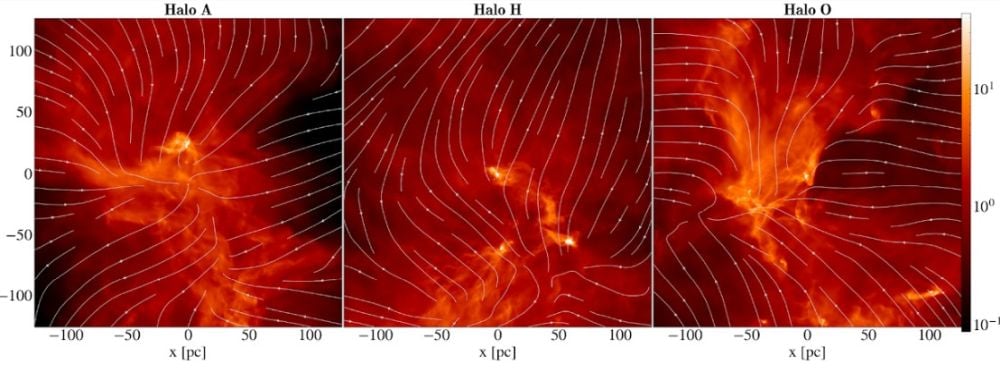
The image above exhibits three representative minihaloes extracted from a cosmological box of side length 30 comoving Mpc. The density is color-coded while velocity vectors illustrate the chaotic flow patterns that give rise to turbulent fragmentation.
3.2 Sub-Grid Physics and Sink Particles
Even with aggressive refinement, resolving the full proto-stellar collapse down to nuclear densities is infeasible. To circumvent this, most simulations implement sink particles or star particles once gas within a cell exceeds a certain density threshold and becomes gravitationally bound. These sink particles then accrete nearby gas according to physically motivated prescriptions, allowing simulations to follow the global evolution without time-stepping constraints imposed by short dynamical timescales.
| Parameter | Symbol | Typical Value / Range | Physical Significance |
|---|---|---|---|
| Box Size | L | 20–50 cMpc | Captures large-scale tidal torques |
| Dark-Matter Particle Mass | mDM | 103–104 M⊙ | Resolves minihalo substructure |
| Gas Cell Mass (Zoom Region) | mgas | 10−1 – 100 M⊙ | Captures dense clump formation |
| Minimum Cell Size | Δxmin | 0.01–0.1 pc | Resolves turbulence down to sonic scale |
| Sink Creation Density | nsink | 1010–1012 cm−3 | Approximates proto-stellar core |
The careful calibration of these parameters is essential: if nsink is set too low, fragmentation may be artificially suppressed; if set too high, the computational time step becomes prohibitively small. Similarly, the treatment of radiative feedback—whether via ray-tracing, moment methods, or flux-limited diffusion—can materially influence the accretion history of forming stars.
3.3 Turbulent Diagnostics
To assess the kinematic state of the gas, researchers compute divergence (∇·v) and vorticity (∇×v), along with the turbulent Mach number distribution. Regions where vorticity and negative divergence overlap are regarded as potential sites of gravitational collapse mediated by turbulence. The joint probability distribution of these quantities provides a diagnostic of the interplay between compressive and solenoidal modes.
“Turbulence is not a mere noise; it is the architect of the primordial initial mass function.”— M. Y. Ho et al., 2026, ApJ
4. Simulation Results: IMF Broadening and Metal Enrichment
By initializing a suite of fifteen high-resolution zoom-ins, the latest studies find a remarkable diversity of fragmentation outcomes. Some minihaloes yield only a handful of stellar seeds, while others produce tens of proto-stellar cores. The multiplicity fraction (defined as the number of bound stellar systems per minihalo) is highly sensitive to the peak turbulent Mach number and the angular momentum content. Crucially, even in haloes of similar mass (∼106 M⊙), the resulting IMF can differ by more than an order of magnitude.
4.1 Mass Spectrum of Pop III Stars
| Clump ID | Initial Core Mass | Sink Growth (0.5 Myr) | Projected Final Mass (3 Myr) | Fate* |
|---|---|---|---|---|
| A1 | 3.2 | 14.7 | 18–22 | Type II SN |
| A2 | 0.9 | 1.4 | 2–3 | Long-lived, survives |
| A3 | 16.1 | 63.5 | 75–85 | Pair-Instability SN |
| A4 | 0.5 | 0.8 | 1–2 | Long-lived, survives |
| A5 | 6.4 | 25.3 | 30–35 | Black-Hole Direct Collapse |
* Fate determined by stellar evolution models at Z = 10−6 Z⊙.
Table 3 illustrates how a single turbulent minihalo can seed proto-stars with a broad mass distribution, ranging from sub-solar to super-massive categories. Notably, clumps A2 and A4, each forming with only a fraction of a solar mass, hold immense cosmological importance: they are candidates for Pop III stars that survive to the present day. Detecting such stars in the Milky Way halo or nearby dwarf galaxies would provide a direct empirical window into the conditions of the high-redshift Universe.
4.2 Chemical Feedback and Metallicity Floors
The chemical legacy of Pop III stars is carried forward by their explosive ends—core-collapse supernovae, hypernovae, pair-instability supernovae (PISN), and, in some instances, direct black-hole formation with minimal ejecta. The heterogeneous IMF engendered by turbulence thereby translates into a heterogeneous enrichment pattern. Regions dominated by intermediate-mass Pop III stars (15–40 M⊙) exhibit relatively modest metal enrichment, leading to so-called metallicity floors of [Fe/H] ≈ −4. By contrast, a single PISN from a 200 M⊙ star can pre-enrich the host halo to [Fe/H] ≈ −2, sterically hindering the survival of ultra-metal-poor environments.
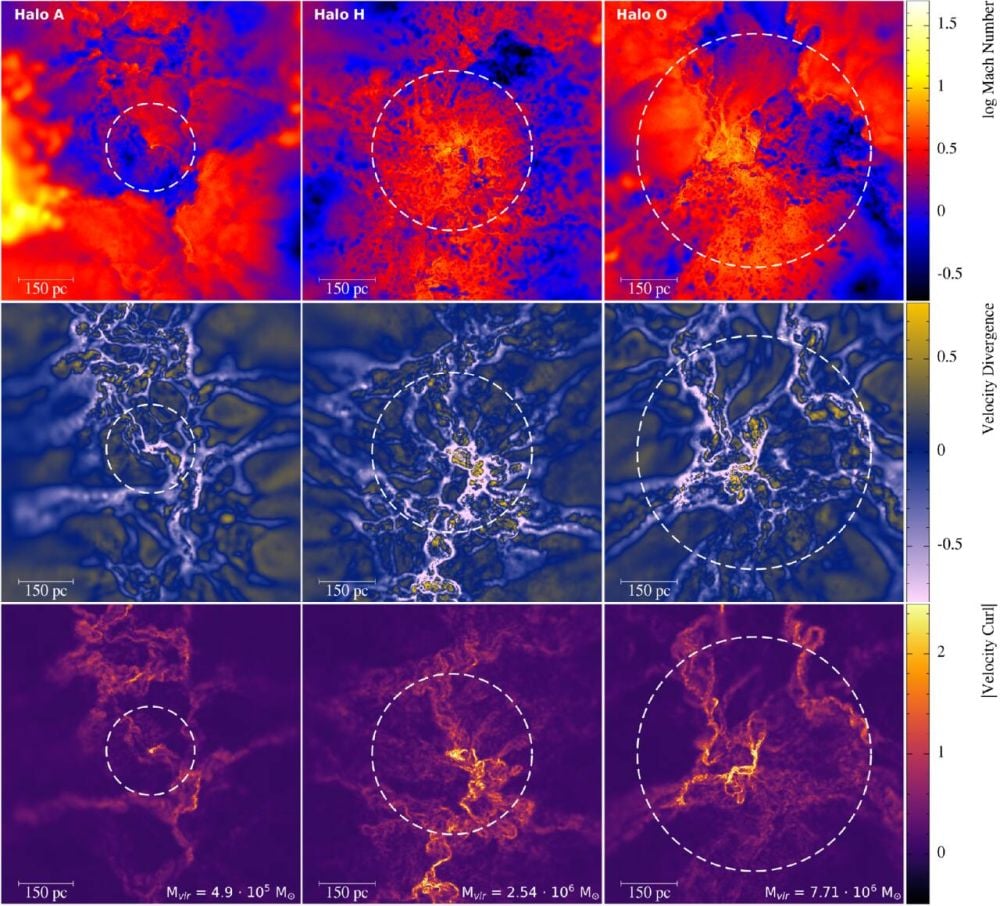
The figure above quantifies turbulent properties across three distinct haloes. Regions with co-spatially high Mach number and overlapping divergence/curl fields (highlighted in purple) correlate strongly with sites of dense clump formation.
5. Observational Signatures and Constraints
While no bona fide Pop III star has yet been observed directly, the fingerprints of their formation lay encoded in a multitude of astrophysical observables.
5.1 Extremely Metal-Poor Stars (EMPS) in the Local Group
The chemical abundance patterns of EMPS in the Milky Way’s halo provide a record of early enrichment. Ratio diagnostics such as [C/Fe], [Mg/Fe], and [Eu/Fe] can constrain the mass and explosion mechanism of progenitor Pop III stars. For instance, C-enhanced metal-poor (CEMP) stars displaying high [C/Fe] and low [Ba/Fe] may originate from mass transfer in binary systems hosting low-mass Pop III AGB stars.
5.2 Nebular Emission Lines in High-Redshift Galaxies
Next-generation telescopes such as the James Webb Space Telescope (JWST) and the Extremely Large Telescope (ELT) can detect rest-frame UV lines (e.g., He II λ1640) that betray a hard ionizing spectrum expected from metal-free stars. However, turbulence-induced IMF broadening weakens the collective UV hardness, potentially complicating straightforward identification.
| Diagnostic | Observable Quantity | Narrow, Top-Heavy IMF | Broad, Turbulent IMF |
|---|---|---|---|
| He II λ1640 Equivalent Width | EW(He II) [Å] | > 10 | 2–8 |
| Metallicity Floor | [Fe/H]min | ≈ −2 | ≲ −4 |
| CEMP Star Fraction | fCEMP | < 10% | 20–30% |
| 21-cm Global Signal | Tb (mK) | Deep trough at z≈25 | Shallower, broader trough |
As indicated in Table 4, a turbulent IMF scenario predicts a richer diversity of chemical and spectral outcomes, some of which are already hinted at in extant data sets but require larger statistical samples for definitive confirmation.
5.3 Stochastic Gravitational Wave Background
The mergers of black holes that formed from massive Pop III progenitors are expected to contribute to the gravitational wave (GW) background detected by observatories such as LIGO and Virgo. A broader IMF implies a wider mass distribution of binary black holes, leading to a distinctive GW frequency spectrum. Future space-based interferometers like LISA will be instrumental in constraining these high-redshift progenitors.
6. Implications for Galaxy Formation and Cosmic Reionization
The Pop III era is not merely a historical curiosity; it sets the stage for subsequent galaxy formation, cosmic reionization, and the thermal history of the intergalactic medium (IGM).
6.1 Radiative and Mechanical Feedback
- Photoionization: Ionizing photons from massive Pop III stars carve out H II regions that can expand beyond the virial radius, reducing baryon inflow.
- Lyman-Werner (LW) Feedback: Emission in the 11.2–13.6 eV band dissociates H2 in neighboring minihaloes, delaying star formation by raising the effective Jeans mass.
- Supernova-Driven Winds: The kinetic energy of supernova ejecta displaces gas from shallow potential wells, modulating subsequent star formation efficiency.
The magnitude and timing of these feedback loops hinge on the stellar mass distribution. A single 200 M⊙ PISN can momentarily sterilize its host halo, whereas a collection of lower-mass stars distributes feedback over a more extended temporal baseline, promoting a spatially patchy reionization topology.
| Mass Range (M⊙) | Ionizing Photons / Baryon | LW Luminosity (104 L⊙) | SN Explosion Energy (1051 erg) |
|---|---|---|---|
| 1–5 | < 100 | < 0.1 | 0.0 (No SN) |
| 15–40 | 1,000–5,000 | 1–3 | 1–3 (Type II) |
| 60–120 | 10,000–20,000 | 8–15 | 5–10 (Hypernova) |
| 140–260 | > 25,000 | > 20 | 30–60 (PISN) |
Table 5 highlights the nonlinear scaling of feedback efficiencies with stellar mass. The presence—even at low number fraction—of ultra-massive stars dramatically amplifies local feedback. Incorporating turbulence in cosmological simulations therefore produces a stochastic mosaic of feedback intensities, affecting not only star formation but also metal transport and the topology of reionization.
7. Surviving Low-Mass Pop III Stars: Prospects for Direct Detection
Should low-mass (< 0.8 M⊙) Pop III stars indeed exist, they would possess main-sequence lifetimes exceeding the current age of the Universe and hence could be lurking in the outskirts of the Milky Way, in ultra-faint dwarf galaxies, or in the stellar halo.
7.1 Search Strategies
- Photometric Pre-selection: Wide-field surveys such as VISTA, Pan-STARRS, and the forthcoming Vera C. Rubin Observatory can identify candidate metal-poor stars via broadband color cuts.
- Medium-Resolution Spectroscopy: Follow-up spectroscopy with instruments like LRIS and X-shooter refines metallicity estimates to [Fe/H] < −3.
- High-Resolution Abundance Analysis: Ultra-stable spectrographs (e.g., ESPRESSO, HDS) measure detailed abundance patterns to confirm the absence of metals.
- Asteroseismology: Space missions like TESS can probe internal structure, distinguishing genuine zero-metallicity stars from accreted metal-polluted impostors.
Successful detection would provide an empirical Rosetta Stone for validating the turbulent fragmentation model, as only such a model can populate the low-mass end of the IMF at appreciable frequency.
8. Challenges and Future Directions
Despite spectacular progress, numerous challenges persist. Accurately capturing the magneto-hydrodynamic (MHD) interplay in primordial gas, for instance, remains an open frontier. Additionally, the relative importance of cosmic rays, dark-matter annihilation, and exotic heating mechanisms is still debated. Crucially, simulating sufficiently large cosmological volumes while preserving resolution adequate for star cluster-scale turbulence is computationally onerous.
8.1 Next-Generation Numerical Developments
- GPU-Accelerated Codes: Leveraging the parallelism of GPUs can expedite hydrodynamics calculations by a factor of up to 50.
- Machine-Learning Emulators: Surrogate models can predict small-scale turbulence statistics from coarse-grained simulations, drastically reducing computational cost.
- Adaptive Time-Stepping: Variable-order integrators can allocate shorter time steps exclusively to high-density regions, improving efficiency without sacrificing accuracy.
8.2 Synergies with Multi-Messenger Astronomy
The simultaneous detection of EM counterparts, GW signals, and neutrino bursts from Pop III remnants opens an exciting multi-messenger vista. For example, a confirmed PISN at z > 10 via JWST spectroscopy, coupled with concurrent GW background constraints from LISA, would disentangle the mass spectrum and explosion models of the underlying Pop III population.
9. Synthesis and Broader Cosmological Significance
The overarching narrative that emerges from the confluence of advanced simulations, nuanced feedback models, and nascent observational clues is one of dynamism and diversity. Turbulence has transmuted from an auxiliary ingredient in star-formation recipes to a principal architect shaping the earliest stellar generations. By broadening the Pop III IMF, turbulence resolves a multitude of erstwhile paradoxes: it reconciles the persistence of ultra-metal-poor stars, aligns theoretical supernova rates with observed abundance patterns, and harmonizes reionization optical depths with Planck satellite measurements.
Moreover, the legacy of turbulent fragmentation permeates cosmic timescales. The seeding of intermediate-mass black holes (IMBHs), the pre-conditioning of the IGM, and the hierarchical assembly of galaxies all bear imprints of this primordial turbulence. As such, a granular understanding of Pop III turbulence is indispensable not just for stellar astrophysics, but for galaxy formation theory, high-energy astrophysics, and cosmology writ large.
10. Concluding Remarks
In closing, we underscore the critical lesson that complexity begets diversity. The early Universe was not a placid cradle giving rise to a uniform population of titanic stars; it was a cauldron of interacting flows, shocks, and instabilities. Turbulence—once relegated to the role of stochastic noise—now commands center stage, dictating where, when, and in what quantity the first stars emerged. As observational technology marches forward and computational prowess continues its exponential climb, the coming decade promises a trove of data capable of validating—or refuting—this turbulence-dominated framework.
For More Information
The following peer-reviewed articles, reviews, and mission pages provide deeper insight into topics discussed herein:
- Ho, M. Y. et al. (2026). “Turbulence in Primordial Dark Matter Halos and Its Impact on the First Star Formation.” ApJ.
- Greif, T. H. (2023). “Population III Star Formation: A Review.”
- NASA—James Webb Space Telescope Official Site
- ESO—Extremely Large Telescope (ELT) Project
- LISA—Laser Interferometer Space Antenna Mission Overview
- Vera C. Rubin Observatory—Legacy Survey of Space and Time
Readers seeking to delve further into the computational aspects are encouraged to consult the public data releases of the IllustrisTNG collaboration, which provide raw and processed simulation outputs pertinent to the topics addressed in this article.