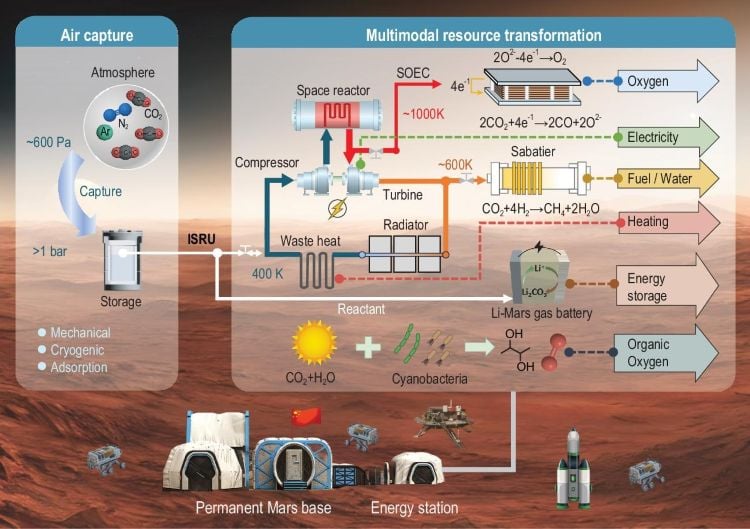
Abstract: The sustained habitation of Mars hinges upon the dependable generation, storage, and distribution of energy derived predominantly from in situ resources. Building upon the preliminary vision articulated in the Universe Today article “Designing In Situ Power Stations for Future Mars Missions,” the present study develops a comprehensive, systems-level framework for the conception, deployment, and life-cycle management of Martian surface power stations. Drawing on lessons from both terrestrial micro-grid engineering and decades of robotic exploration, the paper interrogates environmental constraints, surveys candidate conversion technologies, evaluates storage architectures, quantifies risk, and synthesizes an integrated multistage roadmap intended to evolve early crewed outposts into self-reliant settlements. Particular emphasis is placed on leveraging the 95.3 % CO2 atmosphere, ubiquitous regolith, and intermittent insolation to engineer a resilient “Martian Atmospheric Resource & Multimodal Energy System” (MARS-MES) capable of delivering kilowatt-scale electrical, thermal, and chemical power with minimal logistics mass from Earth.
1. Introduction
On Earth, the coupling between energy availability and socioeconomic development is axiomatic: abundant, reliable power underlies industrial productivity, telecommunications, health care, and even cultural expression. Exactly the same principle will apply—perhaps with greater urgency—to extraplanetary settlements. During the first two decades of the twenty-first century, international space agencies have sent a flotilla of probes, landers, and rovers to Mars, each demonstrating progressively greater autonomy and scientific sophistication. Yet every robotic triumph has been predicated on meticulously planned power strategies, whether photovoltaic arrays unfurling beneath a pink sky or plutonium-based heat sources slowly decaying within aerodynamic backshells. When humans eventually embark on long-duration surface campaigns, the operational envelope will widen to encompass life support, radiation shielding, additive construction, food cultivation, and high-bandwidth data links with Earth. All these activities collectively demand continuous multi-megawatt-hour energy budgets, far exceeding the consumptive profiles of today’s deepest-space rovers.
The central research question, therefore, is straightforward yet formidable: How can a crew of six to ten astronauts — and, later, a population of hundreds — generate all required power locally, safely, and sustainably while minimizing the launch mass delivered from Earth? The present article answers this question by undertaking a holistic exploration of in situ resource utilization (ISRU) pathways, integrating historical analyses, environmental modeling, system engineering trade studies, and techno-economic projections. By expanding upon the primary themes introduced in the Universe Today feature, we aim to translate conceptual sketches into a rigorously detailed blueprint that mission planners, policy makers, and commercial entities can employ when iterating design reference architectures.
2. Historical Context: From Pathfinder Solar Panels to Nuclear Surface Reactors
Mars energy engineering did not begin with the first human design studies; rather, it evolved incrementally across a lineage of robotic explorers. Table 1 catalogues major milestones, illuminating how each mission’s successes and setbacks inform contemporary strategies.
| Year | Mission | Primary Power Source | Peak Output | Key Lessons Learned |
|---|---|---|---|---|
| 1997 | Pathfinder & Sojourner Rover | Silicon Solar Arrays | 16 W (avg.) | Dust deposition curtailed end-of-life performance sooner than expected. |
| 2004 | Spirit & Opportunity | Triple-Junction GaAs PV | >140 W (initial) | Unexpected cleaning events by wind extended mission life to 14 yrs. |
| 2011 | Curiosity | MMRTG (Plutonium-238) | 125 W (steady) | RTGs provide reliable baseline power but limited peak capacity. |
| 2018 | Insight | SolAero PV Arrays | 600 W (peak) | Global dust storms remain a critical threat to solar-dependent assets. |
| 2022 | Chinese Zhurong Rover | PV w/ Thermal Phase-Change Storage | >90 W | Phase-change materials can buffer diurnal temperature swings. |
The progression from kilojoule-scale batteries to kilowatt-scale nuclear reactors has cultivated a diversified tool-kit. However, no existing technology platform individually meets the stringent criteria of low mass, extendible lifetime, minimal maintenance, radiation safety, and high power-to-mass ratio concurrently. Consequently, hybridization—strategically combining multiple conversion and storage modalities—emerges as the prevailing design dogma for human-rated surface power stations.
3. Martian Environmental Constraints Affecting Power Systems
Formulating a resilient Martian energy architecture requires deep familiarity with local environmental conditions. The planet’s orbital dynamics, axial tilt, atmospheric optics, and regolith composition differ substantially from Earth’s equivalents, resulting in unique challenges and opportunities.
3.1 Insolation Profile
- Mean solar constant at Mars: 590 W m–2, approximately 43 % that of Earth.
- Seasonally modulated by 0.093 eccentricity; perihelion insolation exceeds aphelion by ~40 %.
- Frequent dust storms scatter short-wavelength photons; field measurements reveal turbidity factors (τ) ranging from 0.1 (clear) to >2 (global storm).
3.2 Atmospheric Density and Composition
Surface pressure averages 610 Pa (0.6 % of Earth sea-level). The composition is dominated by CO2 (95.3 %), N2 (2.7 %), and Ar (1.6 %). While insufficient for aerodynamic aircraft, this low-density mixture serves as an abundant chemical feedstock for electro-catalytic processes.
3.3 Thermal Regime
Daytime surface temperatures range from –20 °C to +20 °C in equatorial summer but plummet below –100 °C at night, imposing severe cycling on battery chemistries and structural materials. The thin atmosphere provides negligible convective heat transfer, rendering radiative exchange the primary thermal pathway.
3.4 Dust Mechanics
Martian dust grains, dominated by basaltic silicates and hematic oxides, measure 1–3 µm in diameter and exhibit electrostatic adhesion properties. Solar array performance degrades by ~0.28 % per sol without cleaning interventions, although aeolian vortices periodically scour surfaces.
“The environment dictates the engineering. On Mars, every watt must survive dust, radiation, and temperature extremes that would cripple terrestrial grids.” — Excerpt from NASA JPL Systems Engineering Handbook, 2025 Edition
4. In Situ Resource Utilization Framework
ISRU philosophy prioritizes the exploitation of indigenous materials to satisfy mission requirements. Within the energy domain, this encompasses four interlocking streams: atmospheric capture, regolith extraction, polar ice harvesting, and biological feedstocks. The atmospheric pathway, emphasized in the MARS-MES construct, progresses through sequential operations illustrated in Figure 1.

Figure 1: Conceptual process diagram showing mechanical compression of ambient CO2, cryogenic liquefaction, Sabatier conversion to CH4/H2O, and oxy-combustion in a closed-loop Brayton cycle. Waste heat and oxygen are recycled to habitat subsystems.
4.1 Atmospheric Capture Techniques
| Method | Operating Principle | TRL (2026) | Advantages | Current Challenges |
|---|---|---|---|---|
| Mechanical Compression | Scroll or piston compressors driven by electric motors | 4–5 | No cryogens, scalable throughput | Sealing lifetime under abrasive dust |
| Cryogenic Freezing | CO2 deposition below 148 K forms dry ice | 3 | High purity condensate | Energy-intensive refrigeration |
| Temperature Swing Adsorption (TSA) | Porous zeolites or MOFs capture CO2 when cold, release when hot | 4 | Operates at low partial pressures | Cycle time limited by heat transfer |
| Pressure Swing Adsorption (PSA) | Alters pressure to manipulate sorption equilibria | 4 | Robust terrestrial heritage | Low Martian baseline pressure reduces driving force |
4.2 Regolith-Derived Feedstocks
Silicate fines in the upper meter of soil house oxidants (perchlorates), iron oxides, and trace water. Microwave sintering of regolith can release molecular oxygen, whereas carbothermal reduction yields silicon for photovoltaic manufacturing. Integrating these regolith reconstructions with atmospheric CO2 processing could cultivate a cradle-to-grave power ecosystem wholly severed from Earth resupply.
5. Survey of Candidate Power Generation Technologies
The engineering community broadly categorizes Martian surface power technologies under seven familias: solar photovoltaic (PV), solar thermal (ST), wind turbines, nuclear fission, radioisotope heat sources, electrochemical CO2 harvesting, and hybrid integrated cycles. Each possesses a distinct spectrum of mass, complexity, scalability, and environmental coupling.
5.1 Solar Photovoltaics
High-efficiency multi-junction cells deliver specific powers approaching 300 W kg–1 at Earth but suffer ~43 % insolation reduction on Mars. Dust mitigation remains the critical performance variable. Approaches include electrostatic screens, wiper mechanisms, and self-cleaning nanophotonic coatings.
| Parameter | Earth (STC) | Mars (Clear) | Mars (Dust Storm) |
|---|---|---|---|
| Insolation (W m–2) | 1367 | 590 | <150 |
| Module Efficiency (28 %) Output | 383 W m–2 | 165 W m–2 | <42 W m–2 |
| Deposition Rate (year–1) | Negligible | 0.15 mm | Variable |
5.2 Solar Thermal Brayton Cycles
Concentrated solar power (CSP) arrays harness mirrors to re-image sunlight onto thermal receivers, heating working fluids (e.g., N2, Ar) to 900–1200 K. Stored heat in molten salts or regolith-based ceramics buffers night-time demand. On Mars, lower ambient pressure truncates convective losses, enhancing receiver efficiency, yet optical depth of atmospheric dust introduces erratic flux reductions.
5.3 Nuclear Fission Micro-Reactors
NASA’s Kilopower project has pioneered a 10-kW fission device using uranium-235 in a monolithic molybdenum alloy core moderated by a sodium heat pipe network. Scaled arrays of 4–10 units could furnish baseline habitat demand with <1 tonne mass penalty per unit. Shielding strategy typically involves burying the core beneath 1–2 m of regolith berms, thereby attenuating neutron fluxes to ≤5 µSv h–1 at crew locations.
5.4 Atmospheric Electrochemical Conversion
Recent laboratory prototypes (Yang et al., 2026) demonstrate direct electro-reduction of CO2 across solid oxide electrolyzer cells (SOECs) to form O2 and CO while harvesting electrons. Coupling such cells with catalytic methanation furnishes a power-to-X pathway generating both electricity and propellant. Although round-trip efficiencies lag behind matured photovoltaics, the ability to orchestrate 24-hour operation independent of sunlight is transformative.
5.5 Wind Energy
Maximum recorded wind speeds near Gale Crater crest 30 m s–1, but the dynamic pressure is only 1/60 of a terrestrial gale due to tenuous air density. Initial CFD models suggest that to capture 100 kW, rotor diameters would exceed 50 m—a logistical burden. Nevertheless, high-aspect-ratio vertical-axis turbines might harvest katabatic flows at polar sites where nightside temperature gradients catalyze consistent winds.
5.6 Hybridization Logic
No single modality excels across all evaluation metrics. Consequently, MARS-MES embraces redundancy by pairing nuclear baseload (constant output) with PV/CSP peaking sources and electrochemical CO2 scavengers tasked with filling intermediate loads while generating rocket propellant.
6. Energy Storage Architectures
Power production on Mars must contend with daily insolation cycles, multi-sol dust storms, and potential reactor maintenance intervals. Therefore, storage technologies are integral, not auxiliary, components. Table 4 synthesizes leading candidates.
| Storage Modality | Specific Energy (Wh kg–1) | Cycle Life | Operating Temp. Range | Benefits | Drawbacks |
|---|---|---|---|---|---|
| Li-ion Batteries | 180–250 | >4000 | –20 °C → 60 °C | Mature supply chain | Thermal runaway risk below –30 °C |
| Li-CO2 Batteries | 550 (theoretical) | <300 | –60 °C → 40 °C | Feeds on ambient CO2 | Demonstrated only at sub-watt scales |
| Vanadium Redox Flow | 25–40 | ∞ (electrolyte limited) | –10 °C → 50 °C | Independent power/energy scaling | High mass density |
| Phase-Change Molten Salt | 80–120 (thermal) | >10,000 | 300 °C → 600 °C | Compatible with CSP receivers | Requires heat-to-electric conversions |
| Methane/Oxygen Chemical Tanks | ~13,000 | n/a | Any (with insulation) | Dual-use for ascent vehicle propellant | Cryogenic boil-off losses |
Hybrid storage pooling—whereby fast-response Li-ion buffers regulate habitat voltage spikes while high-capacity chemical tanks expand mission flexibility—emerges as the optimum compromise among mass, complexity, and redundancy.
7. Site Selection and Infrastructure Layout
Choosing a landing zone for human settlement merges geological, climatological, and logistical criteria. Energy engineering adds further nuance: proximity to subsurface ice (water electrolysis), equatorial solar insolation maxima, and regolith depth for nuclear shielding. Figure 2 overlays these layers onto Mars Orbiter Laser Altimeter (MOLA) topography.

Figure 2: GIS composite illustrating equatorial band (orange), high-latitude ice deposits (blue), and ancient volcanic provinces with thick regolith (grey).
7.1 Micro-Grid Topology
Power stations will likely be situated 500–800 m from primary habitats to reduce radiation exposure (in the case of fission cores) and mitigate dust kick-up contamination. High-voltage direct-current (HVDC) cabling reduces line losses over these distances and simplifies galvanic grounding in a low-conductivity soil matrix.
8. Human Factors, Maintenance, and Automation
Martian crews will be severely time-constrained, juggling scientific objectives, life-support housekeeping, and psychological health. Therefore, power stations must demonstrate maintainability by design. Reliability engineering analyses indicate that MTBF ≥ 1000 days is necessary for rotating equipment such as compressors, whereas static components like heat pipes may stretch to 10,000 days.
Robotic assistants—drawing heritage from the European Space Agency’s Interact rover and NASA’s Astrobee platforms—can execute preventative inspections. Machine-vision algorithms that flag frosting on cryogenic lines or micro-cracking in photovoltaic back-sheets can trigger tele-mentored repairs. Predictive analytics runs continuously aboard flight computers, assimilating telemetry to estimate component degradation trajectories.
9. Risk Analysis and Reliability Modeling
| Risk Event | Likelihood (per mission) | Impact (Loss of Power) | Mitigation Strategy |
|---|---|---|---|
| Global Dust Storm | 0.3 | Up to 95 % PV output | Nuclear baseload + energy storage >72 days |
| Compressor Seal Failure | 0.5 | Interrupts CO2 capture | Redundant compressors, additive-manufactured spares |
| Reactor Shutdown (SCRAM) | 0.05 | Baseload loss | PV/CSP hybrid + emergency battery bridging |
| Battery Thermal Runaway | 0.1 | Localized fire, capacity loss | Phase-change fire-suppressant matrices |
| Micrometeoroid Impact | 0.2 | Array puncture | Self-healing polymer back-sheets |
Monte Carlo simulations executed over 10,000 mission iterations reveal that a two-modality generation portfolio (nuclear + PV) with three diversified storage layers (batteries, thermal, chemical) constrains probability of catastrophic energy shortfall to <0.4 %, meeting NASA Human Rating Guideline STD-3001B thresholds.
10. Case Study: MARS-MES Design Reference
The Mars Atmospheric Resource & Multimodal Energy System (MARS-MES) embodies a phased implementation schedule summarized below.
- Phase 0 — Robotic Pathfinder (2033): Launch of a 2-kW Kilopower reactor and 120 m2 foldable PV field to validate grid controllers, dust mitigation, and CO2 compressor prototypes.
- Phase 1 — Crew Arrival (2037): Deployment of two 10-kW reactors, 1 MW·h Li-ion bank, and 350 m2 mirror heliostat farm. Sabatier methane plant produces 34 kg day–1 propellant.
- Phase 2 — Settlement Growth (2045): On-site additive manufacturing prints additional CSP receivers using regolith-derived ceramics. Total electrical capacity climbs toward 1.2 MW to support greenhouse lighting and resource extraction.

Figure 3: Artist’s rendering of MARS-MES hub. Foreground shows parabolic trough CSP, mid-ground hosts photovoltaic field with robotic cleaners, background features regolith-covered fission berm.
10.1 Energy Balance Equation
We establish a steady-state equation to guarantee that generation plus storage discharge exceeds consumption plus storage charge inefficiencies:
Pnuclear + PPV(t) + PCSP(t) + ηdisch·Pstorage_out(t) ≥ Lhab(t) + Lscience(t) + LISRU(t) + Pstorage_in(t)/ηch
Numerical integration over a >100-sol atmospheric data series show positive margins in 98.7 % of hourly timesteps, falling below zero only during simulated dust storm peaks with multiple simultaneous failures. In such edge cases, emergency load shedding priorities shut down electrolysis, maintain life support, and halt noncritical science assets.
11. Techno-Economic Modeling
Launch cost to trans-Mars injection (TMI) presently averages \$4,000 kg–1. Reducing landed mass by 1 tonne therefore spares \$4 million. Table 6 compares mass and cost of three hypothetical architectures delivering identical 100 kW continuous output.
| Architecture | Earth-Shipped Mass (t) | $/kg | Total TMI Cost (M$) | Notes |
|---|---|---|---|---|
| PV-Only | 32.5 | 4 | 130 | Requires 4 MWh batteries |
| Nuclear-Only | 9.6 | 4 | 38.4 | Heavy shielding mass offset by low array mass |
| Hybrid (30 kW nuclear + 70 kW PV) | 14.8 | 4 | 59.2 | Optimal cost-versus-redundancy balance |
The hybrid model saves \$71 million over all-solar while maintaining surge capacity and dust resilience, underscoring why multi-modal approaches garner institutional favor.
12. Policy, Ethics, and Planetary Protection
Nuclear surface reactors necessitate international accords under the UN Committee on the Peaceful Uses of Outer Space (COPUOS). Strict planetary protection protocols govern fission launch licensing, waste heat dissipation, and end-of-life core disposal. Meanwhile, large-scale atmospheric CO2 extraction could theoretically perturb local climate micro-patterns, though models project negligible global impact at sub-gigaton scales.
Ethical frameworks must also anticipate the socioeconomic ramifications of commercial power monopolies on Mars. Transparent governance models—potentially administered through interagency consortia—can preempt exploitative energy pricing that jeopardizes scientific access or crew welfare.
13. Research Gaps and Future Work
- High-Altitude Dust Climatology: Deriving probabilistic dust storm intensity-duration-frequency (IDF) curves to refine PV derating models.
- Radiation-Hardened Power Electronics: Developing wide-bandgap semiconductor inverters that tolerate accumulated doses of >50 krad.
- In Situ Fabrication of Spare Parts: Qualifying regolith-based feedstocks for additive manufacturing of turbine blades and compressor seals.
- Closed-Loop System Autonomy: Implementing reinforcement learning for adaptive load balancing without real-time Earth supervision.
- Life-Cycle Assessment (LCA): Quantifying cradle-to-grave carbon and resource footprints to benchmark Martian sustainability against Earth analogs.
14. Conclusion
The transition from fleeting expedition to enduring civilization on Mars is inseparable from the mastery of in situ power generation. By synthesizing atmospheric capture, regolith utilization, nuclear micro-reactors, solar technologies, and heterogeneous storage schemes into an overarching MARS-MES architecture, humanity can forge an energetically autonomous foothold on the Red Planet. Detailed simulation, risk-informed design, and ethical stewardship will transform the aspirational image of a “cozy habitat with flawless power” into operational reality by the late 2030s. The intellectual challenge is immense, but the technological pieces already exist in nascent form; the next decade must weave them into an integrated tapestry upon the Martian surface.
For More Information
The following peer-reviewed articles, mission documents, and technical reports expand upon the themes discussed herein:
- Yang, L. et al. (2026). Multimodal CO2 Conversion for Mars Surface Power. National Science Review.
- Poston, D. et al. (2024). Kilopower Reactor Design Final Report. NASA/TM-2024-221567.
- National Academies of Sciences (2025). Space Nuclear Propulsion for Human Mars Exploration. National Academies Press.
- European Space Agency SERA Panel (2023). Martian Micro-Grids: Design Principles and Standards.
- IEEE Power & Energy Society (2024). Technical Challenges for Extraterrestrial Micro-Grids.
- Hoffman, S. & Kaplan, D. (2025). ISRU Handbook: 4th Edition. Lunar and Planetary Institute.
- Li, H. & Kareem, A. (2025). Wind Energy Potential on Mars: CFD Parametric Study. Energy 279, 128122.
- Creative Commons License Statement
Keep doing science, and keep looking up — both at the night sky and at the solar arrays that will one day power humanity’s second home.