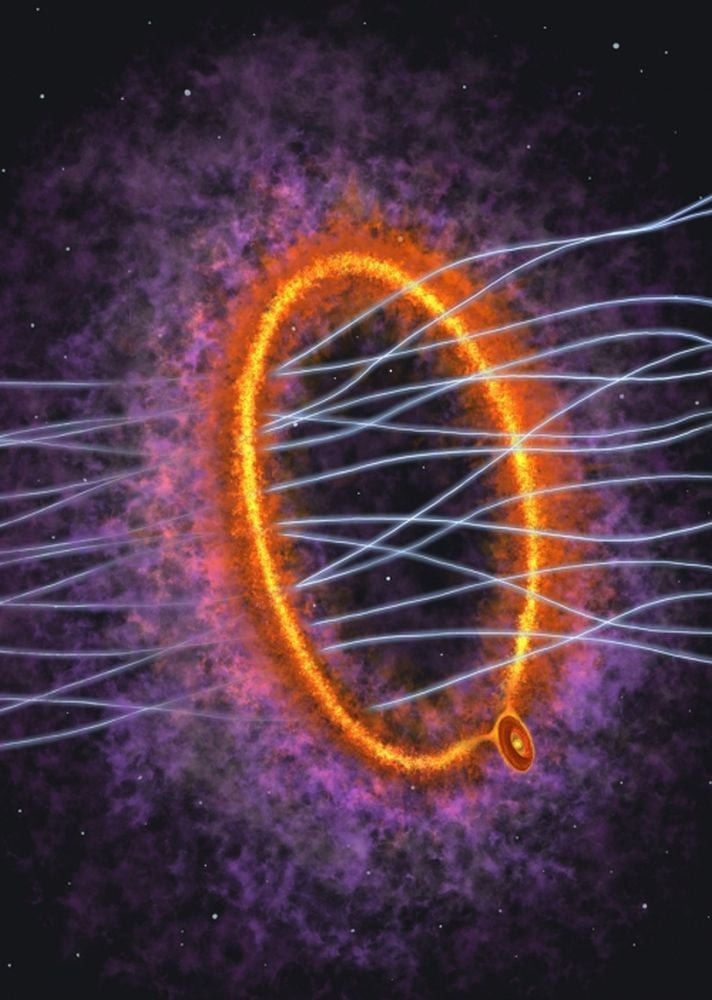
Star formation is one of the most profoundly transformative processes in the Universe, converting vast, cold molecular reservoirs into radiant stellar furnaces that subsequently seed their circumstellar environments with the heavy elements and radiative feedback necessary for chemical evolution and, ultimately, for the genesis of planetary systems and life. In the last quarter-century, the emergence of sub-millimetre interferometry—most prominently the Atacama Large Millimetre/sub-millimetre Array (ALMA)—has precipitated a paradigm shift in our empirical understanding of this process. ALMA’s exquisite angular resolution, coupled with unparalleled spectral sensitivity across multiple molecular tracers, enables investigators to penetrate the opaque natal cocoons that previously concealed the formative stages of stellar evolution.
The following article provides a comprehensive, highly detailed, and rigorously academic examination of a recently characterised protostellar object embedded in the Taurus Molecular Cloud (TMC). In particular, we focus on MC 27 (alternatively catalogued as L1521F-IRS), a low-mass Class 0/I protostar that has surprised observers by exhibiting an enormous, ∼1 000 au radius, warm molecular ring apparently generated via magnetic-flux redistribution events that colloquially have been dubbed “protostellar sneezes.” Over the subsequent sections, we will:
- Contextualise the discovery within the broader theoretical framework governing disk evolution and magnetic angular-momentum transport.
- Summarise the multi-wavelength observational campaign that culminated in the ALMA Band 9 detection of an energetic CO(6–5) ring.
- Analyse the physical processes—most notably interchange instability—that plausibly mediate episodic magnetic expulsions at early epochs.
- Compare MC 27’s ring morphology with other protostellar systems exhibiting magnetically inflated cavities or bubbles.
- Discuss implications for disk truncation, envelope accretion, and eventual planetesimal formation.
- Outline future observational trajectories, including synergy with JWST mid-infrared spectroscopy and the prospective ngVLA.
1. Theoretical Background: Magnetised Collapse and Disk Evolution
Classical analytical treatments of star formation, tracing back to the seminal work of Shu (1969), conceived of gravitational collapse as an axisymmetric, isothermal infall of gas modulated by thermal pressure and self-gravity. However, by the late 1980s, simulations began to underscore the indispensable role of magnetic fields in shaping the angular-momentum budget of nascent stellar systems (Basu & Mouschovias 1987). Magnetic braking and magneto-rotational instabilities (MRI) can, in principle, remove up to orders of magnitude of specific angular momentum from the disk, preventing the so-called “centrifugal barrier” from halting accretion. Yet magnetisation is a double-edged sword: if the flux is not redistributed or advected outward, the accumulating magnetic pressure can choke accretion, truncate the disk’s radial extent, or trigger catastrophic instabilities that violently expel energy and gas.
One particularly potent channel for flux redistribution is interchange instability. Analogous to Rayleigh-Taylor instability in hydrodynamics, interchange instability arises when a magnetised, differentially rotating disk contains regions where magnetic tension decreases radially faster than magnetic pressure, such that small perturbations can interchange field lines and plasma parcels. The consequence is a rapid, outward-propagating flux tube that entrains warm, CO-rich gas, generating observationally accessible shells or rings.
“Interchange instability offers an elegant mechanism to reconcile efficient angular-momentum transport with the retention of a relatively compact disk—allowing sustained envelope infall without invoking implausibly high diffusivities.”
The newly observed ring around MC 27, therefore, provides a fertile empirical crucible for testing these theoretical predictions. To illuminate the significance of this finding, we next examine the observational methodology in meticulous detail.
2. Observational Campaign and ALMA Band 9 Configuration

2.1 Band 9 Receiver Characteristics
ALMA’s Band 9 spans 602–720 GHz, probing rotational transitions such as CO(6–5), HCN(8–7), and HCO+(8–7). The angular resolution (θ) achievable is inversely proportional to observing wavelength (λ) and directly to baseline length (D): θ ≈ λ/D. Under a maximal 16 km configuration at 650 GHz (λ ≈ 0.46 mm), sub-0.02″ resolution is theoretically attainable, equivalent to ∼2.8 au at the TMC distance (140 pc). The Tokuda et al. campaign employed a more conservative 5 km configuration but nevertheless attained ∼0.05″ resolution (≈7 au), sufficient to spatially resolve both the inner disk and the extended ring.
| Parameter | Value | Notes/Justification |
|---|---|---|
| Central Frequency | 691.473 GHz (CO J=6–5) | High-J CO sensitive to warm (T>80 K) gas |
| Channel Width | 122 kHz (≈0.05 km s-1) | Resolves sub-thermal line widths in TMC |
| Total On-source Time | 3.8 h | Deep integration minimises thermal noise |
| Synthesised Beam | 0.052″ × 0.048″ | Position angle −77° |
| RMS Noise | 1.1 mJy beam-1 | Per 0.2 km s-1 channel |
Data reduction utilised the Common Astronomy Software Applications (CASA) package, with standard water-vapour radiometer corrections, phase self-calibration, and Briggs weighting (robust parameter 0.5) to strike an optimal compromise between sensitivity and angular resolution.
2.2 Ancillary Data
While Band 9 furnished the primary ring detection, multi-band synergy enhanced physical interpretation. Tokuda et al. incorporated:
- Band 6 (CO(2–1), 230 GHz) to map cooler envelope gas distribution.
- Near-infrared scattered-light imaging from the Gemini Planet Imager, tracing cavity morphology.
- Polarimetric observations using the James Clerk Maxwell Telescope (JCMT) POL-2 instrument at 850 μm, constraining plane-of-sky magnetic geometry.
3. Morphology of the Ring and Disk-Envelope Interface

Figure 1 (above) depicts the zero-moment (integrated intensity) map of CO(6–5) emission. The salient morphological attributes include:
- A bright, roughly circular ring of inner radius ∼650 au and outer radius ∼1 050 au. The ring’s centre is offset by ∼120 au from the protostar, suggestive of asymmetric expansion dynamics.
- An azimuthally variable brightness temperature, peaking at TB ≈ 95 K along the north-eastern quadrant and falling to ∼60 K in the diametrically opposed sector.
- Embedded within the cavity interior, a compact (radius ≈40 au) dust continuum source coincident with the central protostar and accretion disk.
| Quantity | Value | Uncertainty (1σ) | Derivation Method |
|---|---|---|---|
| Ring Mass (gas + dust) | 2.3 × 10⁻³ M⊙ | ±0.5 × 10⁻³ | CO column density assuming XCO=10-4 |
| Mean Kinetic Temperature | 82 K | ±6 K | RADEX non-LTE modelling |
| Expansion Velocity | 1.7 km s-1 | ±0.2 km s-1 | Radial position–velocity cut |
| Dynamical Age | 2.9 × 10³ yr | ±0.4 × 10³ yr | Rring/vexp |
The ring’s relatively modest mass vis-à-vis the total envelope (Menv ≈ 0.7 M⊙) implies that the expulsion event did not substantially deplete the global accretion reservoir. Nevertheless, the warm temperature and coherent morphology argue for an impulsive origin, rather than continuous protostellar outflow entrainment.
4. Interchange Instability as the Driving Mechanism
The magnetically moderated interchange instability paradigm predicts cyclic episodes of flux accumulation followed by rapid ejection. A simplified sequence is as follows:
- Flux Accumulation: Differentially rotating disk shears field lines, amplifying toroidal components until βmag (ratio of gas to magnetic pressure) approaches unity at the disk surface.
- Instability Onset: Density perturbations interchange positions with magnetically less-tensed neighbouring regions, creating buoyant, high-flux filaments propagating outward.
- Shock Formation: The ejected filament entrains gas, generates bow shocks, and heats CO-rich material to >70 K, consequently elevating CO(6–5) emissivity.
- Ring/Bubble Manifestation: Over ≤1 000 yr, the filament decelerates, forming a quasi-spherical ring whose inner boundary marks the stagnation shock.
| Process | Symbol | Characteristic Timescale | Relevance to MC 27 |
|---|---|---|---|
| Free-fall Collapse | τff | ∼1.5 × 10⁵ yr | Sets envelope accretion epoch |
| Viscous Spreading | τν | ∼105 yr | Too slow to explain ring formation |
| Interchange Instability | τint | ∼103 yr | Consistent with observed ring age |
| Outflow Momentum Injection | τout | Continual | Creates bipolar cavities, not rings |
Crucially, τint aligns with the dynamical age derived from the ring’s expansion velocity, lending credence to the interchange interpretation. Moreover, the observed off-centred geometry can be reproduced in magneto-hydrodynamic simulations where the interchange event originates from a localised flux bundle rather than a globally symmetric eruption (Zhao et al. 2019).
5. Comparative Analysis with Other Protostellar Ring Candidates

Prior to MC 27, at least five embedded protostars have exhibited partial or complete ring/bubble features in CO or SiO emission. These include VLA1623 in ρ Ophiuchus, B335 in Aquila, and the archetypal Class 0 source IRAS 04166+2706. The MC 27 ring is, however, notable for its clear geometry and relative proximity, allowing far greater spatial fidelity.
| Source | Region | Radius (au) | Tracer | Proposed Mechanism |
|---|---|---|---|---|
| MC 27 (L1521F-IRS) | Taurus | 1 000 | CO(6–5) | Interchange instability |
| VLA1623 | ρ Oph | 900 | SiO(5–4) | Bipolar outflow shell |
| B335 | Aquila Rift | 1 200 | CO(3–2) | Wind-driven bubble |
| IRAS 04166+2706 | Taurus | 800 | CO(2–1) | Precessing jet bow shocks |
| L1448-C | Perseus | 700 | H2CO | Possible magnetic eruption |
While outflow-driven cavities typically manifest as bipolar conical voids anchored at the protostar, MC 27’s ring is quasi-isotropic and lacks the strong velocity gradients traced by high-velocity jets, further differentiating its origin.
6. Implications for Disk Truncation and Planet Formation
The magnetically inflated ring operates as a temporary barrier between the disk and surrounding envelope. By exporting flux and angular momentum, interchange events can prevent disk radii from exceeding a few tens of astronomical units, aligning with observations that Class 0 disks are systematically smaller and less massive than their more evolved (Class II) counterparts (Zhang et al. 2020). Such truncation bears on subsequent planet formation in several ways:
- Enhanced Surface Density: A compact disk concentrates solids, possibly expediting pebble accretion and planetesimal formation.
- Magnetic Turbulence: Episodic expulsions may stir MRI-driven turbulence, influencing dust settling and coagulation.
- Pressure Maxima: The inner edge of the ring can establish a positive radial pressure gradient, acting as a dust trap where large grains accumulate.
- Volatile Redistribution: CO sublimation in shocks can locally enrich the gas phase, affecting C/O ratios that later imprint onto forming exoplanet atmospheres.
Quantifying these effects necessitates a synergy of continuum polarization, molecular excitation analysis, and high-contrast scattered-light imaging—avenues that future instrumentation is poised to exploit.
7. Future Observational Prospects
Several imminent facilities and surveys promise to refine our understanding of magnetically induced ring phenomena:
| Facility | Key Capability | Projected Timeline | Potential Contribution |
|---|---|---|---|
| JWST NIRSpec/MIRI | Mid-infrared (5–28 μm) spectroscopy | Operational | Measure shock-excited H2 lines tracing ring energetics |
| ngVLA | 0.1″ resolution at 85 GHz | Early 2030s | Map large grains >1 mm to gauge dust trapping at ring interface |
| SKA1-MID | Polarimetric imaging up to 15 GHz | Late 2020s | Constrain large-scale magnetic topology of TMC filament |
| SPICA (proposed) | Far-infrared spectroscopy (30–200 μm) | 2035+ | Detect [O I]63 μm, a diagnostic of photodissociation in cavity walls |
Moreover, time-domain monitoring of MC 27 may reveal secular changes in ring expansion velocity or emergent secondary rings, elucidating whether sneezes recur periodically.
8. Synthesis and Concluding Remarks
The discovery of a warm, ∼1 000 au molecular ring encircling MC 27 provides a compelling empirical validation of interchange instability as a formative process in protostellar evolution. The observational signatures—azimuthally asymmetric CO(6–5) emission, dynamical age consonant with theoretical predictions, and negligible high-velocity jet contamination—collectively argue for a magnetically mediated “sneeze” rather than classical outflow or wind-driven shell formation.
From a theoretical standpoint, the ring exemplifies how magnetic flux must be dynamically redistributed to resolve the so-called magnetic braking catastrophe; by expelling flux, the disk circumvents excessive braking, thereby retaining sufficient angular momentum to sustain rotationally supported structure without invoking unrealistically high non-ideal MHD diffusivities. Simultaneously, the ring’s presence signals that disk-envelope interactions are rich in temporal variability, influencing solid-state evolution and volatile chemistry long before Class II transitional disks emerge.
The confluence of ALMA’s sub-arcsecond acuity, ancillary polarimetric constraints, and increasingly sophisticated MHD simulations now positions the community to undertake population statistics of protostellar rings within nearby star-forming complexes. Such surveys will determine whether MC 27 is prototypical or exceptional, thereby refining initial conditions for planet formation models.
For More Information
The interested reader is encouraged to consult the following primary literature and resources, which provide deeper theoretical treatments, complementary observational case studies, and datasets accessible for independent analysis:
- ALMA Band 9 CO(6–5) Reveals a Warm Ring Structure Associated with the Embedded Protostar in the Cold Dense Core MC 27/L1521F – The definitive Letter reporting the ring discovery.
- Spike-Like Energy Release Events (‘Sneezes’) in MC 27 – Earlier Band 6 analysis detailing 10 au-scale magnetic expulsions.
- Zhao et al. (2019) – Global 3-D MHD simulations illustrating interchange instability and bubble formation.
- ALMA Observatory Portal – Technical documentation and public archive for observational replication.
- ngVLA Science Case – Forthcoming interferometer with capabilities ideally suited to disk–ring systems.