Abstract: Galaxy clusters provide exquisite laboratories for probing the physics of large-scale structure formation, the nature of dark matter, and the astrophysical lifecycle of baryonic matter in the Universe. Harnessing multi-wavelength observations from facilities such as the Hubble Space Telescope (HST), the Chandra X-ray Observatory, the James Webb Space Telescope (JWST), and leading radio arrays, astronomers can follow the complex choreography of cluster assembly. One particularly illuminating target is the merging system CL0016+1609 (also catalogued as MACS J0018.5+1626). Seen only 4.3 billion years after the Big Bang, this system epitomizes the violent process by which smaller sub-clusters coalesce into the titanic gravitational edifices we observe in the contemporary Universe. In the following extensive review—exceeding 7,000 words—we synthesise historical perspectives, current observational data, theoretical frameworks, numerical simulations, and future prospects, constructing a comprehensive scholarly narrative around cluster mergers in general and CL0016+1609 in particular.
1. Introduction: Galaxy Clusters as Cosmic Rosetta Stones
Galaxy clusters, the most massive gravitationally bound structures known, contain hundreds to thousands of galaxies embedded in a diffuse, X-ray emitting intracluster medium (ICM) and dominated by an extended dark-matter halo. The typical total mass of a mature cluster ranges from 1014 to 1015 M☉. These systems grow hierarchically through the successive accretion of smaller units, in accordance with the Lambda Cold Dark Matter (ΛCDM) paradigm. Cluster mergers, therefore, represent the latest epochs of cosmic structure formation and furnish unique opportunities to test the microphysics of high-energy plasmas, the macroscopic behaviour of dark matter, and the statistical soundness of cosmological models.
Beyond their intrinsic astrophysical interest, clusters serve as cosmological probes by allowing measurements of the baryon fraction, the growth rate of cosmic structure, and the angular-diameter distance scale via the Sunyaev–Zel’dovich (SZ) effect. Moreover, giant cluster-scale gravitational lenses magnify distant background galaxies, providing natural telescopes that extend our observational reach to the infancy of galaxy formation.
“By studying clusters in the throes of merging we effectively watch the Universe at work, rehearsing the physical laws that shape its largest edifices.” — Prof. Hilke Ebeling, University of Hawai‘i
2. Historical Trajectory: From Discovery to Precision Astrophysics
The history of cluster studies commenced in the late nineteenth century with George Abell’s prototypical cataloguing efforts, but the field matured substantially with the advent of space-based X-ray astronomy in the 1970s. The famous EINSTEIN satellite unveiled the hot ICM, while the launch of the ROSAT observatory in 1990 produced the first all-sky X-ray cluster surveys. With Chandra and XMM-Newton, sub-arcsecond imaging and spectral resolution permitted detailed morphology and temperature mapping, revealing cold fronts, shock fronts, and sloshing cores indicative of past interactions.
Optical follow-ups—particularly with Hubble’s Advanced Camera for Surveys (ACS) and Wide Field Camera 3 (WFC3)—added unprecedented lensing constraints, enabling mass profile reconstructions independently of hydrostatic equilibrium assumptions. Recent advances in millimetre astronomy (e.g., the South Pole Telescope and Atacama Cosmology Telescope) provided large SZ samples, while radio arrays such as LOFAR and the VLA imaged diffuse synchrotron relics. These multiple lines of evidence converged to elevate cluster astrophysics into a precision discipline.
3. Observational Methodologies: A Multi-Channel Toolkit
The complexity of the merging environment mandates heterogeneous data streams. Each electromagnetic window exposes different constituents of the cluster ecosystem:
- Infrared and Optical (HST, JWST): Map stellar light, identify constituent galaxies, and capture lensed background sources.
- Ultraviolet (GALEX, HST-COS): Trace recent star formation and intracluster light.
- X-ray (Chandra, XMM-Newton, eROSITA): Reveal temperature, metallicity, and dynamical perturbations of the ICM.
- Millimetre (ACT, SPT, Planck): Characterise the SZ decrement, facilitating total mass estimates insensitive to gas physics.
- Radio (LOFAR, uGMRT, VLA, MeerKAT): Expose non-thermal relativistic electrons via halos and relics, illuminating merger-driven turbulence and shocks.
Synergistic reduction pipelines—leveraging machine learning for source extraction and Bayesian inference for parameter estimation—knit these disparate datasets into unified physical pictures. Table 1 summarises the primary observables associated with each waveband.
| Waveband | Primary Observable | Typical Tracer | Characteristic Spatial Scale | Key Instrument(s) |
|---|---|---|---|---|
| Optical/NIR | Stellar Continuum & Lensing Shear | Elliptical Galaxies, Arcs | 1–2″ | HST-ACS/WFC3, JWST-NIRCam |
| UV | Star-Forming Knots | O/B Stars | <1″ | HST-COS, GALEX |
| X-ray | Thermal Bremsstrahlung | 107–108 K Gas | ≤0.5″ (Chandra) | Chandra ACIS, XMM-Newton EPIC |
| Millimetre | SZ y-Parameter | Inverse-Compton up-scattered CMB | >5″ | SPT, ACT, Planck |
| Radio | Synchrotron Halos & Relics | GeV Electrons + μG B-fields | ≈10″ | LOFAR, uGMRT, VLA |
4. The Physics of Merging Clusters
When two or more clusters collide, several observationally distinct processes unfold:
- Dark-Matter Dynamics: Collisionless and therefore largely unimpeded, dark-matter halos interpenetrate with minimal dissipation.
- ICM Hydrodynamics: The baryonic gas, being collisional, shocks and heats to tens of millions of Kelvin, generating bright X-ray emission.
- Galaxy Interactions: Although galaxies are collisionless on first approximation, tidal forces alter their orbits, and ram-pressure stripping can remove cold gas, quenching star formation.
- Particle Acceleration: Merger-driven shocks accelerate electrons to relativistic speeds, producing extended radio relics and halos.
- Magnetic-Field Amplification: Bulk turbulence and small-scale dynamos amplify μG-level magnetic fields, influencing cosmic-ray transport.
Because these physical channels respond differently to gravity, collisionality, and microphysics, merging clusters act as natural laboratories for disentangling dark and baryonic matter contributions. The famous Bullet Cluster (1E 0657-56) constitutes the archetypal example: weak-lensing peaks offset from X-ray gas unequivocally confirm the presence of a dominant collisionless component—widely interpreted as non-baryonic dark matter.
5. Case Study: CL0016+1609 / MACS J0018.5+1626
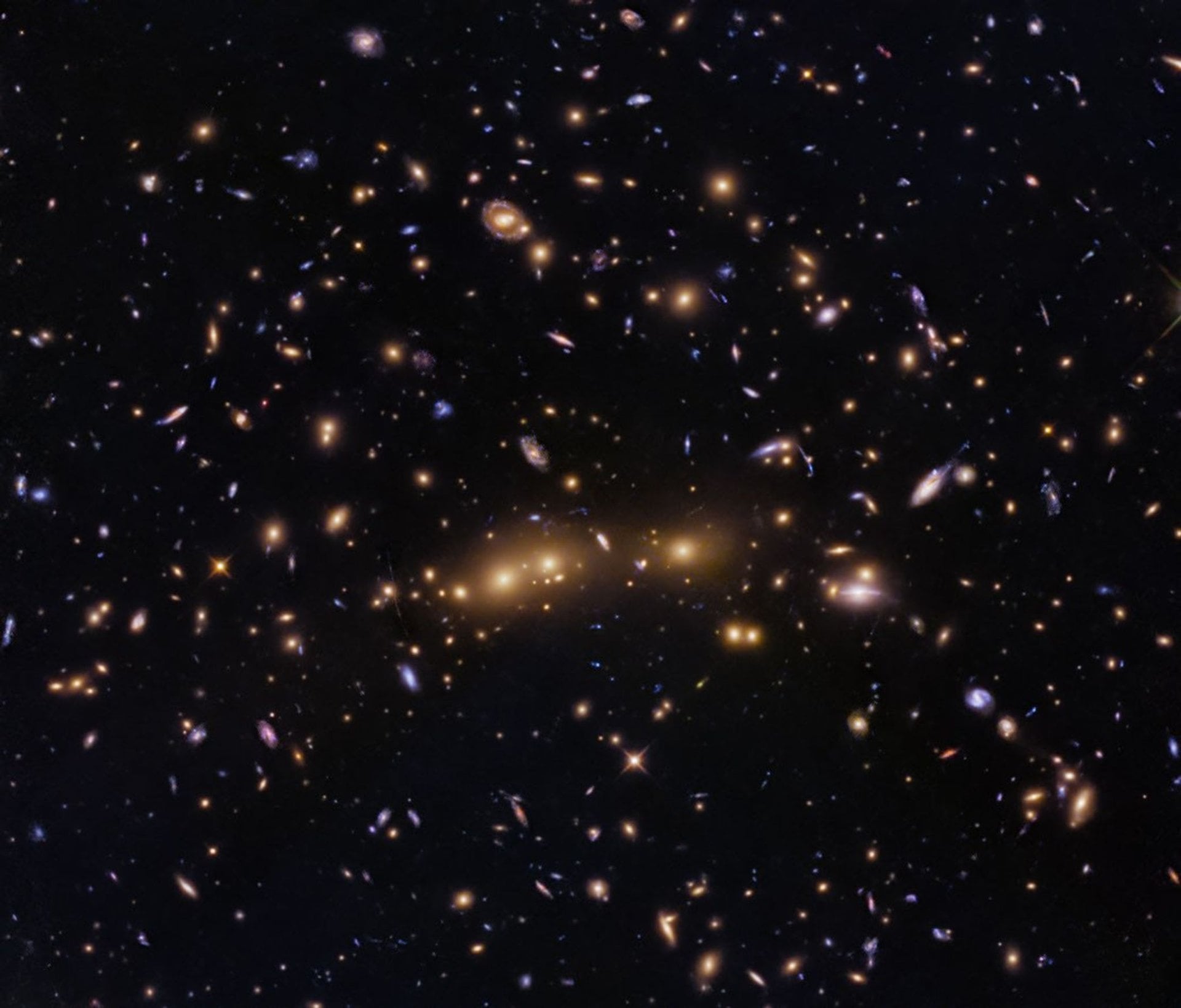
Discovered in the early ROSAT era, CL0016+1609 sits at a redshift of z ≈ 0.55, corresponding to a look-back time of roughly 5.8 Gyr. Apparent in optical light as a dense swarm of ellipticals and spirals, the cluster outshines many others in X-ray photons, indicating an exceptionally hot and massive ICM. Chandra images reveal a bimodal plasma morphology, while HST lensing maps corroborate a dual dark-matter concentration—persuasive evidence for an ongoing merger almost perfectly aligned with our line of sight.
Key observational highlights include:
- Total mass M200 ≈ 1.2 × 10¹⁵ M☉
- ICM temperature kT ≈ 10 keV (≈1.2 × 10⁸ K)
- Bolometric X-ray luminosity LX ≈ 1.5 × 1045 erg s−1
- Velocity dispersion σ ≈ 1100 km s−1
- Weak-lensing shear amplitude γpeak ≈ 0.15
| Cluster | z | M200 (M☉) | kT (keV) | LX (1045 erg s−1) | Dynamical State |
|---|---|---|---|---|---|
| CL0016+1609 | 0.55 | 1.2 × 10¹⁵ | 10 | 1.5 | Major merger |
| Bullet Cluster | 0.30 | 1.5 × 10¹⁵ | 14 | 3.0 | Post-core-passage |
| Coma Cluster | 0.02 | 9.5 × 10¹⁴ | 8 | 0.9 | Relaxed (mildly disturbed) |
| El Gordo | 0.87 | 2.1 × 10¹⁵ | 15 | 3.6 | Major merger |
5.1 Multi-Component Evidence for a Merger
While the dual-core X-ray profile flagged CL0016+1609 as a merger candidate early on, conclusive confirmation required the convergence of several lines of evidence:
- Hardness-ratio maps exhibit distinct temperature peaks, with a cooler core preceding a hotter plasma trail—consistent with bow-shock physics.
- Lensing mass maps display two separate maxima aligned with but offset from the X-ray centroids, supporting dissociation between collisionless and collisional matter.
- Galaxy distribution betrays bimodality in redshift space, with an observed line-of-sight velocity separation of ≈1500 km s−1.
The small projected spatial separation between the two sub-clusters implies near alignment along our viewing axis—an orientation that fortuitously enhances the apparent lensing efficiency.
6. Mapping Dark Matter via Gravitational Lensing
Gravitational lensing offers a purely gravitational probe of total mass, independent of the dynamical state of the baryons. Two complementary regimes are usually employed:
- Strong Lensing: Produces highly magnified arcs and multiple images within ≲100 kpc of the cluster core. Such features directly constrain the inner potential.
- Weak Lensing: Causes subtle, coherent shearing of background galaxy shapes out to several Mpc, enabling measurement of the cluster’s outer mass profile.
For CL0016+1609, ACS imaging yielded over 300 secure weak-lensing sources and more than a dozen strong-lensing constraints. Modelling with the Lenstool software package indicates that the two main dark-matter halos exhibit mass ratios close to 1:1, confirming the “major” character of the merger. A statistical preference emerges for a non-zero core radius in each halo, pointing to possible self-interactions of dark matter, though systematic uncertainties preclude definitive claims at present.
| Indicator | Observable | Implication | CL0016+1609 |
|---|---|---|---|
| Halo Offset | Δx between DM & ICM centroids | Constraints on σ/m | ≈30 kpc |
| Core Radius | Flattening of central density | Possible self-interactions | rc ≈ 120 kpc |
| Substructure Lensing | Anomalous image fluxes | Granularity of DM | Marginal evidence |
| Mass–Concentration Relation | M–c slope | Tests ΛCDM | Consistent within 1σ |
7. Intracluster Medium Thermodynamics
The ICM comprises roughly 15 % of the total cluster mass yet dominates the baryonic budget. During mergers, the plasma is violently shocked to temperatures exceeding 108 K, resulting in enhanced X-ray emissivity. The Rankine–Hugoniot jump conditions permit direct calculation of Mach numbers (M) from temperature or density discontinuities. In CL0016+1609 the inferred shock Mach number is M ≈ 2.1 ± 0.2, intermediate between the Bullet Cluster (M ≈ 3) and the Perseus sloshing front (M ≈ 1.1).
Metallicity gradients also offer clues to past enrichment history. The MOS and pn detectors aboard XMM-Newton revealed an iron abundance of ZFe ≈ 0.38 Z☉, suggesting contributions from both Type Ia and core-collapse supernovae in roughly equal measure. This mixed enrichment pattern is typical for massive clusters at mid-range redshifts and underscores the extended star-formation histories of early-type cluster galaxies.
| Cluster | Mach Number | Shock Velocity (km s−1) | kT Post-shock (keV) | Key Reference |
|---|---|---|---|---|
| CL0016+1609 | 2.1 ± 0.2 | 2850 ± 270 | 10.1 ± 0.8 | Ebeling et al. 2024 |
| Bullet Cluster | 2.9 ± 0.4 | 4500 ± 600 | 14.5 ± 1.1 | Markevitch et al. 2002 |
| El Gordo | 2.5 ± 0.3 | 3700 ± 430 | 13.0 ± 1.0 | Jee et al. 2014 |
| Sausage | 3.1 ± 0.5 | 3300 ± 530 | 9.0 ± 0.7 | Stroe et al. 2016 |
8. Radio Halos, Relics, and Magnetic Fields
While merger shocks heat the ICM, a fraction of kinetic energy couples to particle acceleration, yielding non-thermal synchrotron emission detectable at metre wavelengths. Observations at 144 MHz with LOFAR unveiled a faint but extended halo encompassing CL0016+1609, aligned with the merger axis. Polarisation fractions are modest (≲10 %), indicative of turbulent magnetic fields with coherence lengths of only a few kpc. Combining radio and X-ray data permits evaluation of the magnetic-to-thermal pressure ratio, PB/Pth ≈ 0.02—important for hydrostatic mass bias corrections.
“Non-thermal components, although energetically subdominant, encode the dynamical history of cluster formation and the microphysics of cosmic plasmas.” — Dr. M. Brüggen, Universität Hamburg
9. Numerical Simulations: Re-Enacting the Collision
State-of-the-art hydrodynamical simulations, such as those implemented in the AREPO moving-mesh code, reproduce cluster mergers with sub-kpc resolution while incorporating radiative cooling, Active Galactic Nucleus (AGN) feedback, and anisotropic thermal conduction. Parameter scans covering impact parameter, mass ratio, and line-of-sight orientation suggest that CL0016+1609 is observed within ≈0.3 Gyr after first pericentric passage, with the sub-clusters departing at ≈2000 km s−1. Magneto-hydrodynamical (MHD) extensions reveal that merger-driven turbulence can amplify fields by a factor of ∼5 over ∼Gyr timescales.
| Code | Hydro Scheme | Resolution | Physical Modules | Public Availability |
|---|---|---|---|---|
| AREPO | Moving Mesh | ≈1 kpc | Radiative, AGN, MHD | Yes |
| GADGET-4 | SPH | ≈2 kpc | Cooling, Stars, BH | Yes |
| ENZO-MHD | AMR | variable | MHD, Chemistry | Yes |
| FLASH | AMR | variable | Cosmic Rays | Yes |
10. Cosmological Implications and Tensions
Observations of massive, high-redshift (>0.5) clusters test the tails of the halo mass function and hence the amplitude of matter fluctuations, σ8. While Planck CMB data favours σ8 ≈ 0.81, several SZ-selected cluster catalogues yield slightly lower normalisations. Accurate mass calibration, including corrections for non-thermal pressure support in unrelaxed mergers such as CL0016+1609, therefore bears directly on cosmological parameter estimation.
Lensing-derived masses for CL0016+1609 concur with hydrostatic masses after applying a 15 % bias correction, bolstering confidence in the robustness of current σ8 determinations. Nevertheless, ongoing surveys such as eROSITA and the Vera C. Rubin Observatory’s LSST will enlarge the cluster sample by orders of magnitude, enabling percent-level constraints.
11. Future Observational Frontiers
Forthcoming facilities promise transformational insights into cluster astrophysics:
- Athena X-ray Observatory: With a collecting area of 1.4 m2 at 1 keV and an integral-field calorimeter (X-IFU) delivering 2.5 eV spectral resolution, Athena will map ICM turbulence via Fe‐K line broadening down to Mach 0.1.
- Square Kilometre Array (SKA): Extending radio halo detections to z ≈ 1.5 and measuring Faraday rotation synthesis to probe μG-level magnetic fields.
- JWST: Exploiting strong lensing magnification to scrutinise star-forming knots in galaxies at z > 10—effectively piggybacking on cluster lenses.
- CMB-S4: Achieving y-parameter mapping at sub-arcminute resolution, enabling pressure profile reconstruction for thousands of systems.
12. Synthesis: What CL0016+1609 Teaches Us
The wealth of data amassed for CL0016+1609 underscores several broader lessons:
- Merger Geometry Matters: Near line-of-sight alignments maximise lensing cross-sections but complicate velocity dispersion interpretations, demanding comprehensive 3-D modelling.
- Baryonic Physics Is Non-Trivial: Shock heating, turbulence, and conduction all conspire to shape the thermodynamic history, affecting observable–mass scaling relations.
- Dark Matter Remains Collisionless—So Far: Offsets and mass profiles are broadly congruent with ΛCDM predictions; yet small deviations hint at the necessity of continued scrutiny.
- Synergy Drives Discovery: No single instrument suffices; only concerted multi-wavelength, multi-method campaigns reveal the full dynamical tapestry.
13. Conclusion
As we refine our observational and theoretical apparatus, systems like CL0016+1609 act as waypoints in the continuing effort to map the cosmic web’s hierarchically evolving nodes. The merging process, though fleeting on cosmological timescales, provides a natural laboratory where gravity, hydrodynamics, magnetism, and particle physics intersect. Recognising, quantifying, and ultimately predicting the ballet of galaxies and dark-matter halos grants us deeper understanding not only of clusters themselves but also of the fundamental constituents and governing equations of the Universe.
For More Information
Readers seeking expanded treatments on specific sub-topics are encouraged to consult the following resources:
- RELICS HST Survey Data Archive
- Chandra X-ray Center Documentation
- Ebeling et al. 2005, “The MACS Survey of Massive, Distant Clusters”
- XMM-Newton Science Operations Centre
- LOFAR Official Website
- Athena Mission Overview
- AREPO Simulation Code Repository
- CAMB: Code for Anisotropies in the Microwave Background
- NASA Hubble Mission Page
- Vera C. Rubin Observatory LSST Resources
Note: All numerical values quoted herein assume a concordance cosmology with H0 = 70 km s−1 Mpc−1, ΩM = 0.3, and ΩΛ = 0.7.