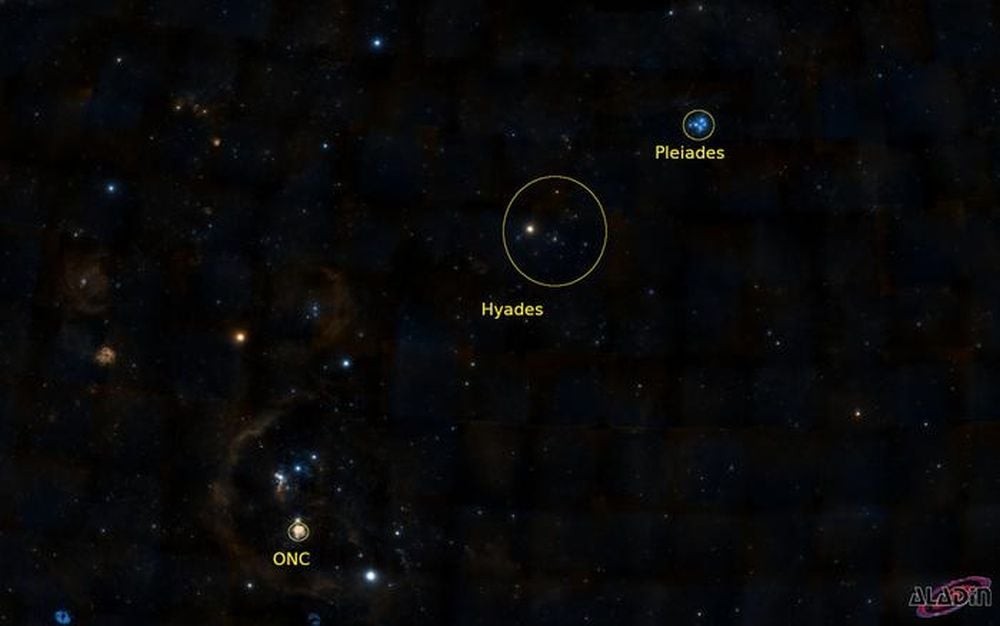
The Orion Nebula Cluster (ONC), the Pleiades, and the Hyades are three open star clusters located in close proximity to each other in the night sky, each representing a unique stage in stellar evolution. Research conducted by astronomers from Iran and Germany has revealed evolutionary links between these clusters, indicating that they may be interconnected and originate from the same progenitor. This article delves into the individual characteristics of these clusters, their life cycles, and the findings of the recent study published in the Monthly Notices of the Royal Astronomical Society.
Introduction
Star clusters, especially open clusters, represent a vital aspect of astrophysical studies. As groups of stars that have formed together from the same molecular cloud, they provide insights into star formation processes and evolutionary dynamics. The ONC, Pleiades, and Hyades are particularly interesting because they are located in roughly the same area of the sky yet differ significantly in their age and maturity. This article explores how these clusters evolve over time and how new research connects their trajectories.
Characteristics of the Star Clusters
Each of these clusters has unique features that reflect their different ages and evolutionary stages. Below, we compare some of their key characteristics in detail.
| Cluster | Age | Number of Stars | Distance from Earth | Primary Features |
|---|---|---|---|---|
| Orion Nebula Cluster (ONC) | 2.5 million years | 2,800 – 10,000 (estimated) | 1,344 light-years | Active star formation region, dense with gas and dust |
| Pleiades | 100 million years | 1,059 | 440 light-years | Dominated by 14 hot, young stars, less dense |
| Hyades | 700 million years | 400 | 153 light-years | Oldest, more dispersed, with stars escaping the cluster |
The Orion Nebula Cluster (ONC)
The ONC is a vibrant star-forming region located within the larger Orion Molecular Cloud Complex. With an age of approximately 2.5 million years, it is the youngest of the three clusters. The ONC contains a vast number of stars, with estimates varying from 2,800 to possibly over 10,000, largely due to its dense environment characterized by gas and dust that obscure the stars.

Figure 1: The Orion Nebula Cluster is a bright area of the sky showcasing the dynamic processes of star formation. Image Credit: NASA/ESA
Research indicates that the cluster is an active site for new star formation, primarily driven by the feedback of its massive stars, including ultraviolet radiation, stellar winds, and supernova explosions which can expel residual gas from the system.
The Pleiades
The Pleiades, commonly known as the Seven Sisters, is a much older open cluster of approximately 100 million years. Located about 440 light-years from Earth, it is easily visible to the naked eye and is one of the most famous asterisms in the northern hemisphere.

Figure 2: The Pleiades, or Subaru in Japan, appears as a distinct cluster in the night sky. It contains around 1,059 stars. Image Credit: NASA, ESA, and AURA/Caltech
Characterized by its hot, luminous stars, the Pleiades is predominantly made up of blue-white stars that are relatively loosely scattered compared to the more compact structure of the ONC. The Pleiades provides an excellent opportunity for studying stellar evolution and dynamics as it reveals insights into the lifecycle of star clusters as they age.
The Hyades
The oldest of the three, the Hyades cluster, is approximately 700 million years old and located just 153 light-years away from Earth. Unlike the ONC and the Pleiades, the Hyades exhibits a much lower density of stars, with only around 400 members. Its stars are found in a more diffuse configuration, with many stars escaping from the cluster.

Figure 3: The Hyades cluster, the closest to our solar system, demonstrates a more dispersed structure compared to younger clusters. Image Credit: NASA, ESA, and STScI.
As the Hyades has aged, it has undergone significant dynamical evolution leading to the loss of many of its stars. Researchers speculate this is the common fate for all open clusters as they continue to evolve and ultimately dissolve over time.
Evolutionary Connections Between the Clusters
The recent study revealed that the ONC, Pleiades, and Hyades represent a sequential narrative of open cluster evolution. The researchers employed numerical simulations alongside observational data to demonstrate that the ONC could serve as a progenitor of the Pleiades and, in turn, the Pleiades could evolve into clusters comparable to the Hyades.
Modeling the Evolution
The researchers started from a simulated model of an ONC-like cluster, with parameters that included total mass, half-mass radius, and core radius. Over a simulated timeframe of 800 million years, they aimed to reproduce the properties currently associated with the Pleiades and the Hyades.
| Time (Myr) | Remaining Stars (%) | Cluster Stage |
|---|---|---|
| 0 | 100 | Younger ONC-like Cluster |
| 100 | 47 | Transitioning to Pleiades-like properties |
| 700 | 9 | Transitioning towards Hyades-like dispersion |
This modeling suggested that by around 100 million years, the ONC would maintain only 47% of its stars and, ultimately, lose around 85% of its original mass after 700 million years. This reveals profound implications for our understanding of star cluster evolution.
Conclusion
This groundbreaking research presents compelling evidence that the ONC, Pleiades, and Hyades are not mere coincidences of stellar formation, but rather, they are stages in a continuum of evolution. The study illustrates the fundamental pathways through which star clusters evolve under the influence of both internal dynamics and external forces such as gravitational interactions.
Understanding the life cycles of star clusters ultimately enhances our comprehension of the fundamental processes governing star formation and evolution across the universe. Future research may continue to uncover additional connections and evolutionary narratives among various stellar systems, offering deeper insights into the nature of our cosmos.
References
For more information, please refer to the following articles:
- Are the ONC, Pleiades, and Hyades snapshots of the same embedded cluster? - Monthly Notices of the Royal Astronomical Society
- Press Release on Star Cluster Evolution – EurekaAlert!
- NASA Paper on Star Formation and Clusters
- Research on Stellar Evolution - ScienceDirect
- AstroBin - Astronomy Photography and Community
As astronomers continue to observe and model these magnificent star clusters, the legacy of their findings will deepen humanity's fascination with the cosmos and reveal intricate details about our cosmic lineage.