How Star Clusters Age: The Pleiades, the Hyades, and the Orion Nebula Cluster
By Evan Gough - July 18, 2025 at 11:00 PM UTC | Stars

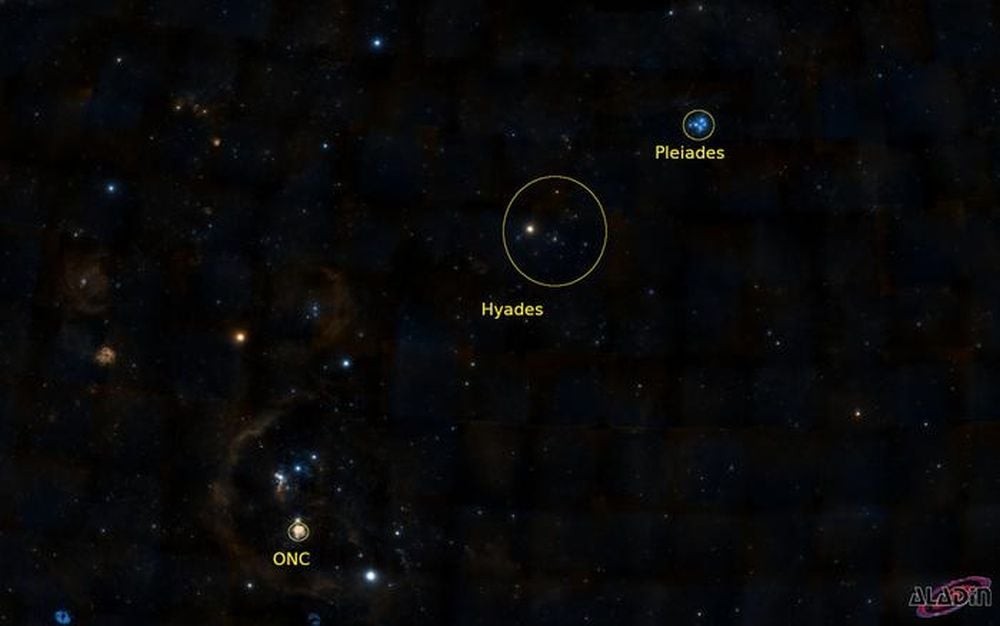
The Orion Nebula Cluster (ONC), the Pleiades, and the Hyades are three distinct open star clusters situated in relatively close proximity to one another. These clusters are significant not only for their visibility in the night sky but also for their distinct stages of evolution and star formation. Researchers have recently unraveled a deep connection between these well-studied clusters, suggesting that they represent various stages in the life cycle of star clusters and shedding light on their shared origins. This article explores the backgrounds, ages, and evolutionary relationships between the Pleiades, Hyades, and the Orion Nebula Cluster.
The Star Clusters: An Overview
Researchers from Iran and Germany, utilizing both observational data and computer modeling, have developed new insights into the relationships between these clusters. The findings were published in a paper in the Monthly Notices of the Royal Astronomical Society titled "Are the ONC, Pleiades, and Hyades Snapshots of the Same Embedded Cluster?" The lead author, Ghasem Safaei from the Institute for Advanced Studies in Basic Sciences, Iran, emphasizes that most stars in our galaxy do not form in isolation. Rather, they arise within clusters embedded in giant molecular clouds that are initially compact structures.
Formation and Age Differences
The ONC, Pleiades, and Hyades are all classified as open clusters, yet they exhibit significant differences in age and composition. The Orion Nebula Cluster is currently the youngest, estimated at around 2.5 million years old, and is characterized by ongoing star formation. Estimates of its member stars vary widely—from approximately 2,800 to around 10,000—primarily due to the presence of dense clouds of gas and dust that obscure many of its stars.

The Pleiades: The Seven Sisters
The Pleiades cluster, often referred to as the Seven Sisters, is considerably older at approximately 100 million years. This cluster is home to about 1,059 confirmed stars, prominently featuring 14 bright blue giants that are easily visible to the naked eye. In contrast to the ONC, the stars within the Pleiades are more loosely dispersed.

The Hyades: Our Closest Neighbor
The oldest of these three clusters is the Hyades, estimated at around 700 million years. It consists of approximately 400 stars and is recognized for being the closest star cluster to Earth, located about 153 light-years away. The Hyades are more diffuse than the younger Pleiades and ONC, with roughly a third of its stars located in an extended halo that suggests some are in the process of escaping the cluster.

Understanding Cluster Evolution Through Simulations
The researchers employed N-body simulations to examine the evolutionary pathways of stellar clusters. They began with a simulation representing the ONC and varied key parameters, including total mass, core radius, and half-mass radius. This approach enabled them to explore how different configurations would lead to the observable characteristics of the ONC. Furthermore, the simulations allowed the team to trace the evolutionary path leading to the properties of the Pleiades and Hyades over an extensive period.
Simulating the Life Cycle of Star Clusters
| Stage of Evolution | Time Scale (Million Years) | Mass Retention (% of Initial) |
|---|---|---|
| Initial Formation (ONC) | 0 - 2.5 | 100% |
| Mid-Evolution (Pleiades) | 100 | 47% |
| Late Evolution (Hyades) | 700 | 9% |
The simulations indicated that during the first 100 million years, the ONC would have lost approximately 53% of its stars. By the time it reached 700 million years of age, it retained only 9% of its initial stellar population. This process aligns closely with the observed characteristics of the Pleiades and Hyades clusters, implying a shared ancestry among these stellar groupings.
Implications of the Findings
The findings of this research have profound implications for our understanding of stellar evolution and the formation of star clusters. The study indicates that these three clusters may have emerged from the same initially embedded cluster, providing a compelling narrative regarding the evolutionary trajectory of star clusters. It further suggests a non-random, preferred mode of star formation influenced by environmental factors within molecular clouds.
“Our highly precise stellar dynamics calculations have now shown that all three star clusters originated from the same predecessor,” said Prof. Dr. Pavel Kroupa from the Helmholtz Institute for Radiation and Nuclear Physics at the University of Bonn, a co-author of the publication.
Star Clusters: A Family Album Analogy
The ONC, Pleiades, and Hyades can be metaphorically viewed as stages in a family album, with each cluster representing a different stage in life. The ONC serves as the “toddler,” bursting with new stars in formation, the Pleiades represents the “adult,” a moment of vigorous youthful life, while the Hyades stands for the “grandparent,” showcasing a wealth of history and a gradual dispersion of its stars.
The Role of Internal Dynamics and External Forces
These findings illuminate the delicate balance between internal dynamics—such as mass segregation within the clusters—and external influences like the gravitational force of the Milky Way. As these clusters evolve, they undergo a loss of mass and structure, leading to a transformation from tightly bound star clumps into solitary field stars.
Conclusion: Observing Our Cosmic Heritage
This groundbreaking research provides a stark reminder of our celestial heritage. The Sun, once part of a cluster similar to the ONC, is now a lone star amidst the vastness of field stars. However, the legacy of these clusters—visible to anyone with a telescope or binoculars—remains a testament to the formation and evolution of stars across the universe.
In conclusion, the evolutionary study of the Pleiades, the Hyades, and the Orion Nebula Cluster not only reveals their interconnected past but also enhances our understanding of the processes governing star formation and the eventual fate of star clusters—a captivating area of research in modern astrophysics.
© 2025 Universe Today
A space and astronomy news site
Support our ad-free content
Become a PatronContact Us Privacy Policy
This work is licensed under a Creative Commons Attribution 4.0 International License.