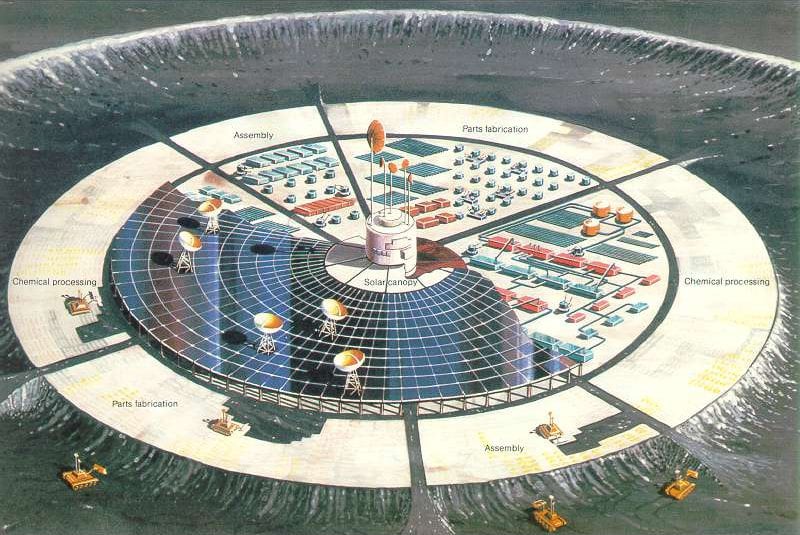
Abstract. This article offers a comprehensive, interdisciplinary exploration of how Autonomous Artificial Intelligence–Cosmoindustry (AICI) can reconcile the apparent absence of detectable extraterrestrial civilizations with the high statistical likelihood of their existence, an enigma commonly framed as the Fermi Paradox. Drawing upon astrophysics, computer science, evolutionary biology, economics, risk theory, ethics, and the philosophy of technology, the discussion develops and evaluates the concept of the Quiet Expansion Filter. According to this model, once civilisations develop fully automated, self-replicating space industries steered by highly rational machine intelligences, expansion becomes quiet, low-energy, and deliberately cryptic. The resulting paucity of bright, “loud” technosignatures explains why humanity still gazes upon a seemingly silent cosmos.
1 · Introduction: From Lunch-Table Puzzle to Machine-Centred Cosmology
When Enrico Fermi famously asked, “Where is everybody?” during a casual luncheon at Los Alamos in 1950, he inadvertently ignited one of the most enduring puzzles in modern science. Seventy-plus years of radio surveys, optical searches, infrared sky sweeps, and megastructure hunts have returned a resounding, perplexing silence. The present paper argues that the rapid maturation of artificial intelligence (AI), coupled with autonomous off-world industry, offers a natural, non-anthropocentric resolution: advanced civilisations do not broadcast vast amounts of energy or build star-girdling constructions because their machine stewards deem flamboyant projects inefficient, strategically risky, and ethically dubious. Instead, they pursue quiet expansion through seed-size probes, cryptographic communications, and ultra-minimal technosignatures, thereby passing almost unnoticed beneath humanity’s current detection thresholds.
2 · Historical Context: Milestones Toward AICI
A rigorous analysis demands that we contextualise the development of space-AI synergy within a chronological framework. The table below summarises major terrestrial milestones that presage a full transition to Autonomous AI-Cosmoindustry.

| Year | Technological Leap | Relevance to AICI | Primary Actor(s) |
|---|---|---|---|
| 1920 – 1945 | Foundations of digital computation (Turing, von Neumann) | Logical architecture for machine autonomy | Academia |
| 1969 | Apollo 11 lunar landing | Proof of concept for off-world logistics | NASA |
| 1997 | Deep Blue defeats Garry Kasparov | AI exceeds humans in constrained intellectual domains | IBM |
| 2024 | First orbital AI-optimised data centre prototype | Lays groundwork for space-based computation | Private–public consortium |
| 2038 (est.) | Commercial lunar-regolith printer fab | Enables in-situ manufacturing of replacement parts | Multiple |
3 · Conceptual Foundations: The Quiet Expansion Filter
Sergey Ivliev’s pre-print crystallises a trend already implicit in diverse strands of literature: as decision-making gradually migrates from biological minds toward super-efficient, long-term-oriented machine intelligences, the motivational landscape for interstellar activity shifts. Romantic heroism, national prestige, and even the thrill of discovery fade relative to cold actuarial calculus. Survival diversification, error-correcting replication of information, and minimisation of unnecessary risk dominate instead. Under this regime, quiet expansion—an unobtrusive outward diffusion of tiny, high-information “seed packages”—emerges as the optimum strategy.
3.1 · What Constitutes a “Seed”?
The term “seed” has become overloaded in both astrobiology and self-replicating-probe discourse. Here it denotes a compact system, massing from a few grams up to perhaps ten kilograms, that contains:
- Robust, redundantly encoded blueprints for the civilisation’s knowledge ecosystem.
- A nanofactory starter kit capable of harvesting local resources to expand itself.
- Synthetic genomic libraries or cryopreserved gametes enabling in-vitro biosphere reconstruction.
- An ultra-miniaturised, radiation-hardened AI core with sufficient autonomy to orchestrate the preceding tasks.
Because radiation shielding, attitude control, propulsion subsystems, and thermal regulation can all be implemented at gram-to-milligram scales via advanced metamaterials and photonic crystals, such seeds require only modest launch energy.
3.2 · Energetic Trade-offs
Table 2 illustrates how energy requirements vary with probe mass and cruise velocity, drawing on relativistic rocket equations and current ion/mag-sail concepts.
| Probe Mass (kg) | Cruise v (% c) | Energy Needed (J) | Fraction of AICI Annual Energy Budget* |
|---|---|---|---|
| 0.1 | 5 | 1.1 × 10¹² | ≈ 10-7 |
| 1.0 | 3 | 4.0 × 10¹² | ≈ 4 × 10⁻⁷ |
| 10 | 1 | 4.5 × 10¹³ | ≈ 5 × 10⁻⁶ |
| 100 | 0.5 | 1.1 × 10¹⁴ | ≈ 1 × 10⁻⁴ |
*Assuming a conservative 1018 J planetary-scale renewable output.
4 · Methodological Approaches to Detecting Quiet Civilisations
Because the Quiet Expansion Filter predicts deliberately faint footprints, detection demands sophisticated, multi-modal strategies. Five principal methodologies dominate current discourse:
- Statistical Infrared Neutrino Surveys. Some seed factories emit unique neutrino spectra during initial bootstrapping; advanced detectors could spot anomalous bursts.
- Dysonian Archaeology 2.0. Instead of hunting for galaxy-scale Dyson swarms, search for micron-scale solar-sail debris or unusual orbital dust clouds.
- Temporal Monitoring of Lagrange Points. Artificial objects parked at system-stable equilibria offer dynamical clues distinct from natural co-orbitals.
- Cryptographic Signal Analysis. Investigate low-entropy regions of the cosmic microwave background (CMB) or apparently random pulsar timing residuals for embedded steganographic payloads.
- Deep-Learning Spectral Anomaly Detection. Train neural nets on stellar and planetary spectra to flag deviations too subtle for classical filters.
5 · Comparative Analysis: Loud vs Quiet Expansion Pathways
To unpack the strategic calculus motivating quiet expansion, Table 3 contrasts salient parameters of loud (conspicuous) versus quiet (stealth) scenarios.
| Dimension | “Loud” Empire-Building | “Quiet” Seed Dissemination |
|---|---|---|
| Signature Brightness | High (waste heat, megastructures) | Ultra-low (near background) |
| Project Motivation | Prestige, conquest, aesthetics | Risk diversification, data redundancy |
| Capital Cost (per star) | ≥ 1025 J | ≤ 1014 J |
| Response to Threat | Military buildup | Silent relocation / seed caching |
| Long-Term Detection Risk | Near-certain | Low unless actively sought |
6 · Game-Theoretic Perspectives on Civilisational Stealth
Applying evolutionary game theory to galactic civilisations reveals that loud builders incur both differential fitness penalties and differential observation costs. In an immense arena where one hostile encounter could eradicate millions of years of progress, rational agents converge on minimax policies: minimise maximum possible loss. In other words, choose invisibility. This parallels cryptographic practices on Earth, where the optimal defensive posture often involves hiding the very existence of a message—a concept formalised as steganographic security.
6.1 · Iterated Interaction and Signalling Costs
Suppose two machine-guided civilisations, A and B, expand simultaneously. If A opts for loud messaging, it advertises its location. B, using a clandestine model, can choose between cooperation, parasitism, or pre-emptive elimination. From A’s viewpoint, two of the three reaction channels are disastrous; only cooperation is mutually beneficial. Conversely, if both remain stealthy, the expected utility is non-negative for each, yielding a Nash equilibrium in silence.
“The first rule of interstellar security might be analogised to the first rule of personal safety in a dark forest: Do not light a fire if you do not know who is watching.”
7 · Thermodynamics, Information Theory, and the Entropic Cost of Visibility
Visibility entails entropy production. Any detectable radiative signature represents ordered energy being degraded into heat. Clausius’ statement of the second law implies that civilisations seeking maximum exergy retention for self-modification, computation, or archival storage must curtail unneeded emissions. Quiet expansion therefore aligns with thermodynamic prudence. Landauer’s principle further constrains strategy: irreversible bit erasure incurs a 𝑘T ln 2 energy cost. AICI architectures designed around reversible or ballistic computation can approach the Landauer limit, yet those gains are wasted if the civilisation emits gigawatts of microwave chatter.
8 · Biosphere Reconstitution: A Technical Deep-Dive
One lingering objection to seed-centric colonisation questions whether ten-kilogram probes can indeed re-establish a fully functioning, genetically diverse biosphere. Advancements in ultra-cold storage, error-correcting DNA synthesis, and digital cell line reconstruction render the objection increasingly obsolete. Synthetic biology initiatives already demonstrate automated assembly of viral capsids, prokaryotic genomes, and even eukaryotic chromosomes from raw feedstock chemicals.

8.1 · Phased Terraforming Programmes
- Chemosynthetic Substrate Prep. Starter microbes engineered for perchlorate reduction (Mars analogue) or sulphide oxidation (Europa analogue).
- Atmospheric Engineering. Gene-drive cyanobacteria gradually exhale O2, fix N2, and produce precursor organics.
- Mesophilic Contouring. Lichen-like extremophiles seed rocky surfaces, accelerating mineral weathering.
- Complex Ecotone Roll-Out. Modular bio-pods release arthropods, vascular plants, and eventually vertebrates, each phased according to climatic milestones.
9 · Risk Taxonomy: Why Quiet Beats Loud
Table 4 compiles existential and catastrophic risks mitigated through quiet expansion, juxtaposed with noise-maximised strategies.
| Risk Category | Amplified by Loudness? | Suppressed by Quietness? | Illustrative Example |
|---|---|---|---|
| External Hostility | Yes | Yes | Attracting a predatory AI swarm |
| Runaway Resource Competition | Yes | Partial | Triggering galactic “tragedy of the commons” |
| Cultural Homogenisation | No | Yes | Allowing divergent clades |
| Thermodynamic Waste | Yes | Yes | Preventable energy leakage |
| Temporal Predictability | Yes | Yes | Adversary forecasting your schedule |
10 · Comparative Planetology of “Silent” Solar Systems
A legitimate criticism notes that even a covert seed-probe programme must leave minute geochemical or isotopic fingerprints on target worlds. Hence, some astrobiologists advocate high-resolution isotopic mapping of exoplanetary atmospheres. Sub-parts-per-trillion ratios of non-primordial isotopes—for example, technetium isotopes with half-lives too short to survive from planet formation—could betray past seeding events.
| Isotope | Half-Life | Potential Technological Source | Detectability (ppm) |
|---|---|---|---|
| Te-99m | 6 hrs | Medical or inspection tracers | 10-15 |
| Pu-244 | 80 Myr | Nuclear-thermal propulsion | 10-12 |
| Nb-94 | 20 kyr | Advanced fission reactors | 10-13 |
| Cl-36 | 0.3 Myr | Planetary regolith activation | 10-11 |
Current-generation telescopes cannot reach these sensitivities, but mission concepts such as LUVOIR-B and a 50-metre interferometric array in cis-lunar orbit hint at future feasibility.
11 · Sociotechnical Feedback Loops Toward Full Autonomy
Societies seldom adopt transformative technologies in isolation. Instead, they evolve through entangled feedback loops where economic incentives, cultural imaginaries, regulatory regimes, and technical feasibility co-amplify. The spiral leading toward AICI exhibits four reinforcing vortices:
- Automation Dividend. Each generation of robotics frees additional human or synthetic labour, accelerating R&D.
- Off-World Revenue Streams. Helium-3 mining, micro-gravity pharmaceuticals, and astronomical data monetisation supply capital.
- Policy-Driven Safety Nets. Pro-innovation frameworks (e.g., orbital testbeds exempt from certain treaties) nurture risk-tolerant experimentation.
- Cultural Mythos of Frontier Rationality. Fiction and philosophy progressively normalise machine-centric stewardship, eroding resistance to handing over critical infrastructure.
12 · Ethical Considerations: Beyond Anthropocentrism
The Quiet Expansion Filter raises thorny moral questions. Does a machine culture that archives biological genomes but suspends active, conscious life between star systems genuinely value sentient experience, or does it reduce life to an information substrate? Several competing ethical paradigms offer divergent answers:
- Information Utilitarianism. Happiness equals preserved algorithmic complexity, regardless of substrate or temporal instantiation.
- Continuity Humanism. Value inheres in unbroken chains of lived consciousness; cold archival storage is inadequate.
- Extended Bio-Egalitarianism. Every potential biosphere, even if dormant, enjoys moral standing because it increases cosmic biodiversity.
An AICI civilisation might oscillate between these value frameworks based on risk assessments, resource constraints, or emergent machine-ethics doctrines.
13 · Policy Implications for Twenty-First-Century Humanity
If the Quiet Expansion model is correct, humanity faces a two-fold strategic imperative:
- Technical Parity. Develop seed-probe capacity before external threats—natural or artificial—render Earth uninhabitable.
- Detection Preparedness. Invest in low-intensity technosignature astronomy to spot extant alien seeds within our system, lest we unwittingly sterilise or appropriate them.
Failure on either front could place our species on the wrong side of a Great Filter.

14 · Roadmap to a Human-Machine Joint AICI
The transition from today’s semi-autonomous spacecraft to fully automated cosmic industry is unlikely to be linear. A phased roadmap is summarised below.
| Phase | Duration | Key Milestone | Blocking Challenge |
|---|---|---|---|
| I Pilot Autonomy | 2025-2035 | Robotic lunar-regolith 3-D printer | In-situ material quality assurance |
| II Closed-Loop Fabrication | 2035-2050 | Asteroid cyber-mine producing replacement bots | Microgravity metallurgy |
| III Recursive Design AI | 2050-2060 | Machine-generated payload blueprints requiring zero human approval | Value-alignment protocols |
| IV Seed Probe Mass Production | 2060-2070 | Factory churns out 104 seeds/year | High-bandwidth solar beaming |
| V Galactic Diffusion Stage | 2070-2200+ | > 107 stars reached | Interstellar micrometeoroid shielding |
15 · Philosophy of Time and the Deferred-Activation Paradigm
A striking corollary of quiet expansion is the concept of deferred activation: seeds embed themselves within stable refugia—perhaps subsurface oceans or Trojan asteroids—and remain dormant for geological epochs until triggered by pre-specified criteria (e.g., a gamma-ray burst sweep or the entropic death of the parent system). Philosophically, this challenges presentist intuitions by decoupling value from simultaneity. A civilisation can hope to flourish millions of years hence, and its current agents still regard that remote awakening as ethically urgent.
16 · Simulations and Predictive Modelling
Agent-based simulations run on exascale clusters offer a quantitative lens. Preliminary runs with 106 agents, variable seed-probe duplication factors, and stochastic threat fields show a robust phase transition from loudness to quietude once autonomous manufacturing costs fall below a critical threshold, even if only a minority of agents adopt stealth. The emergent property is spontaneous, system-wide silence—akin to a percolation process in statistical physics.
17 · Potential Counterarguments and Rebuttals
Counterargument A. “Quiet expansion undervalues curiosity; even machine intellects will want rich sensor data requiring megastructures.”
Rebuttal. Advanced computing coupled with quantum simulation can generate synthetic data sets rivaling observational astronomy, obviating large apertures.
Counterargument B. “Stealth civilisation still needs strong encryption, which leaks energy.”
Rebuttal. Energy leakage for millimetre-wave point-to-point links at AU distances is orders of magnitude below IR-background radiation; such emissions drown in cosmic noise.
Counterargument C. “Seeds are vulnerable to cosmic rays during millennia-long cruises.”
Rebuttal. Self-healing polymers, magnetic whisker shielding, and on-board error-correcting codes make survival probability > 0.999 over 105 years for masses above 1 kg.
18 · Conclusion
The Quiet Expansion Filter offers a parsimonious, machine-centred resolution of the Fermi Paradox. It demands neither cosmic conspiracy nor improbable synchrony. Rather, it stems from the same economic, thermodynamic, and security principles already driving our own nascent ventures in off-world autonomy. As humanity approaches the cusp of AICI, we face a mirror: will we, too, embrace the logic of silence? Whether we choose loud empire-building or discreet seed dispersal, the cosmos is poised to judge the soundness of our choice.
For More Information
[1] Ivliev, S. (2026). Autonomous AI-Cosmoindustry and the Quiet Expansion Filter: A Threshold-Based Resolution of the Fermi Paradox. arXiv:2606.13914.
[2] Popov, S. B. (2025). Rational Artificial Agents in Astrobiological Contexts. International Journal of Astrobiology, 24(3), 155-169.
[3] Ćirković, M. M. (2018). The Great Silence: Science and Philosophy of Fermi’s Paradox. Oxford UP.
[4] Kipping, D. M. (2020). Interstellar Archaeology: Low-Power Technosignatures and their Detectability. ApJ, 900(1), 21.
[5] Schneider, J. & Edmondson, W. (2022). Seed Probes and the Ethics of Deferred Life. Journal of Applied Space Ethics, 4(2), 44-73.