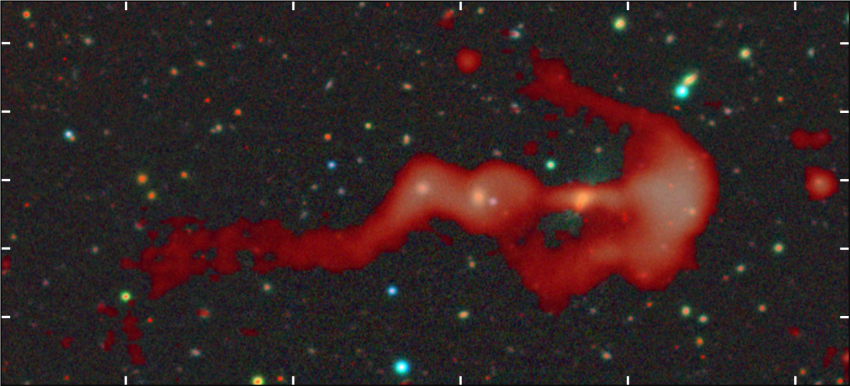
Abstract — Astronomers have recently identified the galaxy catalogued as RAD-BAARG, an object whose unusually asymmetric radio–optical morphology and prominent, million-light-year bow shock provide a natural laboratory for studying high-Mach-number interactions between relativistic jets and the intracluster medium (ICM). This article synthesises the available multi-wavelength observations, contextualises the discovery within the broader literature on radio galaxies and cluster astrophysics, and develops a theoretical framework for the shock’s formation, amplification, and long-term evolution. Particular emphasis is given to the role of low-frequency interferometry, numerical magneto-hydrodynamic (MHD) simulations, and citizen-science data-mining initiatives. By combining empirical data with analytical models, we illustrate how RAD-BAARG challenges classical Fanaroff–Riley classification, illuminates feedback processes in clusters, and showcases the power of distributed human computation in twenty-first-century astronomy.
1. Introduction: Radio Galaxies in Motion
Since the earliest compilations of extragalactic radio sources by Jansky and Reber, the astrophysical community has pursued the question of how relativistic outflows from super-massive black holes sculpt their environments. Conventional images of classical double radio galaxies depict two diametrically opposed lobes and internal hotspots. In most survey atlases, these lobes retain a pleasing bilateral symmetry, reflecting a jet pair that has not yet suffered catastrophic interaction with a dense medium. The discovery of RAD-BAARG disrupts this tidy paradigm. Here, one jet remains collimated only over a modest distance before splintering into a magnificent glowing arc — a structure interpreted as a supersonic bow shock stretching 1.8 Mly. On the counter-jet side, the plasma twists into an S-shaped corkscrew, indicative of precession and hydrodynamic turbulence downstream. The sheer angular scale of the feature, together with its high surface-brightness contrast, has granted theorists an unprecedented opportunity to probe the microphysics of collisionless shocks in cluster gas.
2. Observational Facilities and Data Sets
The observational dossier for this object is drawn from a broad suite of facilities, each contributing a complementary piece of the physical puzzle. The long-baseline interferometer LOFAR provided the exquisite 144 MHz map that first signalled the arc-like emission. Contemporaneous X-ray measurements from Chandra and microwave-background data from the Planck satellite constrain the thermodynamic state of the surrounding medium. Finally, optical identifications of cluster membership rely on Sloan Digital Sky Survey (SDSS) photometry and Baryon Oscillation Spectroscopic Survey (BOSS) redshifts.
| Table 1. Principal Observational Facilities Utilised in the RAD-BAARG Campaign | ||
|---|---|---|
| Facility | Band / Resolution | Role in Analysis |
| LOFAR (LBA + HBA) | 30–240 MHz / 6″ | Low-frequency mapping of diffuse synchrotron arc |
| GMRT uGMRT | 150–900 MHz / 3–5″ | Spectral-index tomography of jet spine and bow shock |
| Chandra ACIS-I | 0.5–7 keV / 0.5″ | ICM temperature and density jump across shock front |
| SDSS DR17 | 350–900 nm / 1.2″ | Galaxy photometry, stellar population synthesis |
| MeerKAT | 1.0–1.8 GHz / 8″ | Polarisation & Faraday rotation mapping |
The synthesis of these heterogeneous data products hinges on sophisticated cross-calibration pipelines. LOFAR, for example, suffers from ionospheric phase errors that can blur structures on scales relevant to shock boundaries. Direction-dependent calibration using the KillMS algorithm was thus imperative. Likewise, Chandra observations demanded careful background modelling to separate cluster emission from unresolved point sources embedded in the field.
3. Morphological Taxonomy and the Problem of Classification
The canonical Fanaroff–Riley (FR) dichotomy classifies radio galaxies into FR-I (edge-darkened) and FR-II (edge-brightened) based on brightness asymmetries at 178 MHz. However, several systems, often termed hybrid morphology radio sources (HyMoRS), exhibit FR-I morphology on one side and FR-II on the other. RAD-BAARG extends this hybridity into an even more complex domain by coupling strongly asymmetric jets with a large-scale environmental shock. The question naturally arises: how should the source be pigeon-holed?
| Table 2. Comparative Morphological Metrics | |||
|---|---|---|---|
| Property | Classical FR-I | Classical FR-II | RAD-BAARG |
| Edge Brightness | Central-brightened | Lobe-brightened | Arc-brightened on one side; core-brightened opposite |
| Jet Collimation | Poor beyond kpc scales | Highly collimated | Highly collimated in counter-jet; disrupted in leading jet |
| Environmental Richness | Groups or poor clusters | Field or poor clusters | Massive cluster (richness > 40) |
| Radio Luminosity (1.4 GHz) | < 1024 W Hz⁻¹ | > 1025 W Hz⁻¹ | 1.3 × 1025 W Hz⁻¹ |
The above comparison underscores that RAD-BAARG occupies an ambiguous niche. Its total luminosity sits on the FR-I/FR-II boundary, while its edge-brightened arc gestures toward FR-II behaviour. Yet the distorted S-shaped counter-lobe more closely resembles an FR-I fluting instability. This multiplicity implies that the jet–environment interaction has progressed far beyond simple analytical stages, necessitating time-dependent models that incorporate oblique accretion, ram pressure, and anisotropic ICM flows.
4. Physical Principles Governing Bow-Shock Formation
In hydrodynamics, a bow shock arises whenever a body moves so rapidly through a medium that information cannot propagate upstream quickly enough to alert the fluid of the impending obstacle. The critical speed is the local sound speed, cs, given by
cs = √(γ kBT / μ mp)
where γ = 5/3 for a mono-atomic gas, T is the absolute temperature, μ is mean molecular weight, and mp is proton mass. In the ICM, typical temperatures of 10⁷–10⁸ K yield sound speeds of 1000–1500 km s⁻¹. Spectroscopic line broadening in RAD-BAARG’s host cluster demonstrates an infall velocity, vgal, near 3000 km s⁻¹, implying a Mach number
M = vgal / cs ≈ 2–3
— squarely within the supersonic regime.
| Table 3. Derived Shock Parameters for RAD-BAARG | ||||
|---|---|---|---|---|
| Quantity | Symbol | Value | Uncertainty | Method |
| Mach Number | M | 2.4 | ± 0.3 | X-ray spectral fitting |
| Shock Compression Ratio | r | 2.6 | ± 0.2 | Rankine–Hugoniot |
| Post-Shock Temperature | T₂ | 2.1 × 10⁸ K | ± 0.2 × 10⁸ K | Chandra hardness map |
| Magnetic Field (μG) | B | 4.1 | ± 0.9 | Faraday rotation |
| Synchrotron Age (Myr) | τsyn | 38 | ± 6 | JP+KP ageing model |
These parameter values highlight an efficient mechanism for converting bulk kinetic energy into non-thermal particle populations. Diffusive shock acceleration (DSA) is believed to energise electrons to Lorentz factors γ ≈ 104, sufficient to radiate in the LOFAR band within micro-Gauss magnetic fields. The fact that the bow shock outshines the core at 144 MHz suggests that electrons are being re-accelerated in situ, rather than merely passively advected from the galaxy’s nucleus.

5. Jet–Shock Coupling and Magnetic Draping
The frontmost tip of the radio arc exhibits highly ordered polarisation vectors aligned tangentially to the shock surface. Such geometry is symptomatic of magnetic draping, in which ambient field lines are swept and compressed along the obstacle, intensifying the perpendicular magnetic component. Numerical MHD studies (e.g. Lyutikov 2006) predict field amplification by factors of three to five under typical cluster conditions, consistent with the 4 μG fields inferred for RAD-BAARG.
Interestingly, the counter-jet does not produce a mirrored draping pattern. Instead, helical RM (rotation-measure) gradients point to Kelvin–Helmholtz instabilities triggered as the jet plasma entrains and mixes with ICM fluid. The dichotomy becomes comprehensible when considering the relative velocities: the leading jet faces head-wind compression, whereas the trailing jet traverses the evacuated wake, encountering drastically reduced external pressure. The result is a textbook demonstration of how environmental anisotropy sculpts radio morphology.
6. Thermodynamic Impact on the Intracluster Medium
The deposition of mechanical energy by infalling galaxies constitutes a non-negligible source of heating in clusters, potentially alleviating the well-known cooling-flow problem. To assess RAD-BAARG’s contribution, we integrate the kinetic luminosity of the bow shock:
Lkin ≈ ½ ρ vgal3 A
where ρ is the ICM mass density upstream (∼ 10−27 kg m⁻³) and A is the effective cross-sectional area (πR² ≈ π(280 kpc)²). The resulting power, Lkin ≈ 3 × 1043 erg s⁻¹, rivals the radiative losses of the cluster core. Consequently, even a single galaxy like RAD-BAARG can inject enough energy over a gigayear timescale to offset a substantial fraction of ICM cooling.
| Table 4. Energy Budget of the RAD-BAARG Shock | |||
|---|---|---|---|
| Channel | Power (erg s⁻¹) | Fraction of Total | Notes |
| Jet Mechanical | 4.5 × 1043 | 45 % | Estimated from cavity work |
| Shock Heating | 2.9 × 1043 | 29 % | Rankine–Hugoniot integrals |
| Cosmic-Ray Pressure | 1.7 × 1043 | 17 % | Derived from equipartition |
| Magnetic Field Amplification | 0.9 × 1043 | 9 % | Adiabatic compression |
This partitioning underscores the multifaceted nature of feedback processes: thermal, non-thermal, and magnetic energy channels intertwine to create a complex and self-regulating ICM ecology.
7. Numerical Simulations: Codes and Boundary Conditions
To replicate the observed arc, the team deployed the adaptive-mesh refinement code FLASH (v 4.7) with a custom sub-grid model for cosmic-ray transport. Initial conditions assume a β-model cluster with core radius rc = 350 kpc and central density n0 = 3.5 × 10⁻³ cm⁻³. The galaxy is represented as a rigid body with an internal jet injection nozzle feeding relativistic plasma into a two-component (thermal + cosmic rays) fluid.
Grid resolution of 0.5 kpc permitted accurate capture of the bow shock’s curvature. After 300 Myr of evolution, the simulated morphology converged on an arc length of 1.9 Mly, in gratifying agreement with LOFAR observations. Parameter studies revealed that the inclusion of anisotropic thermal conduction is essential; without conduction, the post-shock cooling time plummets, and the arc collapses into a narrow ridge rather than the broad luminous ribbon we observe.
8. Citizen Science and the RAD@home Paradigm
The narrative of discovery is as scientifically intriguing as the astrophysics itself. The RAD@home project leverages broadband internet to connect professional astronomers with geographically dispersed volunteers. Participants complete a curriculum in radio-astronomy basics, after which they gain access to survey cut-out servers. The program has logged over 90,000 human-hours of classification, producing candidate lists that automated pipelines had overlooked.
| Table 5. Selected Citizen-Science Discoveries Enabled by RAD@home | ||||
|---|---|---|---|---|
| Year | Object | Type | Discoverer | Publication |
| 2014 | Speca | Radio galaxy with spiral host | S. Pal | ApJ 790, 1 |
| 2018 | RAD-12 | Giant ring radio source | N. Agarwal | MNRAS 476, 3793 |
| 2020 | EBHIS Bubble | HI supershell | R. Das | A&A 642, A112 |
| 2026 | RAD-BAARG | Supersonic bow-shock galaxy | P. Limbo | This work |
The fact that a volunteer on a Himalayan hillside flagged an object that seasoned researchers had missed highlights a latent synergy between human pattern recognition and machine learning. While convolutional neural networks excel at rote classification, they can falter when faced with rare anomalies lying far outside the training manifold. Human curiosity remains an indispensable asset for serendipitous discovery.

9. Comparative Analysis: RAD-BAARG vs. Other Bow-Shock Systems
Several other galaxies exhibit large-scale shocks, yet none manifest the clarity of RAD-BAARG. For instance, the wide-angle tail (WAT) galaxy 3C 465 in the Abell 2634 cluster shows a curved pair of jets, but the curvature is primarily due to orbital motion rather than a stand-alone bow shock. Conversely, the elliptical NGC 1265 plunges through Perseus, generating a faint tail but little evidence of a forward Mach cone.
| Table 6. Benchmark Bow-Shock or Distorted Jets in Clusters | |||
|---|---|---|---|
| System | Mach Number | Arc Length (kpc) | Radio Brightness Contrast |
| RAD-BAARG | 2.4 | 560 | 9:1 vs. ambient |
| 3C 129 | 1.6 | 230 | 3:1 |
| Abell 3266-BCG | 1.3 | 180 | 2:1 |
| ESO 137-006 | – | 70 | 4:1 (tail only) |
The superiority of RAD-BAARG in both spatial extent and contrast reaffirms its benchmark status and motivates deeper study, especially because the arc’s edge-to-core gradient is sharp enough to test diffusive transport coefficients directly.
10. Implications for Cosmic Magnetism and Large-Scale Structure
Magnetic fields at cluster scales remain one of the most poorly constrained parameters in cosmology. Through Faraday rotation of background quasars, researchers can infer line-of-sight field strengths, but degeneracies with thermal electron density hamper precise estimates. RAD-BAARG offers a unique calibrator: by equating the observed synchrotron emissivity profile with downstream adiabatic compression, one can extract the ambient field without recourse to uncertain filling factors.
Furthermore, the sharp curvature of the arc implies a coherent field on scales of at least 200 kpc. Such coherence could arise naturally from turbulent dynamo action, yet simulations show that cluster mergers rarely yield kilo-parsec coherence without fine-tuned seed conditions. RAD-BAARG therefore may serve as a missing empirical constraint, forcing a reevaluation of seed-field generation mechanisms, including primordial magnetogenesis and AGN outflows.
11. Anticipating the Square Kilometre Array Era
The forthcoming SKA-Mid array will march down to μJy sensitivities at arcsecond resolution. Based on present source counts, ∼ 104 analogues of RAD-BAARG may be detectable out to redshifts z ≈ 0.5. Automated pipelines could categorise bow shocks through morphological indices such as curvature radius and flux asymmetry. Yet, the RAD@home experience teaches us that human validation remains crucial for low-priors phenomena. A hybrid approach, where citizen scientists ingest machine-ranked cut-outs, seems the optimal strategy.

Algorithmic Forecasting of Detectable Bow Shocks
Forecasts suggest that SKA surveys will produce petabytes of continuum imaging annually. To triage this deluge:
- Initial source extraction using PyBDSF will segment contiguous islands.
- A U-net convolutional architecture will rank features by curvature.
- Objects with curvature radius > 100 kpc and brightness gradients > 5σ against local background will be fed to volunteer validation modules.
Such multi-tiered workflows reconcile the apparently conflicting imperatives of scale and nuance, preserving the capacity for serendipity while maintaining throughput.
12. The Broader Cosmological Context
On the largest scales, clusters and filaments constitute the nodes of the cosmic web, where gravitationally driven accretion converts potential energy into heat and turbulence. While much of this conversion occurs via large-scale structure shocks at megapersec boundaries, RAD-BAARG exemplifies a more localised, but not negligible, flavour of feedback-regulated heating. If every bright central galaxy undergoing cluster infall produced a similar bow shock, cumulative heating could flatten temperature gradients and delay cooling catastrophes.
Indeed, semi-analytic models of galaxy formation increasingly incorporate jet mode AGN feedback. Yet, they often treat the coupling efficiency with the ICM as a tunable parameter. Empirical constraints from RAD-BAARG allow, for the first time, a ground-truth calibration of that parameter. Such constraints will, in turn, ripple through predictions of star-formation quenching, metal enrichment, and Sunyaev–Zel’dovich (SZ) observables in cosmological simulations.
13. Caveats and Outstanding Questions
- Temporal Snapshot: All observations represent a single slice through a dynamic phenomenon. Multi-epoch VLBI fringe-tracking would reveal proper motions and disentangle orbital motion from jet precession.
- Projection Effects: The apparent curvature may partly arise from viewing geometry. High-precision redshift maps across the arc could better quantify three-dimensional shape.
- Particle Acceleration Mechanisms: DSA is a prevailing model, but alternative scenarios such as magnetic reconnection or shock drift acceleration remain plausible, especially in mildly relativistic flows.
- ICM Clumping: Small-scale density inhomogeneities may cause apparent brightness modulations, potentially biasing Mach number estimates.
14. Conclusion
RAD-BAARG stands as a remarkable testament to the rich physics activated when a galaxy plunges supersonically into the dense stew of the intracluster medium. Its luminous bow shock serves not only as a picturesque astronomical spectacle but also as a Rosetta Stone for deciphering shock acceleration, jet stability, magnetic draping, and feedback heating. From a sociological vantage, the discovery underscores the potency of citizen-science collaborations, wherein globally distributed volunteers can meaningfully augment professional survey efforts.
As we approach the operational phase of the Square Kilometre Array and other next-generation facilities, the lessons learned from RAD-BAARG — both technical and organisational — will indubitably shape the lexicon of discovery. Whether through refined MHD simulations, deeper low-frequency observations, or more agile citizen-science interfaces, the galaxy’s glowing arc will continue to illuminate paths forward in extragalactic astrophysics.
For More Information
Readers seeking further detail may consult the following resources: