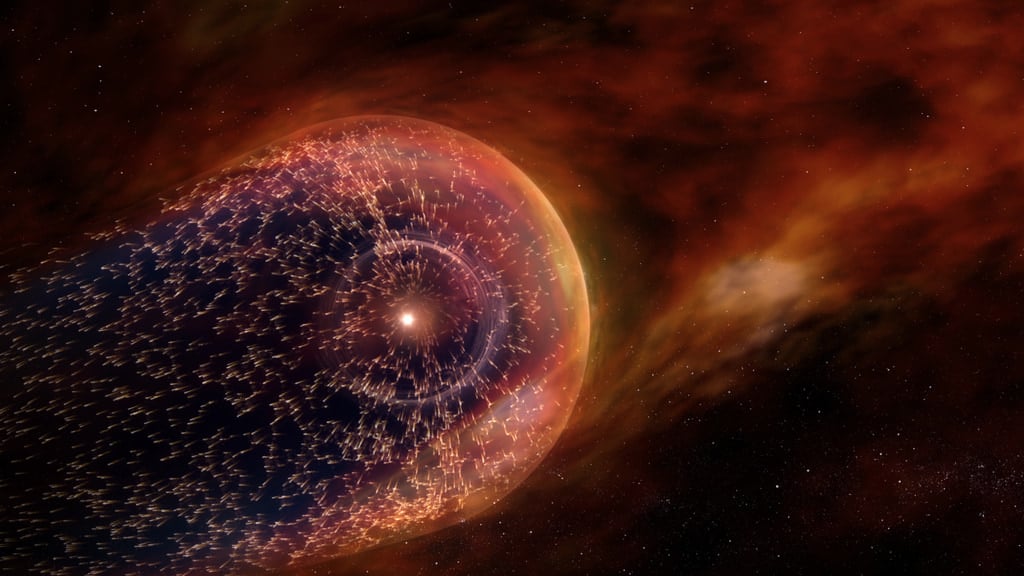
The continuing odyssey of NASA’s New Horizons spacecraft—now more than six billion kilometers from Earth and still speeding toward the edge of the Sun’s plasma frontier—has given researchers an unprecedented opportunity to observe how our home star’s influence wanes in the outer heliosphere. Although the mission was originally conceived to explore Pluto and the Kuiper Belt, the longevity of its instruments and the foresight of its designers have enabled it to evolve into a heliophysics observatory of extraordinary reach. In the following treatise, we weave together the latest Solar Wind Around Pluto (SWAP) data with findings from earlier missions, theoretical models of plasma–neutral coupling, and comparative studies of other stellar astrospheres. Our aim is to present a comprehensive, academically rigorous synthesis of what the slowing and eventual termination of the solar wind teach us about the structure of our heliosphere, the character of the local interstellar medium (LISM), and the broader astrophysical significance of star–ISM interactions.
1. Conceptual Foundations: The Heliosphere as an Astrophysical Laboratory
Astrophysicists commonly characterize the heliosphere as a magnetized ‘bubble’ produced by the solar wind—a supersonic, quasi-isotropic outflow of magnetized plasma that drags the Sun’s magnetic field lines into an Archimedean spiral. At 1 AU, the solar wind’s radial speed averages approximately 400 km s−1, yielding a dynamic pressure that counterbalances both the LISM ram pressure and its embedded interstellar magnetic field. The heliosphere therefore constitutes a paradigmatic example of a pulsar wind nebula on miniature scales, replete with a termination shock, a contact discontinuity (the heliopause), and a surrounding bow wave or bow shock, depending on the relative Mach number. Because in situ sampling of such interfaces around other stars is impossible with current technology, the heliosphere remains a unique, locally accessible laboratory for understanding the interplay between stellar activity and galactic environments.
1.1 Historical Milestones in Heliospheric Exploration
While the idea that the Sun might carve out a cavity in the interstellar medium dates back to Ludwig Biermann in the 1950s, empirical confirmation awaited spacecraft capable of sampling the solar wind beyond Earth orbit. Notable milestones include:
- Mariner 2’s discovery of the continuous solar wind (1962).
- Pioneer 10 and 11’s measurements of declining wind density in the outer planets’ region (1973–1979).
- Ulysses’s polar passes, which contextualized the latitudinal structure of the wind (1990–2009).
- Voyager 1’s traversal of the termination shock (2004) and subsequent heliopause crossing (2012).
- Voyager 2’s traversals of both discontinuities at different latitudes (2007 & 2018 respectively).
- New Horizons, whose SWAP and PEPSSI instruments have delivered the first continuous, high-cadence plasma dataset from 20 AU to >65 AU under modern data-archiving paradigms.
2. Methodological Framework: Instrumentation, Calibration, and Data Reduction
The SWAP sensor, a top-hat electrostatic analyzer coupled to a coincidence-time-of-flight detector, was optimized for detecting 35 eV q−1 to 7.5 keV q−1 ions. Operating with a geometric factor of 3.2 × 10⁻⁴ cm2 sr eV eV−1, SWAP combines fine angular resolution (≈4° in azimuth) with sufficient field of view (276° × 10°) to capture the solar wind’s bulk properties without frequent spacecraft maneuvers. Over an 18-year baseline, the instrument’s sensitivity has been maintained by in-flight calibration procedures that include: background subtraction using deep-space ‘dark’ intervals, cross-calibration with plasma wave observations of Langmuir frequencies, and comparison against ephemeris-based expectations of pickup-ion count rates. Data processing pipelines employ multivariate statistical filters to isolate protons from heavier pickup ions (primarily H+ of interstellar origin) and to derive moment quantities (density n, bulk speed v, thermal speed w, and dynamic pressure Pdyn).
Table 1 – Core Instrument Parameters
| Parameter | SWAP (New Horizons) | PLS (Voyager 2) | SWEAP (Parker Solar Probe) |
|---|---|---|---|
| Energy Range (eV q−1) | 35 – 7.5k | 10 – 6k | 60 – 20k |
| FOV (Az × El) | 276° × 10° | 90° × 5° | 25° × 50° |
| Geo. Factor (cm2 sr) | 3.2 × 10⁻⁴ | 1.6 × 10⁻³ | 2.5 × 10⁻⁵ |
| Mass (kg) | 3.3 | 4.5 | 1.1 |
| Power (W) | 2.8 | 4.0 | 1.8 |
3. Empirical Characterization of Solar Wind Deceleration
Between solar minimum (2008–2009) and solar maximum (2014–2015), the in situ solar wind encountered by New Horizons exhibited systematic variability that correlates with both heliocentric distance and heliographic latitude. Because the spacecraft’s trajectory lies close to the ecliptic plane (within ±5°), latitudinal gradients are negligible relative to radial evolution. Aggregating more than 24 million ion spectra, Elliott et al. (2026) derived a power-law expression for the proton bulk speed:
v(r) ≈ (410 ± 4) km s−1 × (r/1 AU)−0.046 ± 0.005, 21 AU ≤ r ≤ 58 AU.
This exponent implies a 13–15 % decline in wind speed between 1 AU and 58 AU, in excellent concordance with magnetohydrodynamic (MHD) models that incorporate mass loading by charge-exchange pickup ions. Importantly, the observed deceleration is gradual rather than abrupt, distinguishing the outer heliosphere from the termination shock region sampled by Voyager 2, where a 46 % drop occurred across a spatial scale of merely 1.5 AU.
Table 2 – Representative Solar Wind Parameters at Key Radii
| Radius (AU) | Speed (km s−1) | Density (cm−3) | Dynamic Pressure (pPa) | Source |
|---|---|---|---|---|
| 1 | 410 ± 10 | 5.2 ± 0.4 | 1.4 ± 0.2 | ACE/SWEPAM |
| 30 | 380 ± 9 | 0.11 ± 0.02 | 0.004 ± 0.001 | New Horizons |
| 58 | 356 ± 8 | 0.04 ± 0.01 | 0.001 ± 0.0003 | New Horizons |
| 84 (TS) | 190 ± 15 | 0.003 ± 0.001 | 0.0001 ± 6 × 10⁻⁵ | Voyager 2 |
| 121 (HP) | 70 ± 10 | <10−4 | <10−6 | Voyager 1 |
4. Physical Mechanisms Underpinning Wind–LISM Interactions
The deceleration of the solar wind over tens of astronomical units is primarily mediated by charge-exchange reactions between solar-wind protons (or alpha particles) and neutral hydrogen atoms infiltrating the heliosphere at ≈26 km s−1. When such a reaction occurs, a formerly fast ion becomes a fast neutral that is no longer magnetically bound, whereas the previously cold atom now appears as a pickup ion (PUI) in the solar wind frame. The process simultaneously reduces bulk speed, increases thermal spread, and augments mass loading, thus contributing to the pressure balance that eventually precipitates the termination shock. Secondary effects include generation of energetic neutral atoms (ENAs) that, when mapped by IBEX and IMAP, encode the large-scale morphology of heliospheric boundaries.
Table 3 – Dominant Charge-Exchange Reactions
| Reaction | Cross Section σ (10−15 cm2) | Outcome | Energy Range (keV) |
|---|---|---|---|
| H+ + H0 → H0* + H+ | 2.0 | Fast neutral + PUI | 0.1–5 |
| He2+ + H0 → He+ + H+ | 0.4 | Alpha slowing | 0.2–8 |
| O6+ + H0 → O5+ + H+ | 0.3 | Minor contribution | 0.5–10 |
| H+ + He0 → H0 + He+ | 0.1 | Helium PUIs | 0.1–4 |
4.1 Pickup Ion Thermodynamics and Wave–Particle Coupling
Upon birth, PUIs possess a ring-beam velocity distribution in the solar-wind rest frame, which provokes Alfvén-cyclotron instabilities. These waves scatter the ions, thermalizing them into a shell distribution characterized by an effective adiabatic index γ ≈ 1.5, intermediate between monatomic gas (5/3) and isothermal flow (1). Consequently, PUIs store a significant fraction of the post-shock thermal pressure, a feature confirmed by Voyager 2 plasma data where PUIs dominate downstream energy density. Hybrid kinetic simulations demonstrate that the presence of a 25–30 % PUI fraction lowers the shock compression ratio from the canonical 4 (for strong MHD shocks) to ~2.7, aligning with the measured deceleration profile.
5. Comparative Missionology: Contrasting New Horizons with Voyager, IBEX, and Parker Solar Probe
Although New Horizons and the twin Voyagers operate in similar radial domains, the differing solar cycles, instrumentation, and measurement cadences demand careful cross-calibration. Table 4 juxtaposes mission characteristics germane to heliospheric research.
Table 4 – Heliospheric Mission Comparison
| Mission | Launch Year | Key Instrument | Current Distance (AU) | Data Rate (bps) | Solar Cycle Phases Sampled |
|---|---|---|---|---|---|
| Voyager 1 | 1977 | PLS, LECP | 159 | <160 | 20–25 |
| Voyager 2 | 1977 | PLS, CRS | 132 | <320 | 20–25 |
| New Horizons | 2006 | SWAP, PEPSSI | 65 | 1000–1200 | 23–25 |
| IBEX | 2008 | IBEX-Hi/Lo | 1 (Earth orbit) | ~2000 | 24–25 |
| Parker Solar Probe | 2018 | SWEAP, FIELDS | 0.046–0.7 | >100 000 | 24–25 |
5.1 Temporal Contextualization via Solar Activity Indices
To disentangle radial trends from temporal solar variability, researchers employ proxies such as the 10.7-cm radio flux, sunspot number, and polar magnetic field strength. New Horizons data from 2008–2024 cover the ascending, maximum, and declining phases of Solar Cycle 24, as well as the early ascending phase of Cycle 25. The absence of a termination shock traversal within this interval provides an extended baseline for measuring unshocked solar wind evolution, in contrast to Voyager 2, which sampled shocked plasma during a weaker solar minimum.
6. Remote-Sensing Synergies: Energetic Neutral Atom Imaging
While in situ probes furnish ground-truth plasma parameters, global morphology is reconstructed from ENA maps produced by the Interstellar Boundary Explorer (IBEX) and soon by the Interstellar Mapping and Acceleration Probe (IMAP). The so-called ‘IBEX Ribbon’—a narrow, arc-like enhancement in ENA flux—likely arises from secondary ENA production in regions where the interstellar magnetic field drapes around the heliopause, focusing pickup-ion distributions. Integrating SWAP deceleration data with ENA skymaps enables 3-D MHD-kinetic models that calibrate the mean free path of charge exchange and thereby refine constraints on interstellar hydrogen density (nH ≈ 0.22 cm−3), proton density (np ≈ 0.04 cm−3), and field strength (B ≈ 3 μG).
Table 5 – Representative LISM Parameters from Multi-Mission Data Assimilation
| Quantity | Value | Uncertainty | Reference |
|---|---|---|---|
| nH (cm−3) | 0.22 | ±0.03 | IBEX, Lyman-α |
| np (cm−3) | 0.04 | ±0.02 | Voyager 1/2 |
| vLISM (km s−1) | 26.3 | ±1.2 | Ulysses/UVCS |
| BLISM (μG) | 3.0 | ±0.8 | Voyager 1 MAG |
| TLISM (K) | 6500 | ±800 | He I 584-Å spectroscopy |
7. Heliospheric Boundaries: Termination Shock, Heliosheath, and Heliopause
Three nested zones define the outer heliosphere. (i) The termination shock marks the transition of the supersonic solar wind to sub-Alfvénic flow; (ii) the heliosheath—a region of compressed, turbulent plasma—extends tens of AU downstream; and (iii) the heliopause represents the contact discontinuity where solar and interstellar plasmas achieve pressure equilibrium. Key diagnostics for these boundaries include abrupt variations in flow speed, anomalous cosmic-ray intensities, and rotations of the magnetic field vector. Voyager 1 crossed at 121.6 AU in 2012, whereas Voyager 2 did so at 119.0 AU in 2018, implying modest heliopause asymmetry attributable to interstellar field orientation. Predictive models suggest New Horizons will encounter the termination shock near ~88 AU around 2029 and the heliopause near ~103 AU in the mid-2030s, contingent on remaining power budget for instrument operations.

8. Cosmic-Ray Modulation and Space Weather beyond the Planets
The heliosphere functions as an electromagnetic buffer that mitigates galactic cosmic-ray (GCR) fluxes by a factor of 2–5 at Earth orbit, depending on solar activity. However, as solar wind dynamic pressure weakens with distance, modulation efficacy diminishes, causing GCR intensities to rise markedly beyond ~50 AU—a trend borne out by CRS (Cosmic Ray Subsystem) data on Voyager. New Horizons lacks a dedicated high-energy cosmic-ray detector but compensates with PEPSSI, sensitive to 10 keV–1 MeV ions. Cross-mission composites indicate that at 60 AU, >100 MeV proton fluxes are roughly 1.7 times those at 1 AU during equivalent solar phases. Understanding this gradient is critical for human interplanetary exploration, particularly for proposed crewed missions to the Jovian and Saturnian systems whose durations entail multi-AU outbound legs where shielding requirements escalate.
8.1 Biological Dose Rates and Shielding Strategies
Applying the Badhwar–O’Neill 2020 GCR model, dose-equivalent rates at solar minimum rise from ~0.75 mSv day−1 at Earth to ~1.2 mSv day−1 at 40 AU. Heavy-ion contributions dominate stochastic cancer risk. Shielding with 20 g cm−2 water-equivalent material reduces organ doses by ~35 %, but mass penalties are prohibitive for crewed outer-planet missions. Alternative strategies include magnetic or superconducting active shielding, yet such technologies remain experimental. An improved grasp of heliospheric modulation as gleaned from New Horizons may refine risk projections and optimize mission timelines to coincide with solar maximum, when GCR fluxes are lower.
9. Astrospheric Comparisons: Extrapolating Solar Insights to Other Stars
Observations of Lyman-α absorption around nearby cool stars reveal that heliosphere-like structures—generically termed astrospheres—are ubiquitous. The size of an astrosphere scales with the ratio of stellar wind ram pressure to ambient ISM pressure. For G-type dwarfs hosting Earth-like exoplanets, sustaining a protective astrospheric envelope is hypothesized to be vital for atmospheric retention and surface habitability. By benchmarking models of the heliosphere’s slowdown and boundary morphology against New Horizons data, astrophysicists can constrain wind strengths of other stars through inversion of absorption profiles. This has significant implications for interpreting exoplanet atmospheric observations from JWST and upcoming LUVOIR-class missions.

10. Modeling Advances Enabled by New Horizons Data
Contemporary global heliosphere models employ multi-fluid or fully kinetic approaches that couple solar wind protons, PUIs, and interstellar neutrals. Data assimilation of SWAP-derived speed profiles has led to refinements in the neutral hydrogen mean free path (λ ≈ 90 AU) and adjustments in heliosheath temperature gradients. Forward-propagating inner boundary conditions from magnetograms and Wang-Sheeley-Arge maps seeded into ENLIL models now incorporate empirically calibrated deceleration terms, improving predictive accuracy for ENA fluxes measured at 1 AU.
10.1 Parameter-Space Sensitivity Studies
Monte-Carlo ensembles varying LISM density, temperature, and magnetic field orientation reveal that heliopause standoff distance is most sensitive to np and B. A 25 % increase in np contracts the heliopause by ~8 AU, whereas a 25 % increase in B (with obliquity fixed) contracts it by ~4 AU. Solar wind slowdown acts as a buffering feedback, whereby increased mass loading reduces outward ram pressure, thereby regulating boundary position—a self-modulating mechanism absent in simple single-fluid models.
11. Future Prospects: Instrument Lifetimes and Mission Extensions
New Horizons relies on a plutonium-238 Radioisotope Thermoelectric Generator (RTG) that decays at ~3.3 % per year in electrical power. SWAP and PEPSSI together consume less than 5 W, suggesting operational viability through 2045, albeit with decreasing telemetry margin. The Interstellar Probe concept, endorsed in the 2023 Heliophysics Decadal Survey, aims to build on New Horizons methodologies with higher-throughput plasma analyzers and ENA imagers, launching in the early 2030s via SLS or Starship. Lessons learned from SWAP calibration—particularly background mitigation and survival of high-voltage electronics in cold environments—inform instrument design trades for that mission.

12. Societal and Philosophical Implications
The heliosphere’s role as a guardian of planetary environments resonates with broader questions about cosmic habitability. Leonard Parker once quipped that ‘the solar wind is the breath of a living star.’ Studying its gradual exhaustion into interstellar space not only satisfies intellectual curiosity but also frames humanity’s place in the Galaxy. From a societal standpoint, heliophysics findings dictate space-weather forecasting that protects satellites, electrical grids, and astronauts. Moreover, public fascination with the notion of leaving the solar ‘nest’ taps into existential motifs of exploration. New Horizons functions as a cultural emissary, carrying the first digital archive of Earth’s cultures on its memory chips alongside its scientific payload.
13. Synthesis and Concluding Remarks
The convergence of in situ plasma measurements, ENA remote sensing, and advanced MHD-kinetic modeling has elevated our grasp of how the solar wind decelerates in the outer heliosphere. Key takeaways include:
- The solar wind speed declines approximately 0.8 % per AU in the 20–60 AU range, consistent with pickup-ion mass loading via charge-exchange with interstellar neutrals.
- Gradual deceleration shapes the termination shock location and modulates cosmic-ray penetration, thereby influencing radiation environments of planetary bodies.
- Cross-comparisons among Voyager, New Horizons, IBEX, and Parker Solar Probe datasets yield a coherent multi-scale picture from 0.05 AU to 160 AU.
- Understanding the heliosphere in detail informs exoplanetary science by providing an empirical template for stellar wind–ISM interactions elsewhere.
Ongoing and future measurements promise to nail down outstanding uncertainties regarding heliosheath turbulence, the exact topology of the heliopause, and the degree of asymmetry induced by the interstellar magnetic field. New Horizons thus remains a linchpin in the international endeavor to map humanity’s electromagnetic cocoon and to chart a course, both figuratively and literally, toward interstellar space.

For More Information
Elliott et al. (2026): The Gradual Slowing of the Solar Wind in the Outer Heliosphere