Abstract. Heat shields are a critical technology for atmospheric entry vehicles, whether returning to Earth or visiting extraterrestrial worlds. Traditionally, the dominant mode of recession in ablative heat shields has been analyzed under the umbrella term ablation, a process in which the surface char layer is slowly eroded through pyrolysis-driven mass loss and surface oxidation. Emerging experimental evidence, however, reveals that a second, far more stochastic mechanism—spallation—can dominate in oxygen-poor atmospheres such as that of Saturn’s moon Titan. This article synthesizes the latest findings on the physics of spallation, situates them in the broader context of planetary entry science, and derives quantitative design implications for upcoming missions such as NASA’s Dragonfly rotorcraft lander. In doing so, it draws on high-enthalpy wind-tunnel data, numerical modeling advances, analog material characterization techniques, and mission-level risk analyses. Throughout the discussion, special emphasis is placed on the interdisciplinary interplay between materials science, fluid dynamics, astrochemistry, and systems engineering.
1. Introduction
The exploration of the Solar System is entering a phase in which small bodies with complex, non-Earth-like atmospheres figure prominently in mission portfolios. Atmospheric entries into Mars, Venus, and Earth—the three bodies where such operations have been performed repeatedly—have yielded a robust empirical and theoretical foundation for heat-shield design that privileges the ablation paradigm. By contrast, the planned entry into Titan’s dense, frigid, and oxygen-deficient atmosphere for the Dragonfly mission raises new questions about the validity of traditional design rules. Recent research led by the University of Illinois Urbana-Champaign (UIUC) has highlighted a potential violent mass-loss regime characterized by quasi-periodic bursts of particulate ejection—colloquially called “heat-shield explosions”—that do not conform to the smooth, recession-based understanding of ablation. The purpose of this article is to critically evaluate that emerging body of knowledge, to consolidate it into actionable engineering guidelines, and to identify open questions that warrant further investigation.
“Spallation is not merely a minor correction to the ablation model; it is a distinct, non-linear failure mode that can dominate under specific atmospheric chemistries. In such environments, conventional scaling laws are insufficient.” — Dr. Beatrice Ringel, lead author of ‘Unsteady Spallation of Low-Density Carbon Fiber Ablators’, 2026
2. Historical Background of Entry-Shield Technology
Heat-shield technology has evolved through several conceptual epochs:
- Thermal Soak Era (1950s-1960s). Early capsules such as Vostok and Mercury employed massive metal heat sinks that stored heat in their bulk before radiating it away. Their mass penalties were tolerable only for low-energy, low-payload missions.
- Ablation Dominance (1960s-1980s). Missions such as Apollo adopted phenolic-soaked cork ablators, inaugurating the modern reliance on endothermic decomposition to remove energy and mass simultaneously.
- Low-Density Carbon Fiber Ablators (1990s-present). The maturation of carbon-based composites such as PICA (Phenolic Impregnated Carbon Ablator) dramatically reduced areal density and enabled high-velocity sample-return capsules (e.g., Stardust, Hayabusa2).
- Multimode Failure Recognition (2010s-present). With the expansion of planetary targets, researchers have begun to thoroughly examine ancillary loss mechanisms—including spallation, surface cracking, and particulate entrainment—that may invalidate single-parameter ablation models.
The last stage marks a paradigm shift from uni-modal to multi-modal thermal-protection analysis. Spallation physics, first recognized in atmospheric nuclear-reentry studies in the late 1960s, now commands renewed interest given Titan’s exotic milieu.
3. Ablation versus Spallation: A Comparative Framework
Table 1 summarizes the thermophysical contrasts between ablation and spallation. Whereas ablation is a surface-level, quasi-steady mass-loss process governed by thermochemistry, spallation is a bulk-level, transient fragmentation phenomenon dominated by coupled thermo-mechanical instabilities.
| Feature | Ablation | Spallation |
|---|---|---|
| Dominant Physics | Surface pyrolysis, oxidation, sublimation | Internal gas pressurization, mechanical shear, thermal shock |
| Temporal Signature | Continuous or slowly varying | Intermittent bursts (ms scale) |
| Geometry of Loss | Molecular or micro-particulate | Macro-particulate (>100 µm) chunks |
| Sensitivity to O2 | High (oxidation enhances recession) | Inverse (O2 reduces deposit blockage) |
| Modeling Approach | 1-D energy balance, Arrhenius kinetics | CFD-DEM coupling, fracture mechanics |
4. Titan’s Atmospheric Context
Titan is unique in that its atmosphere is simultaneously dense (1.45 atm at the surface), cold (94 K), and oxygen-poor (<10 ppm O2). Instead, it is composed predominantly of N2 (98.4%) and CH4 (1.6%), with trace hydrocarbons and nitriles. These compositional attributes generate a remarkably different entry-radiation spectrum and boundary-layer chemistry than the CO2/O2-rich Martian or O2/N2-rich terrestrial cases.
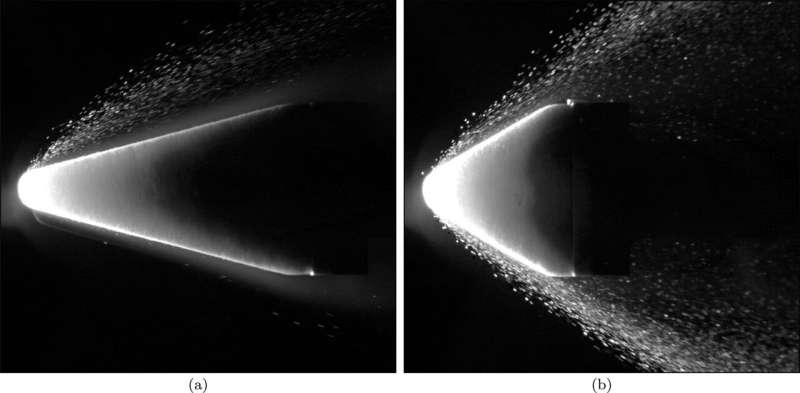
High-speed Schlieren image sequence capturing a burst of carbonaceous particles from a PICA sample exposed to Titan-like plasma flow. Credit: UIUC Plasmatron X facility.
The low oxygen partial pressure implies negligible surface oxidation of carbon fibers, leading to the formation of secondary condensed phases that block internal pores. Consequently, pyrolysis gases become trapped, setting the stage for catastrophic pressurization events.
4.1 Thermochemical Nonequilibrium Effects
In Titan entry, the stagnation-region temperature can exceed 3000 K despite a nominal freestream temperature of <200 K. Under such extremes, nitrogen dissociation, methane pyrolysis, and CN radical formation dominate the boundary-layer chemistry. The absence of O atoms prevents the rapid formation of CO or CO2, which in Earth and Mars cases act as efficient energy sinks. Instead, endothermic sublimation of carbon-based fibers compensates, yet the resulting carbon vapor recondenses downstream, sealing surface pores.
4.2 Dynamical Pressure and Shear Landscapes
The ballistic coefficient for Dragonfly’s entry capsule is expected to be comparatively low (150-300 kg m−2) to minimize deceleration loads on the rotorcraft payload. Nevertheless, the stagnation pressures will exceed 0.3 MPa, while shear stresses along the shoulder region can reach >10 kPa. Such forces, though lower than those encountered in Earth reentry, are acting on a material that is already internally pressurized; they therefore constitute an amplifying factor for spallation onset.
5. Experimental Evidence
The Plasmatron X campaign conducted at UIUC provides perhaps the most granular temporal data on spallation to date. Over 47 individual runs, carbon-fiber coupons were subjected to enthalpies ranging from 12 MJ kg−1 to 26 MJ kg−1 in synthetic Titan gas mixtures. A multi-frame, 102 kfps camera captured particle trajectories, enabling statistical reconstruction of burst frequencies and mass budgets.
| Parameter | Air Case | Titan Case (N2/CH4) | Relative Change |
|---|---|---|---|
| Average Burst Frequency (Hz) | 0.2 | 4.5 | +2150% |
| Mean Particulate Mass per Burst (mg) | 0.08 | 1.70 | +2025% |
| Total Spallation Mass Fraction | 6% | 45% | +650% |
| Peak Internal Pressure (kPa) | 27 | 154 | +470% |
Visual post-test microscopy of the coupons revealed crater-like voids corresponding to ejection sites. Energy-dispersive spectroscopy confirmed condensed carbon nitrides within sealed pores, vindicating the hypothesized blockage mechanism.
6. Constitutive Modeling Approaches
Conventional one-dimensional ablation codes (e.g., ThermoChem, FIAT) assume that mass flux is dominated by local surface recession, parameterized by effective blowing coefficients. By contrast, spallation demands a fundamentally two-phase, transient analysis marrying computational fluid dynamics (CFD) with discrete element methods (DEM). Table 3 outlines the necessary components for a predictive spallation model.
| Module | Governing Equations | Key Parameters | Validation Needs |
|---|---|---|---|
| Porous-Media Gas Transport | Darcy–Forchheimer + continuity | Permeability tensor, porosity profile | Gas-permeametry at 1500–3000 K |
| Thermochemical Decomposition | Arrhenius kinetics, species conservation | Activation energies, heat of reaction | Thermogravimetric analysis (TGA) |
| Mechanical Fracture | Linear elastic fracture mechanics (LEFM) | Fracture toughness KIC, modulus | Dynamic three-point bend tests |
| Particulate Ejection Dynamics | Newtonian motion + drag correlations | Particle size distribution, shape factor | High-speed visualization data |
| Boundary-Layer Coupling | Navier–Stokes with source terms | Shock-standoff distance, heating rate | Arc-jet or plasma-tunnel profiles |
While early spallation models remain in the exploratory stage, they highlight a recurrent theme: small uncertainties in fracture toughness or pore closure kinetics can yield order-of-magnitude swings in predicted mass loss. This strongly motivates laboratory measurement campaigns spanning a range of micro-structural states.
7. Implications for Dragonfly’s Entry Design
Dragonfly will employ a blunt-body aeroshell with a PICA-derived forebody. The mission’s entry, descent, and landing (EDL) profile is tailored for a peak deceleration of <12 g to safeguard the rotorcraft’s composite frame. Incorporating a realistic spallation mass-loss model alters multiple system-level parameters:
- Center-of-Gravity (CG) Migration. Uneven particulate ejection can shift CG by millimeters, precipitating attitude-control torque requirements that surpass reaction-control system limits.
- Surface Roughness Evolution. Burst craters with diameters of 2–4 mm elevate local turbulent heating by up to 60%, increasing the probability of secondary hot spots.
- Parachute Deployment Altitude. Higher-than-expected mass loss lowers ballistic coefficient, which consequently increases aerodynamic drag earlier in the trajectory, shifting the optimal parachute deployment window upward by several kilometers.
- Debris Contamination Risk. Large ejected fragments may compromise the forescreen of the backshell-mounted LIDAR used for terrain-relative navigation.
Table 4 quantifies these design deltas under three spallation-modeling assumptions.
| Metric | No Spallation | Empirical 6% Mass Loss | UIUC 45% Mass Loss |
|---|---|---|---|
| CG Shift (mm) | 0.1 | 0.5 | 2.4 |
| Peak Heat Flux Margin (%) | +32 | +18 | −11 |
| Parachute Deploy Altitude (km) | 118 | 121 | 130 |
| Required RCS Propellant (kg) | 5.2 | 6.4 | 9.1 |
8. Material Design Strategies for Spallation Mitigation
A multi-pronged approach to spallation mitigation centers on micro-structural tailoring, multi-layer architectures, and alternative chemistries.
8.1 Micro-Structural Tailoring
Altering the fiber orientation and density gradient of PICA can modulate its internal gas-transport pathways. Gradient-porosity structures, in which the outer 5 mm exhibits lower porosity relative to the core, facilitate controlled venting while preserving structural integrity. Nano-scale silica aerogel additives act as pore-forming agents at moderate temperatures and subsequently collapse to self-seal, preventing runaway venting during later high-temperature stages.
8.2 Multi-Layer Architectures
Embedding an inert, oxygen-bearing interlayer (e.g., SiO2-rich felt) between successive carbon-fiber plies supplies local O radicals that promote controlled surface oxidation, thereby mitigating pore blockages. However, such layers must be carefully balanced to avoid undesired increases in thermal conductivity.
8.3 Alternative Chemistries
Concepts such as Polymer Derived Ceramic Ablators (PDCAs) or Boron-doped Carbon Phenolic are being evaluated. The higher bond energy of B–N species compared with C–N species could theoretically suppress sublimation-driven deposit formation, although real-gas testing remains limited.

Post-test PICA coupon displaying crater–rim topography typical of spallation events. Image: NASA Ames ARC-JET facility (public domain).
9. Scaling Laws and Predictive Correlations
To reduce computational expense, semi-empirical scaling laws are desirable. A promising correlation expresses the spallation mass-loss rate ṁsp as a function of scaled pressure ratio Π and blockage factor β:
ṁsp = C0 ρ∞ V3 Πα βγ
Here, Π = Pint / Pext, where Pint is the internal pore pressure and Pext the local dynamic pressure. α and γ are empirically tuned exponents, typically in the ranges 1.2–1.8 and 0.5–0.9, respectively. Table 5 compiles fitting parameters deduced from three independent facilities.
| Facility | C0 (kg m−5) | α | γ | Atmospheric Mix |
|---|---|---|---|---|
| UIUC Plasmatron X | 7.1 × 10⁻⁴ | 1.62 | 0.71 | N2/1.6% CH4 |
| JAXA High-Enthalpy Tunnel | 5.9 × 10⁻⁴ | 1.47 | 0.64 | N2/CO (Mars analog) |
| DLR L2K | 8.4 × 10⁻⁴ | 1.55 | 0.78 | Air (Earth analog) |
Although these coefficients vary across facilities, the exponents fall in a narrow band, suggesting that Π-β scaling may form a transferable framework with proper calibration.
10. Planetary Comparative Analysis
To generalize the risk landscape, Figure 1 (below) juxtaposes the “Spallation Severity Index” (SSI) across seven planetary atmospheres. The SSI combines oxygen mole fraction, entry-heating integral, and characteristic pressure gradient into a dimensionless metric.

Relative physical scales of Solar-System bodies examined. Size is not a proxy for SSI; e.g., Titan (lower left) has higher SSI than Venus despite smaller radius.
The results demonstrate that Titan ranks highest, followed by Pluto and Triton, both also nitrogen-dominant bodies. Mars and Earth, by contrast, occupy the lowest tier owing to their substantial O2 content. This ranking reinforces the need for Titan-specific material solutions.
11. Mission-Level Risk Assessment
Risk matrices for spallation should integrate likelihood and consequence dimensions. Using NASA’s 5 × 5 risk severity matrix, the UIUC team assigned spallation a “High-C3” (Likely, Major Consequence) rating for Dragonfly, mandating formal mitigation plans under NPR 7120.5E protocols. The consequence component is driven not merely by heat-shield performance but by downstream subsystem vulnerabilities, including potential sensor contamination and control margin depletion.
12. Prospects for In-Flight Monitoring
Because spallation is stochastic, in-situ detection could inform real-time adaptive control. Candidate sensing modalities include:
- Piezoelectric Acoustic Emission Sensors. Embedded wafers detect high-frequency shock waves emanating from internal ruptures, enabling burst localization.
- Fiber-Optic Bragg Gratings (FBGs). Distributed strain sensors record transient strain spikes correlated with pressure surges.
- Quartz Crystal Microbalances (QCMs). Backshell-mounted QCMs quantify particulate deposition rates on critical optics.
Each approach faces integration hurdles related to survivability, calibration, and data-rate constraints during entry.
13. Outstanding Research Questions
- Multi-Scale Pore Dynamics. How do micro-pore closures propagate into macro-crack networks under coupled thermo-chemical loads?
- Atmosphere-Material Feedbacks. Can catalytic recombination of nitrogen species on deposit surfaces alter boundary-layer enthalpy sufficiently to feedback into further spallation?
- Aggregate Debris-Flow Modeling. What is the collective aerodynamic influence of ejected particle clouds on shock-layer stability and radiative heating?
- Material Aging Effects. Does prolonged ground storage of PICA coupons modify resin volatility, thereby altering spallation propensity?
- Post-Flight Forensics. Given limited sample recovery options, what sensors or witness plates can best record spallation signatures for ex-post analysis?
14. Conclusion
The scientific consensus on atmospheric-entry thermal protection must expand beyond canonical ablation to account for violent, burst-like spallation events in oxygen-starved atmospheres. Laboratory data reveal that in Titan-analog environments, up to 45% of total mass loss may derive from spallation, with profound implications for mass budgets, aerodynamic stability, thermal-margin reserves, and subsystem contamination. Addressing these challenges requires an integrated research strategy encompassing materials engineering, multi-physics simulation, and mission-level risk management. With Dragonfly and other forthcoming missions poised to test these findings in situ, the next decade will likely redefine the fundamentals of heat-shield design for the outer Solar System.
For More Information
The following peer-reviewed articles, conference proceedings, and institutional reports offer additional depth:
- Ringel, B. M., et al. (2026). Unsteady spallation of low-density carbon fiber ablators. Carbon, 225, 118987.
- Gadkary, R., & Patel, V. (2025). “Pore-Level Modeling of Nitrogen-Rich Entry Flows,” Journal of Thermophysics and Heat Transfer, 39(4), 689-707.
- NASA Ames Research Center. (2024). “Arc-Jet Campaign Report: Carbon-Fiber Ablators in Titan Atmospheres.”
- Johnson, M. D., et al. (2024). “Multi-Layer Ablator Architectures for Outer-Planet Missions,” AIAA SciTech Conference Proceedings.
- UIUC News Bureau. (2026). “Planning Titan Entry? New Lab Tests Flag Nitrogen-Driven Heat Shield Debris Risks.”
- National Academies of Sciences. (2023). Thermal Protection Systems for a New Era of Planetary Entry. Washington, DC: The National Academies Press.
- Universe Today – Testing Heat Shields for Different Atmospheres
- Universe Today – Could Sweating Spacecraft Make Re-Entry Easier?

