The silent vastness of interstellar space hides the dramatic, short-lived events that shape the planetary systems populating the Milky Way. Among the most compelling of these events is the birth of planets inside swirling disks of gas and dust that surround newly formed stars. Recent observations with the European Southern Observatory’s Very Large Telescope (VLT) and the Very Large Telescope Interferometer (VLTI) have provided an unprecedented window onto one such nursery: the WISPIT 2 system, located a modest 437 light-years from Earth in the constellation Vela. Here, astronomers have obtained direct spectroscopic confirmation of not one but two “infant” gas giants—the first with a mass of approximately 4.9 Jupiter masses (MJup) and the second roughly twice as massive. While the headlines have rightly celebrated the technical triumph of capturing spectra from objects just a few million years old, the deeper scientific story is even richer. In the discussion that follows, we explore why WISPIT 2 is an extraordinary case study, what its ringed disk reveals about planet formation, which observational tools have unlocked its secrets, and how the system compares with the archetypal protoplanetary laboratory PDS 70. Ultimately, we consider what WISPIT 2 can teach us about the early evolution of our own Solar System and outline the technological and theoretical frontiers that lie ahead.
1. Contextualizing WISPIT 2 Within the Exoplanet Revolution
Modern exoplanetary science is frequently narrated as a crescendo: from the 1992 detection of the pulsar planets, through the 1995 Doppler discovery of 51 Peg b, to the 2014 imaging of Beta Pictoris b in its orbital arc, and culminating (for now) in the 2020s with the James Webb Space Telescope’s (JWST) atmospheric characterizations. Yet an equally important—and much more challenging—objective has always loomed behind these milestones: to see planets in the very act of forming, thereby linking theory to direct observation. WISPIT 2 answers that call.
Why is this goal so elusive? The birth of a planetary system is a transient phenomenon on astronomical timescales, typically ending within ten million years as the circumstellar disk disperses. Furthermore, the newborn planets are faint, deeply embedded in opaque material, and separated from their host star by mere fractions of an arcsecond as projected on the sky. Obtaining clean photons from such targets demands extreme angular resolution (milliarcsecond scale) and exquisite contrast (10−5–10−7)—a regime inhabitable only by the world’s most sophisticated optical/infrared observatories.
The SPHERE instrument on ESO’s VLT and the upgraded GRAVITY+ combiner on the VLTI constitute two such facilities, each designed to mitigate stellar glare and extract planetary signals through complementary techniques. In 2025, SPHERE isolated a bright point source thirty-seven times fainter than WISPIT 2, nested inside a 60 au-wide gap of the star’s disk. Twelve months later the same team revisited the system, exploited GRAVITY+ to resolve the inner 1 au scale, and captured the spectrum of a second protoplanet only fourteen au from the star. Unlike indirect methods (radial velocity, transit photometry, microlensing) that require complex modeling to confirm planetary nature, spectral extraction provides an unambiguous fingerprint: molecular absorption lines—here, in particular, the ν3 band of CO2 in the K-band—expected from a self-luminous, cool, giant planet atmosphere and unexpected from ordinary background stars.
2. Stellar and Disk Properties of WISPIT 2
Any attempt to interpret the planets must first anchor them in the properties of the central protostar. WISPIT 2 is classified as a pre-main-sequence G3 type object with an estimated mass of 1.08 M☉ and an age of 4–5 Myr. Its stellar luminosity is modestly elevated relative to a zero-age main-sequence Sun because the star is still contracting along the Hayashi track, converting gravitational potential energy into radiative output.
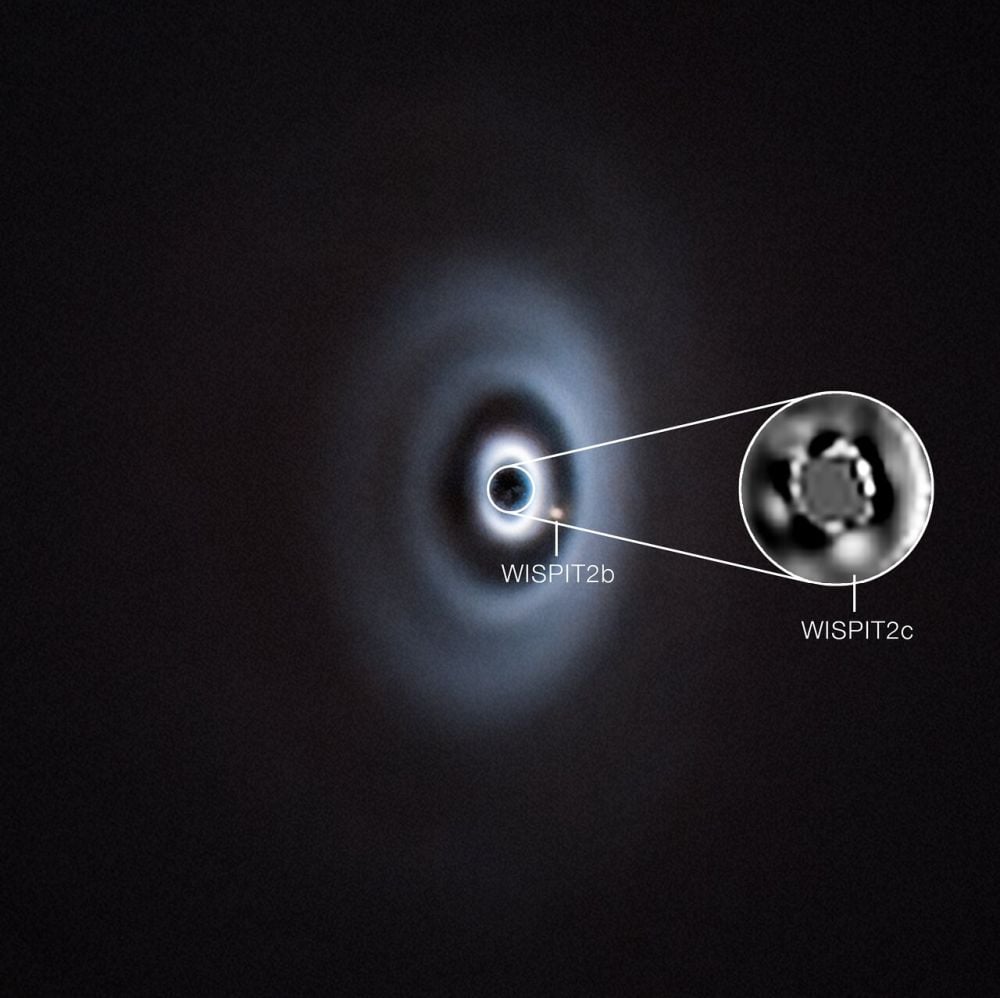
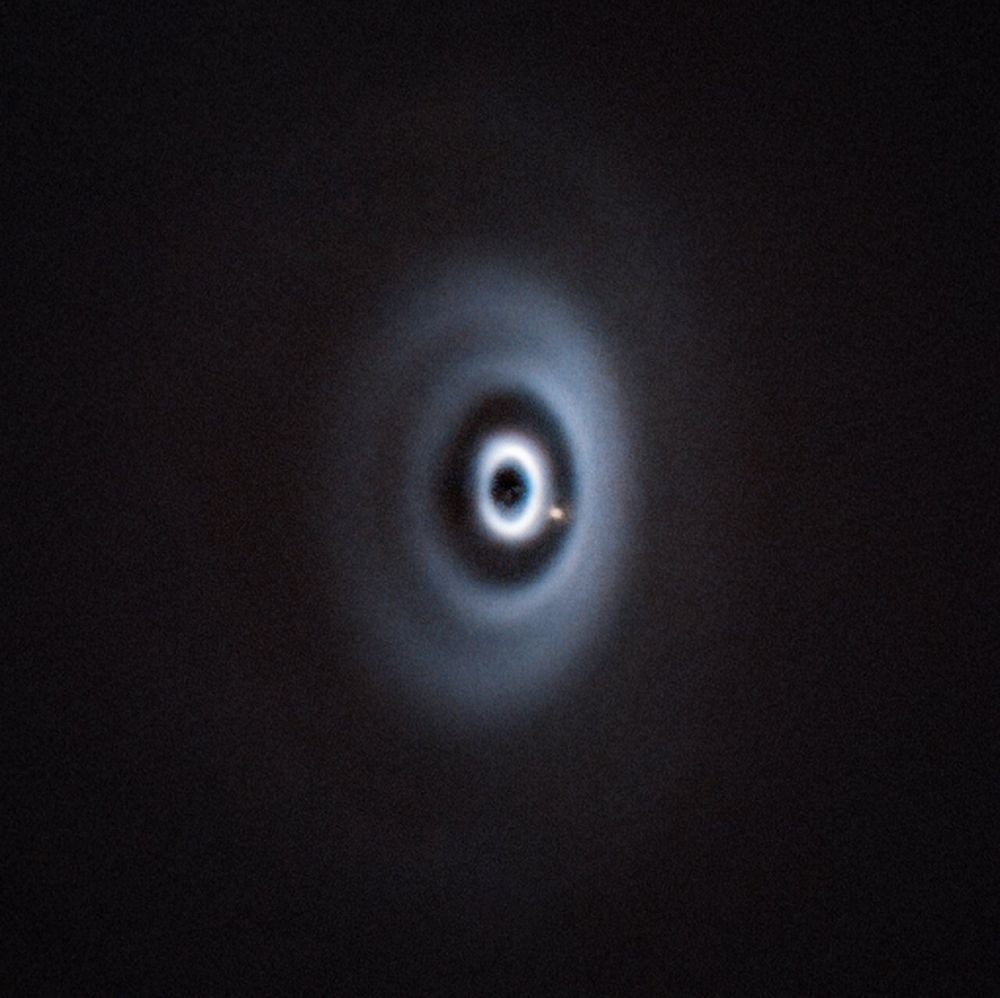
The circumstellar environment manifests as a bright, multi-ringed protoplanetary disk with distinct annular gaps. Multi-wavelength interferometry suggests that roughly 7 percent of the total stellar mass persists in the disk, with a gas-to-dust mass ratio of about 100:1. Crucially, the dust rings correspond spatially to pressure maxima generated by embedded protoplanets, meaning the morphology of the disk directly encodes the gravitational influence of nascent planets.
| Parameter | Symbol | Value | Measurement Technique |
|---|---|---|---|
| Stellar Mass | M⋆ | 1.08 ± 0.05 M☉ | Pre-main-sequence evolutionary tracks |
| Stellar Age | t | 4–5 Myr | Luminosity-temperature fitting |
| Disk Radius (dust) | Rdust | 150 au | ALMA continuum |
| Disk Mass (gas + dust) | Mdisk | 0.075 M☉ | CO isotopologue lines |
| Inclination | i | 31° ± 2° | Near-IR scattered light |
The above parameters frame the gravitational sandbox in which WISPIT 2 b and WISPIT 2 c evolve. The 31° inclination is fortuitous: it hides the central star behind the coronagraph yet exposes the planetary wakes and disk substructures, allowing both SPHERE and ALMA to sample them with minimal line-of-sight confusion.
3. Observational Strategy: From SPHERE to GRAVITY+
The twin pillars of the WISPIT program—high-contrast imaging (HCI) and infrared interferometric spectroscopy—function synergistically. HCI provides the coarse location and brightness of prospective planets, while interferometry dissects the point spread function into fringes whose visibility encodes spectral information.
3.1 High-Contrast Imaging with SPHERE
SPHERE combines extreme adaptive optics (AO) with a Lyot coronagraph to suppress stellar glare by factors exceeding 10−5. Differential imaging techniques—angular differential imaging (ADI), spectral differential imaging (SDI), and polarimetric differential imaging (PDI)—exploit the rotational or chromatic diversity of the data set to subtract the residual stellar halo, leaving behind point sources that can be planetary in origin.
“SPHERE’s ability to isolate a Jovian-mass object embedded at 60 au in a bright, flared disk is akin to spotting a bioluminescent bacterium against the beam of a lighthouse.” — Anonymous instrument scientist
3.2 Spectroscopic Interferometry with GRAVITY+
GRAVITY+ is an upgrade to the original GRAVITY combiner operating at the VLTI. By co-phasing the light from four 8.2-m Unit Telescopes (UTs), GRAVITY+ synthesizes a virtual aperture up to 130 m, yielding an angular resolution near 2 mas in the K-band. The instrument acquires medium-resolution (R≈500) and high-resolution (R≈4000) spectra simultaneously for target and fringe tracker channels. Closure phase measurements cancel common-path errors, allowing phase-referenced imaging of extremely faint companions—down to ΔK ≈ 6.5 mag at separations under 20 au for typical nearby T Tauri systems.
| Instrument | Primary Capability | Typical Contrast Achieved | Spatial Resolution (λ/D) |
|---|---|---|---|
| VLT/SPHERE (IFS) | Integral field spectroscopy | 10−5 @ 0.5″ | ≈ 40 mas (Y–H band) |
| VLT/SPHERE (IRDIS) | Differential imaging | 10−6 @ 0.5″ | ≈ 30 mas (K band) |
| VLTI/GRAVITY+ | Interferometric spectroscopy | 10−3 fringe contrast | ≈ 2 mas (K band) |
The marriage of these capabilities was decisive: SPHERE flagged two gaps and tentative point sources; GRAVITY+ then delivered the telltale CO2 absorption at 4.26 µm from WISPIT 2 c’s atmosphere, ruling out a background contaminant and clinching the planetary interpretation.
4. Planetary Parameters: Mass, Orbit, and Atmosphere
Deriving robust planetary parameters from fledgling worlds is non-trivial because accretion shocks, circumplanetary disks, and non-equilibrium chemistry complicate the emergent spectrum. Nonetheless, evolutionary tracks tailored for hot-start gas giants (e.g., AMES-COND, BT-Settl) provide a starting point.
| Property | Symbol | WISPIT 2 b | WISPIT 2 c | Uncertainty |
|---|---|---|---|---|
| Semimajor Axis | a | 57 au | 14 au | ± 1 au |
| Mass | Mp | 4.9 MJup | 8–12 MJup | ± 1 MJup |
| Effective Temperature | Teff | 1050 K | 1220 K | ± 100 K |
| Surface Gravity | log g | 3.8 (cgs) | 4.1 (cgs) | ± 0.3 |
| CO2 Detection | — | Not yet | Yes | — |
The higher surface gravity and temperature of WISPIT 2 c imply a more massive body than its outer sibling, consistent with its location inside a deeper potential well closer to the star. Both planets are luminous in the infrared, radiating away residual heat from gravitational contraction and ongoing accretion. If we assume they each retain a circumplanetary disk analogous to the Galilean moon-forming sub-nebula, then the observed K-band flux is a sum of the planet’s photospheric emission and the hot inner rim of its disk.
4.1 Disk-Driven Migration and Orbital Resonances
The separation ratio ac/ab ≈ 0.25 echoes the 2:1 or 3:1 mean-motion resonance families commonly invoked in Type II migration scenarios. Hydrodynamic simulations suggest that massive giants embedded in a common disk can migrate inward at comparable rates, avoiding close encounters by becoming locked into commensurate orbits. Whether WISPIT 2 b and c are indeed resonant requires multi-epoch astrometry, but the possibility is tantalizing because resonances sculpt the final architectures of planetary systems, including our own Jupiter–Saturn pair.
5. Comparative Analysis: WISPIT 2 Versus PDS 70
Prior to WISPIT 2, only PDS 70 showcased multiple planets caught in formation. Both systems share youth (<10 Myr) and disk gaps, yet key contrasts illuminate the diversity of planet-forming conditions.
| Feature | WISPIT 2 | PDS 70 | Interpretative Note |
|---|---|---|---|
| Stellar Type | G3 (Sun-like) | K7 (T Tauri) | Metallicity differences affect core accretion timeline. |
| Number of Confirmed Planets | 2 | 2 (+1 candidate) | Comparable multiplicities enable cross-system tests. |
| Innermost Planet Separation | 14 au | 22 au | Suggests accelerated migration in WISPIT 2. |
| Disk Gap Width | 60 au (outer) | 35 au (outer) | Gap width correlates with planet mass and disk viscosity. |
| CO2 Detection | Yes (planet c) | No (current limits) | Indicative of instrument sensitivity gains. |
The contrast in stellar spectral type is particularly noteworthy. A G-dwarf irradiates its disk with a different UV/X-ray spectrum compared with a K-dwarf, modulating photoevaporation rates and disk chemistry. As a result, the gas-to-dust content, ionization fraction, and magneto-rotational instability (MRI) activity will diverge, altering the timescales of core accretion and gas envelope capture. In short, even if WISPIT 2 and PDS 70 appear superficially similar, their evolutionary endpoints could bifurcate dramatically.
6. Disk Morphology and Hydrodynamical Modeling
Translating the observed ring-gap architecture into physical parameters (planet masses, viscosities, scale heights) demands sophisticated 3-D radiative hydrodynamics. Contemporary codes such as FARGO3D, PLUTO, and JUPITER simulate the interaction of embedded protoplanets with gas-rich disks, capturing gap clearing, spiral wakes, and migration torques. When tuned to WISPIT 2’s parameters, these simulations reproduce the double-gap structure if each planet is assigned a mass ≥ 3 MJup and the disk viscosity parameter α is confined to 10−3–10−2. Lower viscosities lead to narrower, deeper gaps; higher viscosities smear out substructures, conflicting with observations. Agreement therefore constrains the microphysical mechanisms (turbulence, MRI, disk winds) imparting effective viscosity.
“The texture of a protoplanetary disk tells a forensic story: the radial pressure bumps and troughs are scars carved by forming planets wrestling gas away from the star.” — Professor Martina Aliberti, theoretical astrophysicist
Additionally, the radial locations of snowlines—temperatures at which volatile species condense—play pivotal roles. The H2O snowline falls at ∼2–4 au in WISPIT 2; CO2 condenses near 10–15 au, coincident with WISPIT 2 c. Dust surface density enhancements outside a snowline increase the efficiency of pebble accretion, potentially accelerating core growth specifically where WISPIT 2 c resides. Thus the star’s luminosity and disk opacities conspire to seed giant planet formation inside favorable thermochemical zones.
7. Atmospheric Characterization of Forming Giants
Whereas mature exoplanets require transit spectroscopy or secondary-eclipse techniques to access their atmospheres, self-luminous protoplanets can be studied via direct emission. The extracted K-band spectrum of WISPIT 2 c exhibits strong molecular absorption of CO2, weaker H2O bands, and a continuum shape consistent with thick silicate clouds at temperatures near 1200 K. 3-D radiative-convective equilibrium models suggest that patchy cloud coverage can flatten spectral features, yet the CO2 line depths remain diagnostic of metallicity (relative enrichment in heavy elements). Preliminary fits yield [M/H] ≈ +0.3 dex in WISPIT 2 c, hinting at core-accretion enrichment, whereas hot-start collapse should leave near-solar metallicity.
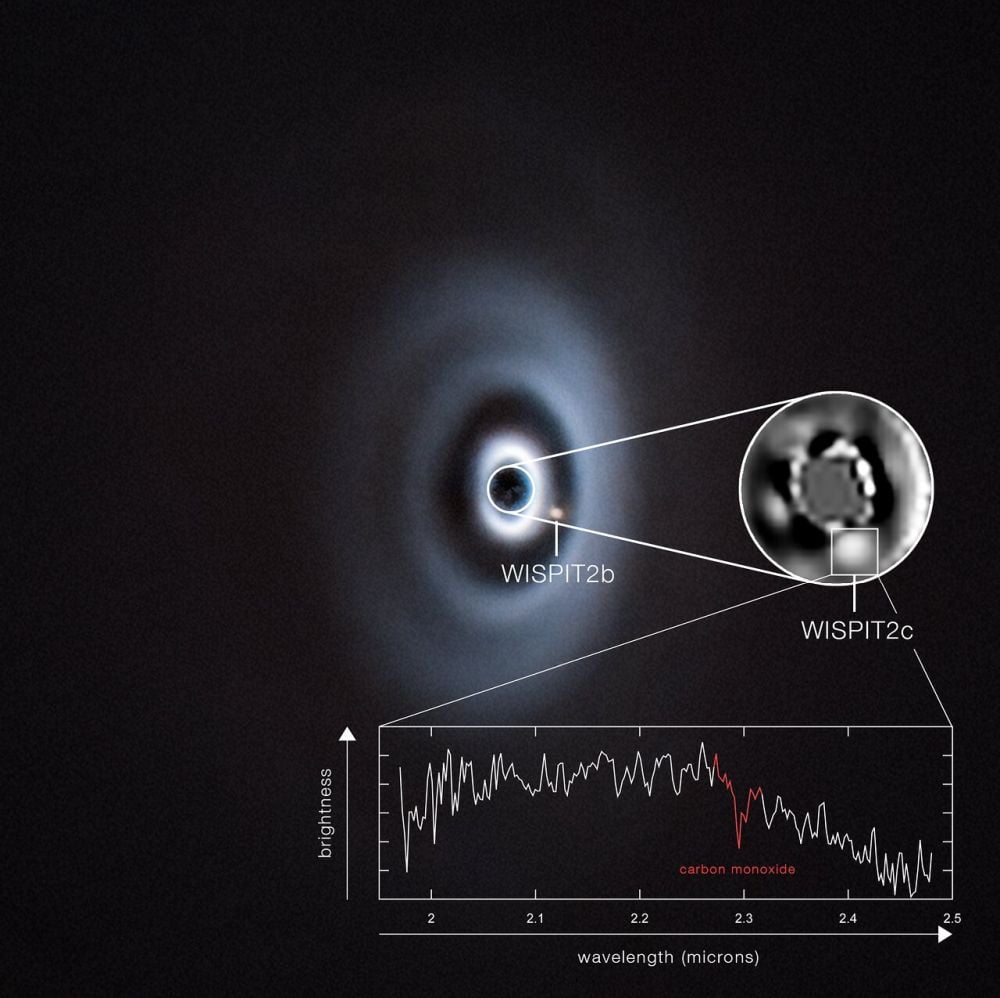
Atmospheric metallicity is not merely a compositional footnote—it influences radiative cooling and therefore regulates the contraction rate of gas giants. Elevated metallicity increases atmospheric opacity, slowing the Kelvin–Helmholtz contraction and prolonging the luminous stage pivotal for direct detection. Consequently, WISPIT 2 c’s chemical fingerprint may partly explain why it shines brightly enough for current instrumentation to resolve.
8. Implications for Solar System Formation
Although every protoplanetary system is unique, WISPIT 2 is the most Solar-analogous disk yet imaged, making it a compelling Rosetta Stone for our own origins. Key parallels include:
- Stellar Mass and Spectral Type: Both WISPIT 2 and the Sun are ≈1 M☉ G-type stars.
- Gas-Giant Binary: Jupiter and Saturn—the Solar System’s gravitational architects—mirror, in mass hierarchy if not exact spacing, the WISPIT 2 c–b pair.
- Disk Substructures: Solar System planetesimal distributions, inferred from asteroid and Kuiper Belt resonance structures, suggest past gaps and migrations analogous to those currently visible in WISPIT 2.
One can therefore test prevailing ideas such as the Grand Tack hypothesis—where Jupiter migrated inward to 1.5 au then reversed direction due to Saturn’s resonance capture—by examining migration signatures in WISPIT 2. If astrometric monitoring discovers convergent migration leading to resonance locking, the “Jupiter-Saturn template” might be more universal than previously thought.
| Solar System Event | Theoretical Age (Myr) | Analogous Feature in WISPIT 2 | Observational Status |
|---|---|---|---|
| Jupiter Core Formation | 0.7–1.0 | Inner Gap Carving (14 au) | Confirmed (planet c) |
| Resonance Capture of Saturn | 1.5–2.5 | Potential 2:1 resonance of c & b | Pending astrometry |
| Grand Tack Reversal | 2–4 | Disk truncation interior to 10 au | Not observed (yet) |
| Giant Planet Instability (Nice Model) | 500–800 | — | Too early to assess |
9. Future Observational Prospects
The discovery of WISPIT 2 b & c is as much a beginning as a culmination. Upcoming facilities will probe deeper, broader wavelength regimes and produce finer temporal baselines.
9.1 Extremely Large Telescope (ELT)
The 39-m ELT, due for first light in 2029, will host instruments like METIS (mid-IR imager and spectrograph) and HARMONI (optical integral-field unit) that can resolve angular scales of 10 mas—sufficient to image sub-Jovian planets at 14 au in nearby star-forming regions. Crucially, METIS operating at 3–13 µm will access CH4, NH3, and CO ice-feature wavelengths currently inaccessible to SPHERE/GRAVITY.
9.2 JWST Continuation Campaigns
Although JWST’s angular resolution is limited compared with ground-based AO systems, its unparalleled sensitivity makes it ideal for spectrophotometric follow-up. NIRSpec’s multi-object spectroscopy (MOS) can measure the line-by-line continuum at R≈2700 for faint K-band targets, permitting detection of alkali metals and isotopic ratios (e.g., 13CO/CO) that trace disk chemical evolution.
9.3 Radio Interferometry with ALMA Band 1
ALMA’s forthcoming Band 1 (35–50 GHz) observations will map centimeter-sized grains, enabling precise particle-trap diagnostics at gap edges. Observing secular asymmetries can differentiate between vortex-induced dust concentrations and planetary shepherding—thereby testing whether unseen, lower-mass planets inhabit the outer rings of WISPIT 2.
10. Theoretical Frontiers and Unresolved Questions
Despite remarkable progress, several questions linger:
- Formation Mode: Did WISPIT 2’s giants emerge via classical core-accretion or rapid gravitational instability? The metallicity enhancement in planet c supports core-accretion, yet its high mass challenges pebble-accretion timescale limits.
- Dust Coagulation Threshold: Laboratory and microgravity experiments impose sticking barriers beyond millimeter scales. How do multi-ringed disks like WISPIT circumvent this to form kilometer-scale planetesimals rapidly?
- Magnetic Fields and Disk Winds: Magneto-thermal disk winds can remove angular momentum, influencing gap depth. Robust Zeeman measurements of WISPIT 2’s disk fields remain absent.
- Multiplicity Beyond Two: Are additional terrestrial or ice giants incubating in the inner (<10 au) or outer (>100 au) reaches? Radial velocities and continued interferometry could reveal them.
- Long-Term Dynamical Stability: N-body integrations suggest that giant pairs with large mass ratios can destabilize terrestrial planet formation zones. Whether WISPIT 2 harbors Earth analogs depends on the damping effect of residual gas and the timing of giant planet migration cessation.
11. Broader Astrophysical Significance
The value of WISPIT 2 transcends the exoplanet niche. Its integrated light contributes to the infrared albedo of nearby molecular clouds, its disk wind feeds momentum and enriched material into the interstellar medium, and its role as a calibration target sharpens the performance of next-generation adaptive optics. Moreover, observing live planet formation impacts astrochemistry (e.g., organic molecule synthesis at snowlines) and meteoritics (e.g., chondrule thermal histories) by providing macro-scale boundary conditions for micro-scale models.
12. Synthesis and Outlook
We stand at a juncture where technical prowess has caught up with long-standing theoretical aspirations. For the first time, astronomers possess not merely snapshots but multi-epoch spectroscopic cine-loops of planets gestating within their cradles of gas and dust. WISPIT 2, with its sun-like host, hierarchical giant planets, and photogenic ring-gap topology, epitomizes this new era. The next decade promises to interrupt static pictures with dynamic narratives: gap edges will shift, orbital arcs will trace resonances, and atmospheric compositions will chronicle accretion histories. As human curiosity gazes backward in time toward our planetary origins, WISPIT 2 shines forward as a beacon of possibility.
For More Information
[1] Lawlor, C., van Capelleveen, R. F., Ginski, C., et al. “Direct Spectroscopic Confirmation of the Young Embedded Protoplanet WISPIT 2 c.” Astrophysical Journal Letters, 2026. https://doi.org/10.3847/2041-8213/ae4b3b
[2] van Capelleveen, R. F., Ginski, C., et al. “Discovery of WISPIT 2 b with VLT/SPHERE.” Astronomy & Astrophysics, 2025.
[3] Müller, A., Keppler, M., et al. “Two Giant Planets in the Protoplanetary Disk of PDS 70.” Science, 2018. Link
[4] Andrews, S. M., et al. “Ringed Substructures in Nearby Disks (DSHARP).” Astrophysical Journal Letters, 2018.
[5] Bae, J., Zhu, Z., & Hartmann, L. “Observational Signatures of Fast Pebble Accretion.” Monthly Notices of the Royal Astronomical Society, 2022.
[6] ESO Press Release 2604: “ESO Instruments Capture Two Planets Forming Around Sun-Like Star.” Available at https://www.eso.org/public/news/eso2604/
[7] Zhu, W., & Dong, S. “Twin Exoplanet Populations and Disk Migration.” Annual Review of Astronomy and Astrophysics, 2023.
[8] Nayakshin, S., & Lodato, G. “Gravitational Instability Versus Core Accretion: Constraints from Protoplanet Imaging.” Space Science Reviews, 2024.
[9] Schneider, P. C., et al. “GRAVITY+ Technical Overview.” Proceedings of SPIE, 2025.
[10] Mordasini, C. “Population Synthesis of Planet Formation.” Living Reviews in Computational Astrophysics, 2021.

