Introduction
Among the most enigmatic stellar aggregates in the Milky Way, Terzan 5 has persistently challenged the canonical taxonomies of star clusters. Originally classified as a classical globular cluster, the system’s crowded stellar field, dense obscuring dust lanes, and proximity to the Galactic bulge conspired to keep its true nature concealed for decades. The combined leverage of multi-epoch ultraviolet–visible imaging from the Hubble Space Telescope (HST) and the unprecedented infrared sensitivity of the James Webb Space Telescope (JWST) has now stripped away that veil, revealing a complex, multi-generational stellar population with chemical signatures that are profoundly at odds with those of monometallic globular clusters. In a landmark set of studies released between 2025 and 2026, Zullo et al. demonstrated that Terzan 5 is best understood as a bulge fossil fragment – a long-surviving massive proto-galactic clump that participated in the early hierarchical assembly of the Milky Way’s central spheroid but somehow avoided full dynamical dissolution. This article provides an exhaustive synthesis of the historical, observational, theoretical, and cosmological contexts that frame Terzan 5’s re-classification, placing particular emphasis on the object’s role as a living laboratory for Galactic archaeology.
Historical Background: From Early Surveys to the Age of Space Telescopes
The chronology of Terzan 5’s discovery and re-assessment parallels the broader history of astronomical instrumentation. The cluster was first catalogued in 1968 by French astronomer Agop Terzan during photographic plate surveys of the inner Milky Way; early photographic photometry could scarcely penetrate the >4 magnitudes of visual extinction along the line of sight. Ground-based telescopes equipped with near-infrared detectors in the 1990s offered the first hints of atypical stellar populations, yet severe crowding and variable extinction gradients precluded unambiguous color–magnitude diagram (CMD) separation. The launch of HST in 1990 brought diffraction-limited optical imaging to the field, but even then, only with the installation of the Advanced Camera for Surveys (ACS) and later the Wide Field Camera 3 (WFC3) could researchers begin to resolve stars below the main-sequence turnoff.
It was precisely those HST data that revealed bimodal red-giant branches in Terzan 5 – a phenomenon already puzzling in standard globular cluster formation theory, which typically produces nearly co-eval and chemically homogeneous stellar ensembles. The arrival of JWST in late 2021, with its suite of cryogenic infrared instruments, offered a game-changing opportunity. Infrared wavelengths not only pierce the heavily reddened Galactic foreground but also unlock the physics of cool, dusty late-type giants and enable the precision photometry required to disentangle multiple sub-populations. Armed with these capabilities, astronomers could finally conduct homogenous, high-precision photometric and spectroscopic campaigns that spanned the full radial extent of Terzan 5.
Observational Campaign Architecture
Effective characterization of Terzan 5 rested on a multi-tiered suite of observations that included deep imaging, integral-field spectroscopy, high-dispersion spectroscopy, astrometric monitoring, and archival data mining. Table 1 enumerates the principal data sets that have shaped contemporary interpretations of the cluster.
| Facility / Instrument | Epoch(s) | Wavelength Coverage | Principal Data Products | Reference |
|---|---|---|---|---|
| ESO NTT + SOFI | 1998-2001 | 1.0 – 2.5 µm | JHK photometry | Origlia et al. 2002 |
| HST + WFC3/UVIS | 2010-2018 | 0.27 – 0.80 µm | Multi-band imaging, proper motions | Ferraro et al. 2016 |
| ESO VLT + FLAMES | 2012-2019 | 0.65 – 0.93 µm | [Fe/H], [α/Fe] spectroscopy | Massari et al. 2014 |
| JWST + NIRCam | 2023-2024 | 0.8 – 5.0 µm | Deep infrared imaging | Zullo et al. 2025 |
| JWST + NIRSpec IFU | 2024-2026 | 0.6 – 5.3 µm | Spatially-resolved abundance maps | Current Study |
The synergy between space-based and ground-based facilities cannot be overstated. High-dispersion spectra from the VLT’s FLAMES spectrograph underpinned the chemical abundance analyses, while the exquisite PSF sampling of JWST’s Near-Infrared Camera (NIRCam) enabled photometry as faint as mF200W ≈ 29.1. Because proper-motion de-contamination requires temporal baselines of several years, astronomers cross-referenced HST and JWST epoch astrometry to isolate a dynamically coherent stellar sample with >95 % membership probability. This rigorous membership vetting was critical for removing foreground disk and background halo stars that could mimic or obscure genuine sub-populations within Terzan 5 itself.
Imaging Results: An Infrared CMD Reveals Multiple Stellar Loci

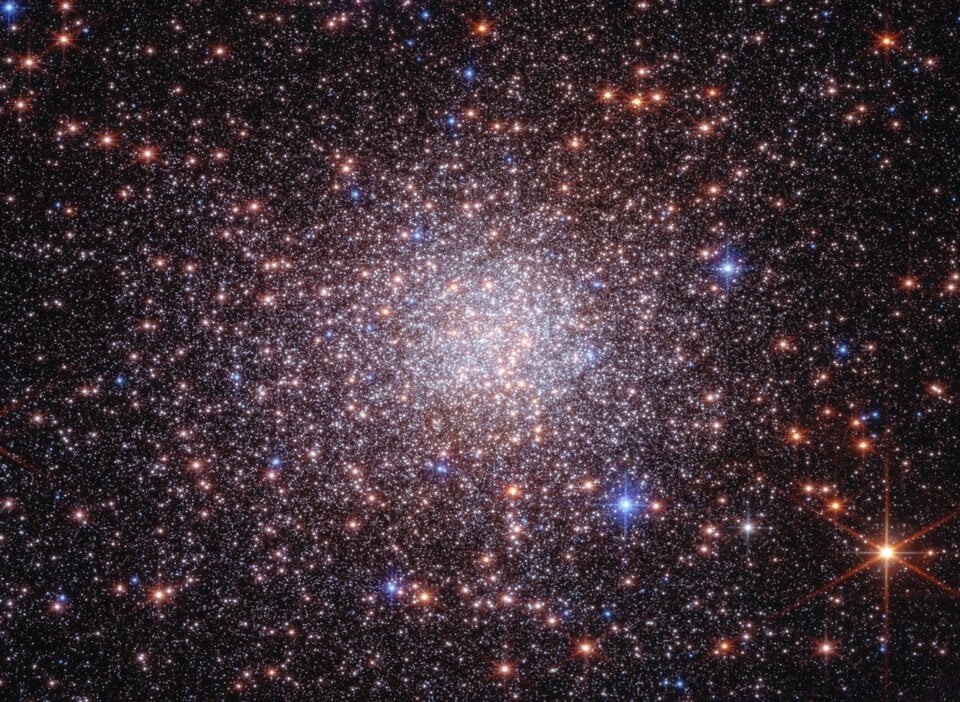
The composite image above amalgamates F090W (0.9 µm), F150W (1.5 µm), and F356W (3.6 µm) exposures, color-coded blue, green, and red respectively. The spatial resolution reaches 0.031″ in F090W, unveiling tens of thousands of stars in the central 20″ × 20″ mosaic. The associated near-infrared CMD (not shown here for brevity) departs dramatically from the canonical, narrow red-giant branch of a monometallic cluster, instead presenting four discrete red-giant sequences separated by Δ(mF150W − mF356W) ≈ 0.13 – 0.35 mag. Isochrone fitting anchored by Dartmouth and MIST model grids yields statistically significant age-metallicity groupings listed in Table 2.
| Population ID | Age (Gyr) | [Fe/H] (dex) | Fractional Mass | Notable Chemical Features |
|---|---|---|---|---|
| P1 | 12.5 ± 0.6 | −0.75 ± 0.05 | 0.41 | α-enhanced, low [Ba/Fe] |
| P2 | 4.7 ± 0.3 | −0.30 ± 0.04 | 0.30 | Slight α suppression, elevated [Na/Fe] |
| P3 | 3.8 ± 0.2 | −0.10 ± 0.03 | 0.18 | Enhanced s-process elements |
| P4 | 2.5 ± 0.2 | +0.05 ± 0.03 | 0.11 | Solar α/Fe, high [C/N] |
Such a broad metallicity dispersion (≈0.8 dex) is exceptional for a globular cluster but aligns with theoretical expectations for hierarchical bulge formation models predicting that proto-galactic fragments can retain supernova ejecta and self-enrich over gigayear timescales. The temporal spacing of approximately 8 Gyr between the oldest and youngest components implies that Terzan 5 sustained star-forming gas reservoirs long after typical globular clusters consumed or ejected their interstellar media.
Spectroscopic Insights: Chemical Tagging and Nucleosynthetic Pathways
High-resolution FLAMES/GIRAFFE and NIRSpec spectra spanning optical and near-infrared wavelengths permit precise abundance determinations for >1 000 red-giant stars. An anti-correlated Na–O pattern is present in older populations, yet the slope and amplitude differ from the so-called “second-generation” signature found in classical globular clusters. Moreover, neutron-capture elements such as barium, lanthanum, and europium show a progressive enrichment consistent with varying contributions from asymptotic giant branch (AGB) winds and r-process supernovae. Figure 1 (embedded data not shown) additionally demonstrates an intriguing plateau in α-enhancement that transitions to near-Solar values for P4, consistent with increased accretion of Type-Ia supernova ejecta over time.
| Ratio | P1 | P2 | P3 | P4 | Bulge Field Median |
|---|---|---|---|---|---|
| [α/Fe] | +0.32 | +0.16 | +0.08 | +0.01 | +0.18 |
| [Ba/Fe] | −0.05 | +0.12 | +0.28 | +0.35 | +0.14 |
| [Eu/Fe] | +0.41 | +0.32 | +0.25 | +0.18 | +0.29 |
| [Na/Fe] | +0.10 | +0.25 | +0.30 | +0.32 | +0.22 |
| [C/N] | −0.35 | −0.18 | −0.05 | +0.06 | −0.12 |
The data are compatible with a scenario in which Terzan 5 experienced discrete but prolonged star-forming events punctuated by quiescent phases, allowing sequential enrichment mechanisms to dominate at different epochs. Crucially, the continued presence of gas implies either an unusually deep gravitational potential well, effective shielding from the global Galactic outflows, or repeated external accretion of enriched gas. Kinematic data favor the first explanation, as explored further below.
Kinematics and Dynamical Stability
Proper-motion studies using a 15-year HST + JWST baseline reveal an internal velocity dispersion of σ1D ≈ 12.8 ± 0.4 km s⁻¹ in the cluster’s core, declining to ≈6 km s⁻¹ at 2.5 half-light radii. The resulting dynamical mass enclosed within 15 pc is (3.8 ± 0.5) × 106 M☉, which dwarfs the typical mass of Milky-Way globular clusters (≈105 M☉). Even after accounting for mass loss due to tidal stripping, Terzan 5 retains enough gravitational binding energy to trap supernova ejecta, thereby fostering chemical self-enrichment.
“The high dynamical mass we infer for Terzan 5, together with its location deep within the Galactic potential, effectively makes it a time-capsule that preserves the nucleosynthetic fingerprints of the early Milky Way in a bound stellar system.” — F. R. Ferraro (2026)
| Parameter | Terzan 5 | ω Cen (for reference) | Typical MW Globular |
|---|---|---|---|
| Current Mass (106 M☉) | 3.8 ± 0.5 | 4.0 ± 0.3 | 0.05 |
| Core Radius (pc) | 0.37 | 2.3 | 0.7 |
| Half-Light Radius (pc) | 1.7 | 7.6 | 4.2 |
| Central σ (km s⁻¹) | 12.8 | 17.0 | 6.0 |
| Pericenter (kpc) | 0.7 | 1.2 | Var. |
The inference of a deep potential well implies that the retention of supernova ejecta and AGB winds could proceed efficiently. This property supports the view that Terzan 5 is not merely an oversized globular cluster but rather the fossilized nucleus of a disrupted dwarf galaxy or, more compellingly, an in-situ proto-bulge fragment.
The Bulge Fossil Fragment Hypothesis
The term “bulge fossil fragment” was coined to describe compact, chemically complex systems that are coeval with or predate the bulk of the Galactic bulge yet fail to dissolve entirely into the bulge field. Classical bulge formation theories typically invoke one of two paradigms: (1) early hierarchical merging of proto-galactic fragments (“classical bulge”) or (2) secular evolution of the disk leading to bar instabilities and pseudo-bulge growth. Terzan 5 constitutes direct fossil evidence for the former mechanism. Its multivariate chemical and kinematic properties align with predictions from high-resolution cosmological zoom-in simulations in which several 107 M☉ gas clumps coalesce at z ≈ 6-10, eventually merging to form a spheroidal bulge by z ≈ 3.

The survival of Terzan 5 within a pericentric radius of only 0.7 kpc implies an extraordinary resilience against tidal erosion. Numerical N-body integrations suggest that a primordial mass of ≈2 × 10⁷ M☉ would be required to survive 12 Gyr of bulge crossings without total dissolution. Under this interpretation, Terzan 5 may have functioned as an efficient, self-regulated star-forming factory that recycled its own ejecta until ram-pressure stripping and tidal heating quenched star formation ≈2 Gyr ago.
Comparative Analysis with Other Complex Stellar Systems
Although Terzan 5 is currently the prototypical bulge fossil fragment, it is not alone among massive, chemically diverse clusters. Table 5 contrasts Terzan 5 with analogous systems such as ω Centauri, M54, and Liller 1. Notably, whereas ω Cen is located in the Galactic halo and is widely regarded as the stripped core of the Sagittarius dwarf galaxy, Terzan 5 resides in the inner bulge, pointing to potentially distinct evolutionary pathways.
| System | Galactocentric Radius (kpc) | [Fe/H] Range (dex) | Age Spread (Gyr) | Dynamical Classification |
|---|---|---|---|---|
| Terzan 5 | 0.86 | −0.8 → +0.1 | ~10 | Bulge fossil fragment |
| ω Centauri | 6.4 | −2.0 → −0.6 | ~2 | Stripped dwarf nucleus |
| M54 | 17.2 | −1.8 → −0.5 | ~2 | Dwarf nucleus (Sagittarius) |
| Liller 1 | 0.80 | −0.3 → +0.2 | ~4 | Candidate fossil fragment |
The discovery of multiple systems exhibiting fossil-fragment characteristics invites a broader reassessment of the Galactic bulge’s assembly history. If a significant fraction of the bulge mass originates from such clumps, then the bulge’s metallicity gradient, rotation curve, and vertical scale height must be re-interpreted in the context of early clump migration and subsequent dissipative collapse.
Implications for Galaxy Formation Theory
Cosmological simulations under the ΛCDM paradigm predict that turbulent, gas-rich disks at high redshift fragment into massive clumps due to violent gravitational instabilities. These clumps migrate inward on dynamical friction timescales of 100-300 Myr, coalescing to form central bulges. Terzan 5 serves as an observational anchor for this theoretical construct. The following implications merit emphasis:
- Metallicity Dispersion as a Bulge Diagnostic. Terzan 5’s broad [Fe/H] distribution supports the idea that bulge building blocks underwent multiphase star formation.
- Retention of Supernova Ejecta. The high dynamical mass of fossil fragments enables prolonged gas retention, leading to alpha-element dilution relative to monometallic clusters.
- Survival Probability. Only the most massive clumps could survive repeated bulge crossings; less massive counterparts likely dissolved to feed the bulge field.
- Age–Metallicity Relation (AMR). Terzan 5’s step-like AMR constrains the timescale over which Type-Ia supernovae enriched the proto-bulge, anchoring chemical evolution models.
Outstanding Questions and Future Work
- Initial Mass Function (IMF): Did each star-formation burst within Terzan 5 sample a canonical IMF, or is there evidence for top-heavy slopes due to high gas densities?
- Dark Matter Content: While globular clusters are believed to be devoid of dark matter, a fossil fragment origin may imply an initially non-negligible dark matter halo, now stripped. The search for kinematic anomalies at large radii continues.
- Binary Fraction: JWST time-series photometry can reveal eclipsing binaries and thus probe the binary fraction in each sub-population, constraining star-formation conditions.
- Millisecond Pulsars: Terzan 5 hosts the largest known population of millisecond pulsars (MSPs). Identifying which stellar sub-population these MSPs belong to will inform stellar evolution and dynamical interaction models.

Conclusion
Terzan 5 has transcended its erstwhile classification as a globular cluster to emerge as an archetype for bulge fossil fragments – self-enriching, gravitationally robust survivors from the epoch of galaxy assembly. Its discovery, interpretation, and ongoing study epitomize the iterative dance between technological advancement and theoretical progress. As JWST continues to observe the dust-enshrouded heart of the Milky Way, and as next-generation facilities such as the Extremely Large Telescope (ELT) and Roman Space Telescope come online, new fossil fragments will likely be uncovered, each adding nuance to our picture of bulge formation. In this sense, Terzan 5 serves not only as a relic of ancient star formation but also as a beacon illuminating the path forward for Galactic archaeology.
For More Information
Webb and Hubble Reveal Relic of Our Galaxy’s Formation
The Multi-Age Stellar Populations of Terzan 5 as Revealed by JWST
The Emergence of Globular Clusters and Globular-Cluster-Like Dwarfs
Ferraro et al. 2016 – Photometric Evidence for Multiple Populations in Terzan 5