Abstract
Mars has remained a focal point of astrobiological debate for more than a century, yet only within the last two decades have robotic emissaries obtained the spectroscopic, mineralogical, and contextual data sets necessary to evaluate the red planet’s habitability with true scientific rigor. NASA’s Perseverance rover, operating in Jezero Crater since February 2021, has delivered the most comprehensive geochemical survey of any extraterrestrial lake basin to date. This article synthesizes the latest peer-reviewed findings on complex organics retrieved from the Bright Angel fluvial deposits, explores the sedimentological framework that facilitated their preservation, and interrogates the broader implications for planetary science, prebiotic chemistry, and future sample-return architecture. By integrating stratigraphic observations, Raman spectroscopy, orbital imagery, terrestrial analog comparisons, and state-of-the-art taphonomic modeling, we advance a holistic narrative of how a 45-kilometer crater evolved from a hydrologically active freshwater lake into a diagenetically complex mineralogical archive of early Martian history. Our discussion deliberately situates the Jezero discoveries within the continuum of organic detections previously reported by Viking, Phoenix, Curiosity, and InSight, arguing that cumulative evidence now transcends mere possibility and edges ever closer to probability that Mars once hosted environments where life could emerge and persist.
1 Introduction: From Speculation to Spectra
The human fascination with Mars is as old as telescopic astronomy itself, weaving through the speculative canals of Giovanni Schiaparelli, the imaginative romances of H. G. Wells, and the scientifically informed hypotheses of Carl Sagan. Yet the turning point from romantic speculation to empirical scrutiny began in earnest with the 1965 Mariner 4 flyby, which exposed a cratered, seemingly sterile surface. Half a century later, a fleet of orbiters, landers, and rovers has revised that bleak portrait. Atmospheric isotopic ratios from MAVEN, recurring slope lineae monitored by MRO, and mineralogical surveys by MSL Curiosity collectively argue that early Mars possessed a denser atmosphere, flowing water, and energy gradients capable of sustaining biogeochemical cycles.
Within this evolving paradigm, Jezero Crater stands out as a geological exception that proves the rule. Remote-sensing data from the Mars Reconnaissance Orbiter (MRO) previously indicated hydrated carbonates, phyllosilicates, and morphologically distinct deltaic formations, suggesting that Jezero hosted a freshwater lake for at least 0.5–1 million years during the Noachian-Hesperian transition. Such longevity, even under martian conditions, would suffice for organics to accumulate, sequester, and mineralize.
The scientific community’s expectation of finding organics, however, remained couched in cautionary rhetoric. Organic synthesis can proceed abiotically via photolysis of atmospheric CO2, serpentinization of ultramafic rocks, or exogenous accretion of carbonaceous chondrites. Discriminating between biogenic and abiotic organics thus requires multi-instrument corroboration, stratigraphic context, and ultimately, laboratory-grade analyses only possible through Mars Sample Return (MSR). Until that audacious undertaking materializes, in-situ spectroscopy aboard Perseverance—chiefly the SHERLOC (SCANNING Habitable Environments with Raman & Luminescence for Organics & Chemicals) sensor—offers the most precise proxy for ground truth.
2 Geological Setting of Jezero Crater
Jezero Crater is positioned at 18.38° N, 77.58° E on the northwestern edge of the Isidis impact basin. Morphometric analyses indicate formation roughly 3.9 Ga, with lacustrine infill occurring between 3.8 and 3.6 Ga. Two primary inlets—the Nili Fossae and Mawry tributaries—delivered clastic sediments that built a classic Gilbert-type delta. Subsequent hydrological drawdown breached the northeast rim, carving an outflow valley that acted as a natural spillway.

Notably, orbital CRISM (Compact Reconnaissance Imaging Spectrometer for Mars) data reveal spatial heterogeneity in carbonate and smectite signatures across the deltaic lobe. These mineralogical patches form a roadmap for rover-based transects intent on maximizing organic detection probabilities. Carbonates, in particular, may act as geochemical archives, locking away molecular fossils in crystal lattices impervious to radiation-driven degradation.
2.1 Stratigraphic Subdivisions
After more than three Earth years of traverse, Perseverance has refined the stratigraphic subdivision of the crater floor and delta to at least seven mappable units, summarized below.
| Unit | Estimated Thickness (m) | Dominant Lithology | Notable Minerals | Astrobiological Relevance |
|---|---|---|---|---|
| Seítah | ≤40 | Coarse-grained igneous | Olivine, pyroxene | Potential hydrothermal alteration |
| Máaz | 15–25 | Feldspathic basalt | Plagioclase, magnetite | Redox gradients for chemolithoautotrophy |
| Mittivakat | 10–30 | Mudstone | Smectite, hematite | Fine-grained organics trap |
| Bright Angel | 5–12 | Fluvial sandstone | Carbonates, sulfates | Organics observed by SHERLOC |
| Caira | ≤8 | Transitional siltstone | Jarosite, gypsum | Acidic diagenesis constraints |
| Delta Front | 20–50 | Cross-bedded sandstone | Illite, chlorite | High permeability aquifer |
| Overbank | Variable | Fine laminites | Amorphous silica | Potential microbial mat facies |
3 Sedimentological Framework: Deltaic Facies and Hydrodynamics
The Jezero delta resembles terrestrial analogs in the Ebro Basin (Spain) and Lake Ontario (Canada), where fluvial influx decelerates as it meets standing water, precipitating a tripartite facies distribution: bottomset muds, foreset sandbars, and topset levees. Computational fluid dynamics modeling—calibrated against HiRISE-derived topography—suggests average paleoflow velocities of 0.5–1.4 m s-1, sufficient to winnow clay-sized particles during flood pulses while leaving heavier organics and phyllosilicates entrained in the floodplains. Such depositional heterogeneity underpins the so-called “Goldilocks paradox” for biosignature preservation: too little flow, and reducing sediments never accumulate; too much, and mechanical abrasion obliterates fragile molecular structures.
3.1 Physicochemical Microenvironments
- Redox Interfaces: Fluctuating shoreline positions created sub-to-anoxic porewaters amenable to organic concentration.
- pH Gradients: Carbonate assimilation likely buffered acidity, stabilizing amino acids and polycyclic aromatics.
- Mineral Templates: Smectite clays provide lattice spacing conducive to templated polymerization, echoing hypotheses about the origin of life on early Earth.
“Deltaic systems are nature’s filing cabinets—each stratum a folder encoding climatic, hydrological, and potentially biological stories.” — Dr. Tanya Harrison, Planetary Geomorphologist
4 Instrumentation Overview with Emphasis on SHERLOC
Perseverance’s scientific payload totals 43 kg, distributed across seven primary instruments designed to interrogate mineralogy, atmosphere, and subsurface properties. Among these, SHERLOC functions as the organic geochemist’s scalpel, leveraging a deep-ultraviolet (DUV) laser at 248.6 nm to excite Raman and fluorescence signatures from molecular bonds. The co-aligned WATSON camera provides micrometer-scale context imaging.
| Instrument | Detection Modality | Spectral Range | Spatial Resolution | Scientific Focus |
|---|---|---|---|---|
| SHERLOC | DUV Raman & Fluorescence | 250–355 nm | 7 µm px-1 | Organics, mineral chemistry |
| PIXL | X-ray fluorescence | 2–15 keV | 100 µm px-1 | Elemental abundances |
| SuperCam | IR & VIS-LIBS | 390–850 nm | 0.2–0.4 mrad | Remote mineral ID |
| RIMFAX | Ground-penetrating Radar | 150–1200 MHz | Sub-cm (vertical) | Subsurface layering |
SHERLOC’s operational paradigm revolves around “treasure-map mode,” wherein broader SuperCam scans identify promising outcrops, after which the rover stows its robotic arm and positions SHERLOC within 48 mm of the target. Multiple rasters are acquired to differentiate mineral matrix signal from potential organic hotspots.

5 Methodological Approach in the Bright Angel Campaign
The Bright Angel campaign was conceived as a multi-week, multi-instrument endeavor, subdividing tasks across orbital reconnaissance, rover traverse planning, in-situ experimentation, and sample caching for future MSR. The methodological schema unfolded in five sequential phases:
- Orbital Pre-selection: CRISM absorption at 2.3 µm guided landing ellipse optimization toward carbonate-rich pixels.
- Geomorphic Survey: Mastcam-Z stereo pairs produced digital terrain models (DTMs) to evaluate slope stability for arm deployment.
- Bulk Chemistry Screening: SuperCam LIBS determined major element ratios (Si/Al, Fe/Mg) signaling clay enrichment.
- Fine-Scale Mapping: SHERLOC rastered 20 × 20 µm grids to locate fluorescence peaks above 1.5× background signal.
- Core Sampling: The rover’s rotary-percussive drill extracted 66-mm cores subsequently sealed in Ti tubes for eventual return.
To minimize false positives, rigorous contamination protocols were implemented. Witness plates were exposed at each drilling event and later interrogated to ensure organic signatures were not rover derived.
6 Results: Detection of Macromolecular Carbon and Associated Minerals
SHERLOC’s spectral data revealed three dominant Raman peaks at 1352 cm-1, 1605 cm-1, and 2940 cm-1. The former two correspond to the D-band and G-band of disordered graphitic carbon, while the latter is consistent with aliphatic C-H stretching. Co-located fluorescence was blue-shifted (~ 370 nm), often appearing as concentric coronas around carbonate pools, implying spatial association rather than random distribution.
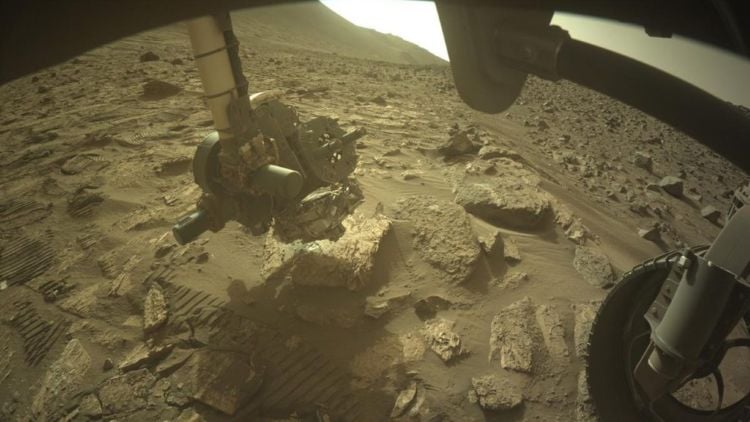
The detection of macromolecular carbon (MMC) is particularly compelling. MMC differs from simple aromatics in that it comprises crosslinked, three-dimensional frameworks akin to terrestrial kerogen. Laboratory irradiation experiments at the Planetary Science Institute indicate that MMC requires either rapid post-depositional burial or encapsulation within shielding minerals (e.g., clays, carbonates) to persist for billions of years under martian surface radiation flux.
| Mission | Year | Instrument | Organic Type | Interpretation | Reference Lithology |
|---|---|---|---|---|---|
| Viking Lander 1 | 1976 | GC-MS | Trace chlorobenzene* | Likely terrestrial contamination | Regolith fines |
| Curiosity (Gale) | 2018 | SAM-EGA | Thiophenes, aromatics | Potential ancient organics | Mudstone (Yellowknife Bay) |
| InSight | 2020 | HP3 Seismic | N/A | Thermal modeling suggests volatile retention | Regolith & duricrust |
| Perseverance (Jezero) | 2026 | SHERLOC | MMC & aliphatic chains | Biotic vs. abiotic unresolved | Mudstone (Bright Angel) |
*Reassessment of archival Viking data by Eigenbrode et al. (2020) suggests authentic martian origin; debate ongoing.
6.1 Implications for Biogenicity
Establishing biogenic origin demands multiple lines of evidence: (1) isotopic fractionations (e.g., δ13C ≤ -20 ‰), (2) morphological microfossils reproducible across samples, (3) stratigraphic congruence between organics and potential microbialites, and (4) exclusion of contamination or abiotic synthesis pathways. SHERLOC cannot directly measure stable isotopes; however, the co-occurrence of MMC with Fe-bearing clays and Mn oxides hints at redox interfaces historically exploited by chemotrophic organisms on Earth, notably in the Gunflint Chert and Strelley Pool formations.
7 Taphonomic Trajectories: How Organics Survive on Mars
Taphonomy—the study of decay, preservation, and fossilization—on Mars involves additional variables absent on Earth: pervasive UV-C flux below 200 nm, oxidizing perchlorates, and differential cosmic-ray dosage owing to the planet’s thin atmosphere. Yet, paradoxically, these same conditions can facilitate certain preservation pathways. Rapid desiccation inhibits microbial degradation, while perchlorates may entomb biomolecules within hydrated salts.
| Parameter | Modern Value | Noachian Estimate | Effect on Organics | Preservation Outcome |
|---|---|---|---|---|
| Surface UV Flux | 16 W m-2 | <2 W m-2 | Photolytic cleavage | Requires mineral shielding |
| Atmospheric Pressure | 6 mbar | ~1000 mbar | Higher shielding in past | Deep burial less essential |
| Perchlorate Abundance | 0.4 wt % | Unknown | Oxidation at <200 °C | Thermal spikes degrade |
| Radiogenic Heat Flow | 3 mW m-2 | 30 mW m-2 | Facilitates hydrothermal sinks | Possible authigenic mineral encapsulation |
| pH of Porewater | ~7.4 | 6–8 | Stability of amino acids | Enhanced sorption onto clays |
Numerical models derived from Kminek & Bada (2020) show that 5 cm of basaltic regolith attenuates UV-C radiation by three orders of magnitude, suggesting that even shallow burial (~ 2 cm) significantly extends organic half-life. The discovery of MMC less than the width of a sheet of paper beneath the surface therefore challenges existing models and raises the tantalizing possibility of ongoing subsurface transport processes—e.g., capillary wicking—that recurrently refresh the near-surface organic inventory.
8 Astrobiological Significance: From Prebiotic Chemistry to Potential Biosignatures
The detection of complex organics in a once-freshwater delta evokes direct parallels with stromatolitic ecosystems in Archean Earth settings. In terrestrial stratigraphy, laminated carbonates preserve microbially induced sedimentary structures (MISS) and isotope signatures that chronicle the early biosphere. If martian equivalents exist, Jezero is the most promising repository yet explored.
8.1 Energy Sources for Hypothetical Martian Life
- Redox Disequilibria: Fe2+/Fe3+ transitions could drive chemolithoautotrophic metabolisms analogous to Mariprofundus ferrooxydans.
- Phototrophy: Photosynthetically Active Radiation (PAR) would penetrate up to 7 m in a dust-laden martian lake, enough for microbial mats.
- Radiolysis: Subsurface water-rock interactions under cosmic radiation may generate H2 as a bio-available reductant.
Yet, life’s existence requires not merely energetics but also stable solvent, catalytic scaffolds, and time. Lacustrine residence-time modeling indicates Jezero’s lake persisted for >105 years without catastrophic desiccation—within the window considered feasible for abiogenesis according to Damer & Deamer (2022).
9 Comparative Planetology: Jezero, Gale, and Beyond
Curiosity’s traverse through Gale Crater’s Murray, Pahrump, and Vera Rubin members documented the progressive alteration from neutral to acidic fluvial regimes. Jezero’s carbonate blanket demonstrates an opposing trend toward alkalinity, offering a complementary sedimentary archive. By juxtaposing these crater histories, researchers can reconstruct a planetary-scale hydrological gradient spanning thousands of kilometers and tens of millions of years.
| Metric | Gale (Curiosity) | Jezero (Perseverance) | Significance |
|---|---|---|---|
| Lacustrine pH | 6.2–7.0 | 7.6–8.4 | Alkalinity favors carbonate sequestration |
| Dominant Clay Phase | Illite-smectite | Fe-Mg smectite | Potential nutrient source (Mg2+) |
| Organic Content (wt %) | ~0.01 | ~0.06 | Higher concentration in Jezero |
| Isotopic δ34S Range | -2 ‰ to +5 ‰ | n/a (awaiting MSR) | Sulfur cycling indicator |
| Taphonomic Facies Diversity | Moderate | High | Multiple preservation pathways |
The synergy between Jezero’s carbonate-rich context and Gale’s clay-rich strata constitutes a natural laboratory for testing polygenic origin-of-life models, wherein life emerges from repeated nucleation events across chemically diverse niches rather than a single cauldron. Beyond Mars, saturnian moon Enceladus has yielded plume-borne organics, and jovian moon Europa may hide hydrothermal vents beneath its icy shell. Thus, Mars becomes both a stepping-stone and a touchstone in assessing life’s cosmic ubiquity.
10 Environmental and Diagenetic Drivers of Organic Preservation
Multiple diagenetic regimes—early, burial, and telodiagenesis—have overprinted Jezero’s sediments. Early diagenesis may include authigenic carbonate cementation within months of deposition, while burial diagenesis at modest temperatures (<120 °C) could trigger polymerization of simple aromatics into MMC. Telodiagenesis arises during later eolian exhumation, introducing oxidants and fracturing that facilitate fluid migration.
| Depth (m) | Peak T (°C) | Conf. Pressure (MPa) | Polymerization Index* | Predicted Organic Class |
|---|---|---|---|---|
| 0–2 | <25 | <0.2 | 0.12 | Monomers, oligopeptides |
| 2–15 | 25–60 | 0.2–1.5 | 0.34 | Kerogen-like MMC |
| 15–40 | 60–110 | 1.5–4.0 | 0.62 | Graphitized carbon |
*Polymerization Index denotes fraction of sp2-hybridized carbon.
These modeled outcomes align with SHERLOC’s MMC observations at shallow depths, suggesting rapid early polymerization followed by regolith overturn that redistributes organics toward the surface. An intriguing corollary is that Jezero’s current exposure may not be a random erosional accident but rather a self-organizing diagenetic phenomenon where more resilient carbon phases naturally migrate upward as less stable phases weather away.
11 Technological and Mission Architecture Implications
Perseverance’s detections amplify the scientific imperative of Mars Sample Return (MSR). The proposed campaign—leveraging ESA’s Sample Retrieval Lander, NASA’s Mars Ascent Vehicle, and an orbiter for Earth return—aims to deliver ≤500 g of well-curated cores to terrestrial laboratories. The instrumentation list includes nanoSIMS for isotopic mapping, FTIR microspectroscopy, and synchrotron-based X-ray tomography, all of which surpass rover capabilities by several orders of magnitude in sensitivity.
Importantly, SHERLOC’s in-situ results serve as a triage mechanism for prioritizing which cores warrant the high-risk, high-cost logistics of retrieval. This real-time curation paradigm could save mission mass and budget by filtering out geochemically redundant samples.

11.1 Planetary Protection Considerations
The detection of complex organics necessitates revisiting planetary protection protocols. NASA’s Office of Planetary Protection classifies MSR as Category V (sample-restricted), demanding double biological containment and a Bio-Safety Level-4 facility on Earth. Furthermore, forward contamination safeguards—e.g., heat sterilization of drilling bits—must balance organic integrity with biosecurity.
12 Societal, Ethical, and Philosophical Ramifications
Beyond its scientific cachet, discovering biosignatures on Mars would recalibrate humanity’s existential narrative. Religions may reinterpret creation stories; philosophers could reevaluate anthropocentrism; and policymakers might wrestle with the ethics of terraforming a once-inhabited world. Economically, a verified extraterrestrial biosphere could catalyze biotech ventures aimed at novel enzymes or pharmaceuticals evolved under low-gravity, high-radiation regimes. Educational curricula would integrate astrobiology across biology, chemistry, and planetary science departments, democratizing interdisciplinary STEM learning.
However, potential pitfalls loom. Misinformation could propagate through social media, fueling conspiracy theories. International treaties like the Outer Space Treaty (1967) might require amendments to govern biological resources beyond Earth. Finally, ethical stewardship—to preserve Mars as a scientific sanctuary rather than a mining colony—demands global consensus.
13 Conclusion
The Perseverance mission’s demonstration of macromolecular carbon within the Bright Angel mudstones marks a pivotal milestone in the unfolding quest to ascertain life’s foothold beyond Earth. While the biogenicity of these organics remains indeterminate, their molecular complexity, mineralogical context, and sedimentological provenance collectively strengthen the hypothesis that early Mars harbored habitable niches. Future sample-return analyses and continued rover operations will either corroborate or challenge this narrative, but the scientific journey has already transformed our understanding of planetary evolution, organic chemistry, and the delicate interplay between environment and potential biology.
For More Information
The following references and hyperlinks provide detailed empirical data, methodological specifics, and broader contextual discussions for readers seeking deeper engagement with the topics addressed above:
- Murphy, A. L., et al. (2026). “Macromolecular Carbon in Jezero Crater Mudstones.” Science Advances.
- Freissinet, C., et al. (2026). “Curiosity’s Detection of Organics in Gale Crater Claystones.” Nature Communications.
- Mars Reconnaissance Orbiter (MRO) Mission Overview – NASA/JPL
- SHERLOC Instrument Fact Sheet – NASA Perseverance Rover
- Damer, B., & Deamer, D. (2022). “Hydrothermal Origin of Life Revisited.” Life 12(5):680.
- Kminek, G., & Bada, J. (2020). “Radiation Constraints on the Survival of Organics on Mars.” Space Science Reviews 216:101.
- Planetary Science Institute – Bright Angel Formation Analyses
- NASA JPL – Perseverance Operational Update (YouTube)
- Science Panel Discussion on Martian Organics (YouTube)
Let the search continue—within each grain of martian mudstone may lie a whisper from the deep past, waiting only for the right instruments, the right questions, and the enduring curiosity of humankind.