Introduction
As it is known, during spaceflight, astronauts are exposed to numerous stressors, including microgravity and ionizing radiation, which are linked to various harmful health effects, such as cardiovascular diseases, neurodegenerative diseases, and cancers. In recent years, researchers have identified a specific microRNA signature that is associated with spaceflight that can be used as a biomarker and are even developing countermeasure treatments to mitigate the damage caused by space radiation.
MicroRNAs are small non-coding RNA molecules that control cell proliferation and, in some cases, are responsible for tumor development. Multiple microRNAs are differentially changed by microgravity experienced by astronauts during space missions and could also provide prognostic and diagnostic measures of radiation exposure. Therefore, studying miRNAs in this context can help in determining the molecular characteristics of diseases, as well as in response to spaceflight stressors could reveal targets for biomarkers.
Key microRNAs Implicated in Spaceflight Response
To give a brief history, miRNAs were first discovered in Caenorhabditis elegans at the beginning of the 1990s by Lee and colleagues. Later, more than 1900 microRNAs have been reported that play a critical role in almost all physiological processes such as cellular development, proliferation, differentiation, metabolism and homeostasis.
Also, studies show that detection of a small number of miRNAs provides more information about the developmental lineage and differentiation stage of tumors. Today, several key miRNAs have drawn particular attention in space health due to their potential to reflect biological responses to spaceflight stressors.
A study by McDonald and colleagues indicated increased levels of miR-16-5p, miR-125b-5p, and let-7a-5p in cells exposed to space radiation. These miRNAs suppressed certain genes involved in DNA repair and cell cycle regulation. Interestingly, when the researchers blocked these miRNAs with antagomir, they observed a reduction in radiation damage in the cells. In other words, the antagomir acted as a "protective molecule," halting harmful miRNA activity.
Emerging Diagnostic Approaches: miRNA as a biomarker
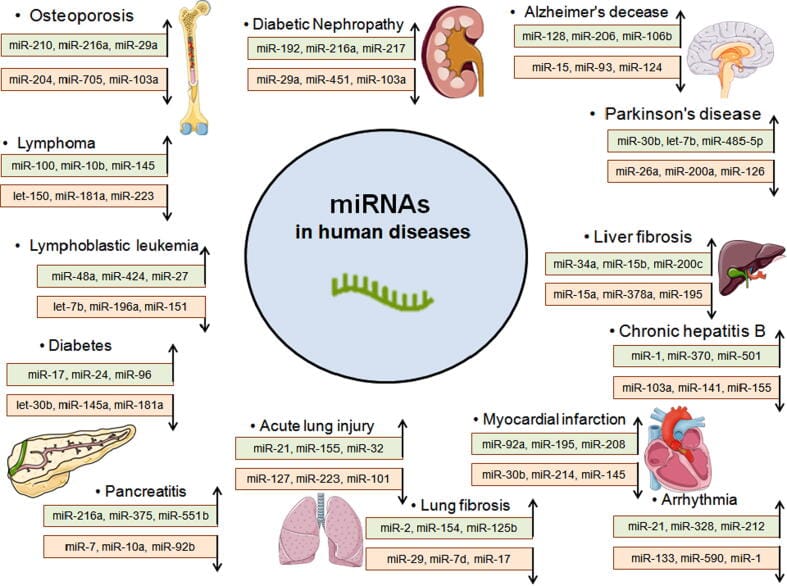
One of the reasons miRNAs have attracted so much attention is their advantage of greater stability compared to other genetic markers. Over the past decades, scientists have shown altered miRNA levels in multiple cancer types, such as breast cancer, leukemia, liver cancer, ovarian cancer, pancreatic cancer, and prostate cancer. In view of these findings, differentially abundant miRNAs detected in blood, cystic fluid, plasma, pancreatic juice, serum, and urine samples have been proposed as candidate biomarkers of different types of cancer.
Moreover, an increasing number of miRNAs and their targets are involved in regulating brain and neuron development. According to the researchers' report, the importance of miRNAs in the nervous system is illustrated by the finding that 70% of known miRNAs are expressed in the brain. Several brain-specific miRNAs, such as miR-9 and miR-134, have been extensively studied in neurogenesis. These miRNAs play a key role in various aspects of neural development. Because the nervous system is one of the organ systems most affected by spaceflight conditions such as microgravity and radiation, monitoring these brain-related miRNAs could offer new clues about how astronauts’ brains adapt during missions.
The cardiovascular system is another area where miRNAs show tremendous potential. Differential miRNA levels have been reported for diseases such as heart failure, cardiomyopathy,
and aortic stenosis. In fact, circulating miRNAs such as miR-1 and miR-208a have been proposed as biomarkers for cardiovascular diseases. Since long-duration space missions can strain the cardiovascular system, these miRNAs may help detect early signs of heart-related changes in astronauts.
Future Directions
In recent years, interest in microRNAs has grown incredibly rapidly. As days go by, scientists are discovering new types of miRNAs and investigating how these small molecules act in various disease states. At the same time, new technologies are emerging that allow us to measure these molecules quickly and reliably. These developments suggest that miRNAs may soon be incorporated into routine health monitoring tests.
However, many miRNAs proposed as candidates to date have not performed equally well across different studies. This means that even if they indicate the same disease, they can provide a strong signal in one study and a weak signal in another. Therefore, for miRNA tests to be truly reliable, standardization of measurement methods is necessary.
This is even more critical for space travel, as astronauts are exposed to two major stressors that wreak havoc on our bodies: microgravity and radiation. If miRNAs can provide early signals of these stresses, we could have a powerful biomarker tool for monitoring astronauts' health in real-time. For example, a sudden increase in a particular miRNA could indicate that cells are beginning to be damaged by radiation; a decrease in another miRNA could show a weakened immune system.
Scientists are currently working with biologists, engineers, doctors, and even space agencies to understand how these small molecules could be used clinically. There's still a long way to go; tests, especially in space, need to be validated. But the pace of progress is truly promising. If these studies are successful, the health of astronauts on future space missions may be able to monitored with just a few drops of blood, or perhaps even just breath samples. This would not only make long-duration space missions safer but also create new opportunities for early disease detection on Earth.
Conclusion
To sum up, miRNAs play an exceptionally vital role in both clinical diagnostics and the future of space medicine research. As a tiny regulating molecule, they offer a unique window into how cells respond to stress, disease and even extreme environments like space. However, the main challenges remain. Scientists must identify miRNAs that are consistently reliable across diverse patient groups and develop simple, affordable, and rapid detection technologies. So, these steps are essential for turning miRNAs into practical diagnostic tools both on Earth and beyond. Yet, the progress so far is promising, with continued research and collaboration, miRNA-based diagnostics may soon help us protect human health in space and save more lives here on our planet.
References
Srivastava, S. K., Bhardwaj, A., Leavesley, S. J., Grizzle, W. E., Singh, S., & Singh, A. P. (2013). MicroRNAs as potential clinical biomarkers: Emerging approaches for their detection. BioMed Research International, Article 253539. https://pmc.ncbi.nlm.nih.gov/articles/PMC4318494/
McDonald, J. T., Kim, J., et al. (2024). Space radiation damage rescued by inhibition of key
spaceflight-associated miRNAs. Nature Communications, 15, 4825. https://www.nature.com/articles/s41467-024-48920-y#Sec11
Gaines, D., Nestorova, G. G. (2022). Extracellular vesicles-derived microRNAs expression as biomarkers for neurological radiation injury: Risk assessment for space exploration. Life Sciences
in Space Research, 32, 54–62. https://www.sciencedirect.com/science/article/abs/pii/S2214552421000833
Wang, J., Chen, J., & Sen, S. (2016). microRNA as biomarkers and diagnostics. Journal of Cellular Physiology, 231(1), 25–30. https://pmc.ncbi.nlm.nih.gov/articles/PMC8776330/