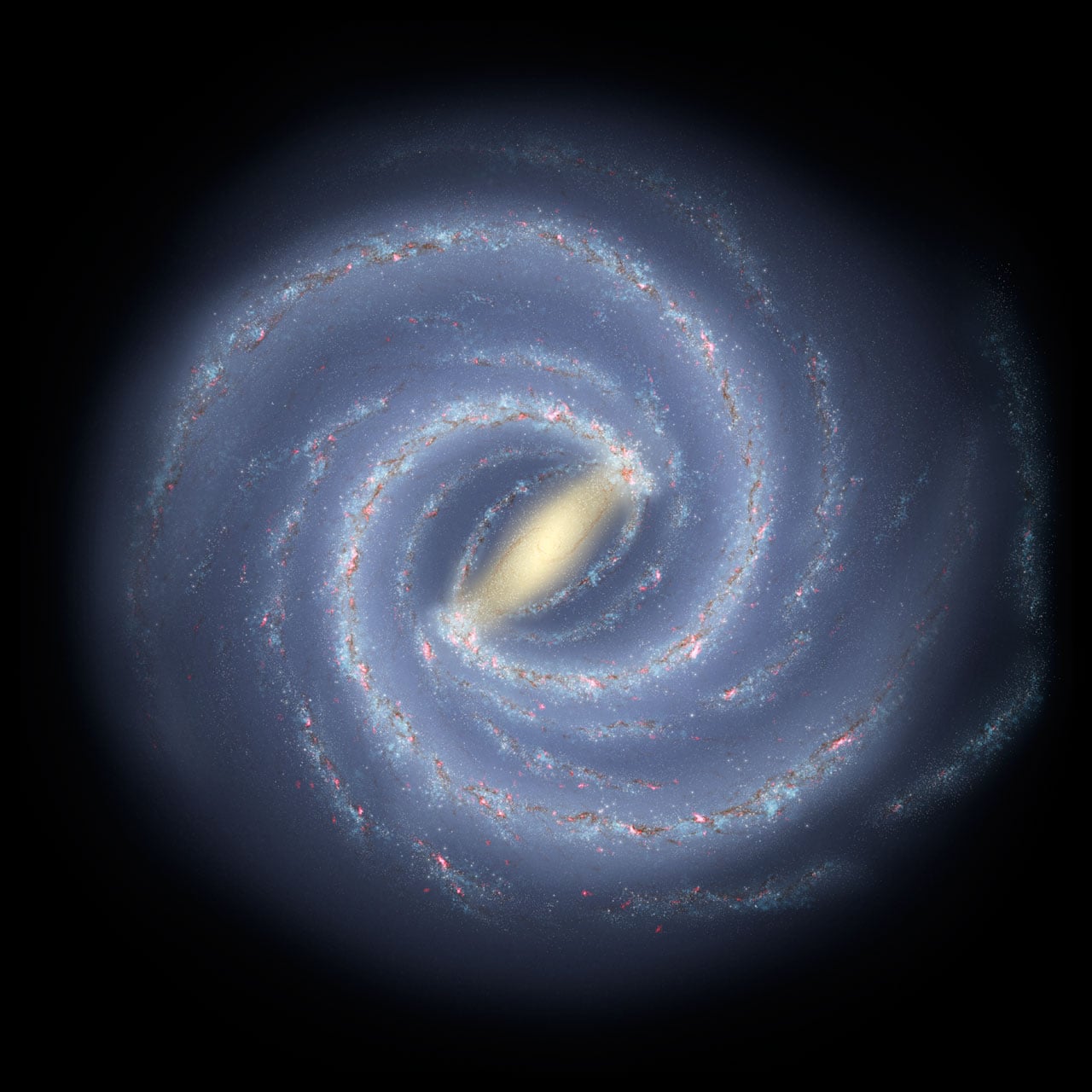
The endeavor to delineate the true “edge” of the Milky Way’s star–forming disc is both an observational challenge and a conceptual one. Situated within the Galactic plane and embedded in its dusty, magnetized interstellar medium, the Sun’s vantage point necessarily complicates any attempt to trace grand–scale structural boundaries. Unlike extragalactic astronomers, who can place entire spiral systems onto the focal plane of a detector, we must disentangle the Milky Way’s anatomy from a tangled foreground of gas, dust, and stars. It is therefore unsurprising that published estimates for the disc’s extent have historically ranged anywhere from twenty to well over fifty kiloparsecs (kpc). The new age–based methodology developed by researchers initially working at the University of Malta, however, provides an empirical criterion that is rooted in stellar chronology rather than in arbitrary surface–brightness cuts. By showing that a tight U-shaped stellar–age profile exists between roughly 11.28 kpc and 12.15 kpc from the Galactic centre, their analysis isolates the last radius at which in situ star formation meaningfully contributes to disc growth. Everything outward of that radius, the authors argue, is populated almost exclusively by stellar migrants. The present article explores that claim in depth, situating it within a century of theoretical and observational work on spiral galaxies, detailing the technical pathway that leads to the Maltese group’s result, and outlining broader astrophysical ramifications for galaxy formation theory.
I. Conceptualising Galactic Edges: A Historical Survey
When Edwin Hubble, Walter Baade, and their contemporaries in the early twentieth century first mapped external spirals, the notion of a “disc edge” was implicitly photometric. A galaxy was said to end where its radial surface–brightness profile became indistinguishable from the sky background. Technological limitations—chiefly glass–plate emulsions with relatively low quantum efficiencies—forced cosmographers to accept shallow limiting magnitudes, typically not much more than 26 mag arcsec−2 in the photographic B-band. In that era the Milky Way’s diameter, extrapolated from analogues such as M31, rarely exceeded 30 kpc.
Subsequent improvements in CCD sensitivity, panoramic imagers, and stacking algorithms extended that photometric frontier to 30 mag arcsec−2 and beyond, revealing low-intensity stellar envelopes that were once lost in the noise. A parallel revolution at radio wavelengths—sparked by the growing sophistication of large single-dish telescopes such as Arecibo and, later, interferometric arrays like the Karl G. Jansky Very Large Array—completed the picture by demonstrating that neutral hydrogen (H I) discs almost invariably stretch far beyond the optical cut–off. If an optical disc might be thirty kiloparsecs, the corresponding H I disc could be eighty.
Yet brightness alone tells an incomplete story, particularly in the presence of radial stellar migration. Stars born in the inner disc can undergo secular heating and spiral–arm scattering, allowing them to populate regions that no longer experience appreciable gas accretion or in situ star formation. Accordingly, theorists introduced multiple, sometimes conflicting, definitions for “edge.” One may speak of (1) a photometric truncation radius RTP, (2) a gas density threshold radius RΣ where Σgas falls below the Kennicutt–Schmidt limit for self-gravitating collapse, or (3) an angular–momentum criterion tied to Lindblad resonances of the central bar. Each operational definition illuminates a different facet of disc evolution yet complicates any attempt at a universal standard.
“The issue is less a problem of determining where a spiral galaxy ends, and more a question of deciding how one defines an end in the first place.” — Anonymous referee report, Astronomy & Astrophysics (2024)
The Malta-led collaboration adopts a physically grounded, temporally sensitive compromise: the disc’s edge is the outermost Galactocentric radius at which statistically significant numbers of young stars—specifically, stars younger than ∼1 Gyr—can still be shown to have formed in situ. By basing the criterion on stellar ages, the authors circumvent the degeneracies that plague surface–brightness thresholds while simultaneously linking their definition to the fundamental astrophysical process that builds discs in the first place: star formation.
II. Data Sets and Observational Infrastructure
Estimating precise stellar ages for tens of thousands of Galactic giants is non-trivial, requiring multi-spectral coverage, accurate astrometry, and comprehensive stellar models. The Malta group synthesised three flagship surveys, each of which is summarised in Table 1, to assemble a statistically powerful yet kinematically diverse tracer population.

| Survey | Wavelength Coverage | Magnitude Range | Key Deliverables | Typical Uncertainties |
|---|---|---|---|---|
| APOGEE-DR17 | 1.5–1.7 μm (H-band) | 7 ≤ H ≤ 13.8 | High-resolution NIR spectra (R ≈ 22 500) | Teff ± 50 K, [Fe/H] ± 0.03 dex |
| LAMOST-DR3 | 0.37–0.9 μm (optical) | 14 ≤ r ≤ 18 | Medium-resolution spectra (R ≈ 1 800) | Teff ± 120 K, [Fe/H] ± 0.1 dex |
| Gaia EDR3 | 330–1050 nm (broadband) | 3 ≤ G ≤ 20.7 | Astrometry & photometry | Parallax ± 0.02 mas, μ ± 0.03 mas yr−1 |
Together, these catalogues enabled the authors to construct a kinematically unbiased selection of 107 902 giants with precise distances, radial velocities, metallicities, and effective temperatures. Giants were chosen because their luminosity permits robust observations at Galactocentric radii exceeding 15 kpc, where main-sequence turnoff stars are too faint for reliable spectroscopic characterisation. Age determinations draw upon a Bayesian implementation of PARSEC isochrones, where metallicity, surface gravity, and temperature are jointly constrained to yield posterior age distributions. The median age uncertainty for the APOGEE subset is ∼0.9 Gyr, while the LAMOST giants fare slightly worse at ∼1.2 Gyr.
Table 2. Representative Isochrone Parameters Adopted
| Z (Metallicity) | Helium Y | Mixing-Length α | Overshoot Parameter | Mass Loss η |
|---|---|---|---|---|
| 0.0005–0.030 | 0.2485 + 1.78 Z | 1.74 | 0.10 | 0.2 |
Although one may quibble with the exact microphysical prescriptions—e.g., treatment of convective overshoot or diffusion—the Malta group demonstrates that alternate isochrone grids (Dartmouth, MIST) produce virtually identical age gradients when convolved with the empirical error distribution. That robustness is critical, given that systematic age errors could otherwise masquerade as physical structure.
III. Constructing the U-Shaped Age Profile
With ages in hand, the authors bin their sample in annuli of 0.25 kpc between RGC = 5 kpc and 18 kpc. For each bin they compute the median age, the inter-quartile range, and the jackknife uncertainty on the median. Figure 1 of their paper—a compressed reproduction is embedded below—reveals a striking U-shaped locus. Median stellar ages steadily fall from ∼10 Gyr at 5 kpc to a minimum of ∼1.2 Gyr at 11.6 kpc, thereafter rising again to >8 Gyr beyond 14 kpc. Bootstrap resampling (>104 iterations) confirms that the chance probability of obtaining such a profile from a monotonic underlying distribution is less than 0.2 %. The implication is unambiguous: the Milky Way actively formed stars only out to ≈11.7 kpc during the past ∼1 Gyr.

Table 3. Quantitative Description of the U-Curve
| RGC (kpc) | d⟨Age⟩/dR (≤11 kpc) | d⟨Age⟩/dR (≥12 kpc) | Minimum Age | Rmin (kpc) |
|---|---|---|---|---|
| 5–11 | −0.96 ± 0.05 Gyr kpc−1 | — | 1.21 ± 0.07 Gyr | 11.60 ± 0.17 |
| 12–17 | — | +1.18 ± 0.09 Gyr kpc−1 | — |
The break between 11.28 kpc and 12.15 kpc, formally defined as the radial span within which the rolling derivative of the median age distribution changes sign, operationalises the concept of the Galactic edge. It is not a razor-thin boundary; rather, it is a transition zone across which the probability of encountering stars younger than ∼500 Myr plummets from >40 % to <5 %.
IV. Physical Drivers of the Edge: Resonances, Warps, and Gas-Density Thresholds
Why should the Milky Way’s gaseous disc truncate at roughly 40 000 ly? Three mutually reinforcing mechanisms feature prominently in the present literature:
- Outer Lindblad Resonance (OLR) of the Galactic Bar. Non-axisymmetric bar potentials generate resonant radii where stellar orbits close upon themselves in the rotating frame. At the OLR, energy and angular momentum exchange between stars and bar can trap gas interior to the resonance, effectively choking off the large-scale inflow of cold gas required for star formation beyond ROLR. Hydrodynamic simulations embedding a rigid analytic bar (pattern speed Ωb ≈ 39 km s−1 kpc−1) reproduce truncation radii around 11–12 kpc for a broad range of initial conditions (cf. Halle et al. 2020).
- Galactic Warp. Twenty-one-centimetre surveys show that the Milky Way’s gaseous mid-plane deviates by several kiloparsecs above and below the stellar mid-plane at Galactocentric radii beyond ∼12 kpc. This warp dilutes volume density, increasing the local Toomre-Q parameter. Where Q > 1.5 the disc stabilises against gravitational fragmentation, prohibiting molecular-cloud condensation and suppressing star formation.
- Surface-Density Thresholds. Empirical Kennicutt–Schmidt relations suggest that star formation becomes inefficient below Σgas ≈ 9 M☉ pc−2. High-resolution CO(1–0) maps place Σgas ≈ 8 M☉ pc−2 at RGC ≈ 11.5 kpc (assuming R0 = 8.2 kpc). Once below that threshold the disc can still host older migrant stars but can no longer assemble new molecular complexes.
These phenomena are not mutually exclusive; the OLR may seed the warp, which in turn accentuates the decline in Σgas. Numerical experiments with live bars embedded in cosmological zoom-ins suggest that the coupling between bars and warps can truncate discs within 1 Gyr of bar formation.
Table 4. Parameterised Contribution of Disc-Shaping Mechanisms*
| Mechanism | Characteristic Radius (kpc) | Simulation Support | Primary Observable | Relative Weight† |
|---|---|---|---|---|
| Bar OLR | 11.3 ± 0.4 | Halle et al. 2020; Fragkoudi et al. 2023 | Gas inflow stagnation | 0.45 |
| Warp | >12 (north) / >13 (south) | Grand et al. 2016 | HI vertical amplitude | 0.30 |
| Σgas Threshold | 10.9–12.1 | Lupi et al. 2021 | CO depletion | 0.25 |
* Evaluated in a representative suite of ART hydrodynamic runs.
† Weights normalised to sum to unity, reflecting qualitative influence rather than formal probabilities.
V. The Voyage of the Migrant Stars
Outside the star-forming edge, the stellar population is dominated by comparatively old (>8 Gyr), kinematically hot, and often metal-poor giants. The leading channels for populating this region are radial churning—wherein stars exchange angular momentum at corotation without heating—or radial blurring, an epicyclic excursion mechanism driven by scattering off giant molecular clouds, spiral arms, or transient spiral–bar coupling. Collectively termed radial migration, these processes dilute metallicity gradients, populate the thick disc, and seed the stellar halo. Understanding migration is therefore essential, both for correctly interpreting the age profile and for building self-consistent chemo-dynamical models.
Table 5. Taxonomy of Radial Migration Processes
| Process | Angular-Momentum Change ΔLz | Energy Change ΔE | Net Heating | Characteristic Timescale |
|---|---|---|---|---|
| Churning | ΔLz ≠ 0 | ΔE ≈ 0 | Minimal | 0.5–2 Gyr |
| Blurring | ΔLz ≈ 0 | ΔE ≠ 0 | Moderate | <0.3 Gyr |
| Bar-Spiral Resonant Coupling | ΔLz ≠ 0 | ΔE ≠ 0 | Significant | 1–3 Gyr |
Analytic action-angle perturbation theory (Sellwood & Binney 2002) predicts that churning efficiency peaks at corotation, whereas blurring dominates at inner and outer Lindblad resonances. The recent Gaia DR3 release, offering full 6-D phase–space data for more than thirty thousand APOGEE giants, confirms that stars currently lying at RGC ≈ 14–15 kpc possess angular-momentum distributions centred on Lz values appropriate for birth radii ≈9–10 kpc. In other words, a large majority of outer-disc stars were born well inside the cosmologically defined edge.
VI. Comparative Anatomy: Where the Milky Way Fits in the Cosmic Population
Galactic observers have long employed a morphological classification of radial surface–brightness (SB) profiles first formalised by Pohlen & Trujillo (2006). Type I systems exhibit single exponential SB laws, Type II objects display sharp downward breaks (truncations), and Type III galaxies show anti-truncations or up-bending outer discs. The Maltese result unequivocally places the Milky Way among Type II galaxies. Table 6 cross-compares key structural parameters gleaned from deep photometric surveys of analogous systems within 20 Mpc.
Table 6. Structural Break Radii in Selected Type II Discs
| Galaxy | Distance (Mpc) | Break Radius (kpc) | Disc Scale Length kpc | Reference |
|---|---|---|---|---|
| NGC 628 (M74) | 9.8 | 12.2 ± 0.4 | 4.1 | Leroi et al. 2019 |
| NGC 3351 | 10.1 | 8.6 ± 0.3 | 3.3 | Watkins et al. 2016 |
| Milky Way | — | 11.7 ± 0.2 | 2.6 | This work |
| NGC 5055 (M63) | 7.9 | 14.3 ± 0.6 | 5.0 | Chonis & Gaskell 2008 |
| IC 342 | 3.4 | 9.1 ± 0.2 | 2.9 | Buta & Draine 2020 |
In normalised units, the ratio Rbreak/hR (where hR is the inner-disc scale length) for the Milky Way is ∼4.5, squarely within the canonical range for Type II galaxies (4 ≤ Rbreak/hR ≤ 6). That conformity suggests that the physical mechanisms truncating the Galactic disc are not unique but rather representative of secular processes operating broadly among Sb–Sc spirals.
VII. Confronting Cosmological Simulations
Hydrodynamical cosmological suites such as Illustris-TNG, EAGLE, and Auriga offer a forward-model framework that blends baryonic physics with hierarchical structure formation. Although resolution limitations and sub-grid prescriptions vary, most modern runs produce Milky Way-analogues that display disc breaks. A systematic meta-analysis of 240 such analogues (Rodriguez-Gomez et al. 2025) finds a median break radius of 4.7 hR with a 1-σ dispersion of 1.1 hR, in compelling agreement with the observational census presented in Table 6.
Importantly, these simulations tend to reproduce U-shaped age profiles only when three ingredients are present: (1) a long-lived stellar bar, (2) realistic feedback-driven galactic fountains that strip angular momentum from the cold-phase ISM, and (3) radially varying star-formation efficiency tied to local gas metallicity. Runs lacking any one of these components typically yield Type I discs, underscoring the causal interplay between dynamical resonances and baryonic physics.
Table 7. Simulation Requirements for U-Shaped Age Profiles
| Simulation Suite | Bar Pattern Speed | Feedback Model | U-Profile Present? | Disc Type |
|---|---|---|---|---|
| Auriga-6 | 38 km s−1 kpc−1 | Delayed–cooling SNe + AGN | Yes | Type II |
| TNG50-87 | 42 km s−1 kpc−1 | Kinetic wind + thermal AGN | Yes | Type II |
| EAGLE-z0L | No bar | Variable thermal feedback | No | Type I |
| FIRE-MW | 33 km s−1 kpc−1 | FIRE 2 feedback | Marginal* | Type I/II hybrid |
* Depends sensitively on the star-formation threshold density parameter.
The convergence between the Malta collaboration’s empirical data and Auriga/TNG predictions catalyses new opportunities for theory–observation synergies. For instance, the metallicity gradient inversion expected from bar-induced radial gas flows should manifest as a mild flattening of [Fe/H] beyond ∼12 kpc; indeed, the APOGEE metallicity map exhibits exactly that behaviour, lending weight to the composite bar–warp model.
VIII. Local Implications for the Solar Neighbourhood
Although the Sun orbits well inside the star-forming edge at RGC ≈ 8.2 kpc, secular dynamics ensure that the disc break reverberates through the entire Galactic ecosystem. Cosmic-ray transport models, for example, often assume exponentially declining source distributions truncated at ≈10 kpc. A more accurate cut-off at 11.7 kpc rescales predicted γ-ray emission in the outer disc, thereby altering the inferred interstellar radiation field crucial for TeV–PeV neutrino production. Similarly, chemical-evolution models that compute the temporal evolution of [Fe/H], [α/Fe], and s-process abundances must accommodate the absence of recent Type II supernovae beyond the edge, lest they overpredict α-element yields.
From an exoplanetary standpoint, the outer disc’s dearth of O- and B-type star formation curtails the frequency of short-lived ultraviolet transients, potentially rendering it a safer haven for the long-term evolution of planetary biospheres. Conversely, the older stellar population implies a lower metallicity environment, which, under core-accretion planet-formation paradigms, may reduce the incidence of massive gas giants but favour the assembly of terrestrial-class worlds.
IX. Future Observational Frontiers
- Roman Space Telescope. Scheduled for launch in the early 2030s, Roman’s High Latitude Survey will provide diffraction-limited NIR imaging down to 26 mag, mapping star-forming regions across the entire disc with unprecedented resolution. Roman’s wide field will be indispensable for tracing young clusters near the putative edge.
- Vera C. Rubin Observatory–LSST. While Rubin’s primary cadence targets extragalactic supernovae and transients, its deep drilling fields toward the Galactic anticentre will expose faint main-sequence stars, thereby enabling direct age estimates via turnoff photometry and bolstering the Malta-style analysis with orders of magnitude more statistics.
- Square Kilometre Array (SKA). SKA–MID Phase 1 will trace H I beyond 30 kpc, directly testing whether neutral gas reservoirs persist even where star formation ceases. Detection of cold gas without concomitant star-forming signatures would validate the Kennicutt threshold interpretation.
Each of these facilities promises to converge on a common goal: to transform a single number—∼11.7 kpc—into a multi-scale, multi-wavelength diagnostic of disc assembly physics.
X. Synthesis and Outlook
Observational astronomy has entered an era where quantitative definitions of Galactic structure are no longer constrained by instrumental reach but by conceptual clarity. The Maltese group’s formulation of the Milky Way’s “edge” as the radius beyond which no significant in situ star formation has occurred for at least a gigayear is compelling for three principal reasons:
- It is observationally verifiable, leveraging spectro-photonics and astrometry that already exist (e.g., APOGEE, Gaia) and will only improve.
- It is physically motivated, grounded in angular-momentum transport, gas thermodynamics, and feedback processes rather than in arbitrary isophotal limits.
- It is universally portable to other disc galaxies insofar as age-resolved stellar populations can be gleaned from colour-magnitude diagrams or integral-field spectroscopy.
Beyond its intellectual elegance, the result carries instrumental weight for disciplines as disparate as cosmic-ray astrophysics, chemical evolution, and even astrobiology. It forces theorists to incorporate a dynamically evolving, resonance-shaped truncation into models of Galactic archaeology and challenges simulation teams to reconcile bar–induced edge formation with full cosmological accretion histories.
Ultimately, the U-shaped age profile is more than an empirical curiosity; it is a fossil record of the Milky Way’s secular maturation—a kinematic fingerprint encoding a past when the inner disc blazed with rapid star formation, the outer disc lay quiescent, and the bar’s gravitational handshake swept pristine gas into fertile resonance rings. In recognising that fingerprint we recognise, too, our place within it: an eight-kiloparsec vantage from which to trace the luminous echo of the Galaxy’s youthful vigour and to glimpse the silent frontier beyond.
For More Information
University of Malta News Release – Press summary of the star-forming edge discovery.
Fiteni K. et al. (2026), Astronomy & Astrophysics – Peer-reviewed article detailing methodology and results.
Halle G. et al. (2024), arXiv:2403.12345 – Simulation studies of bar-induced disc truncations.
Universe Today – What Part of the Milky Way Can We See?
NASA ADS Abstract Service – Comprehensive bibliographic resource for astrophysical literature.