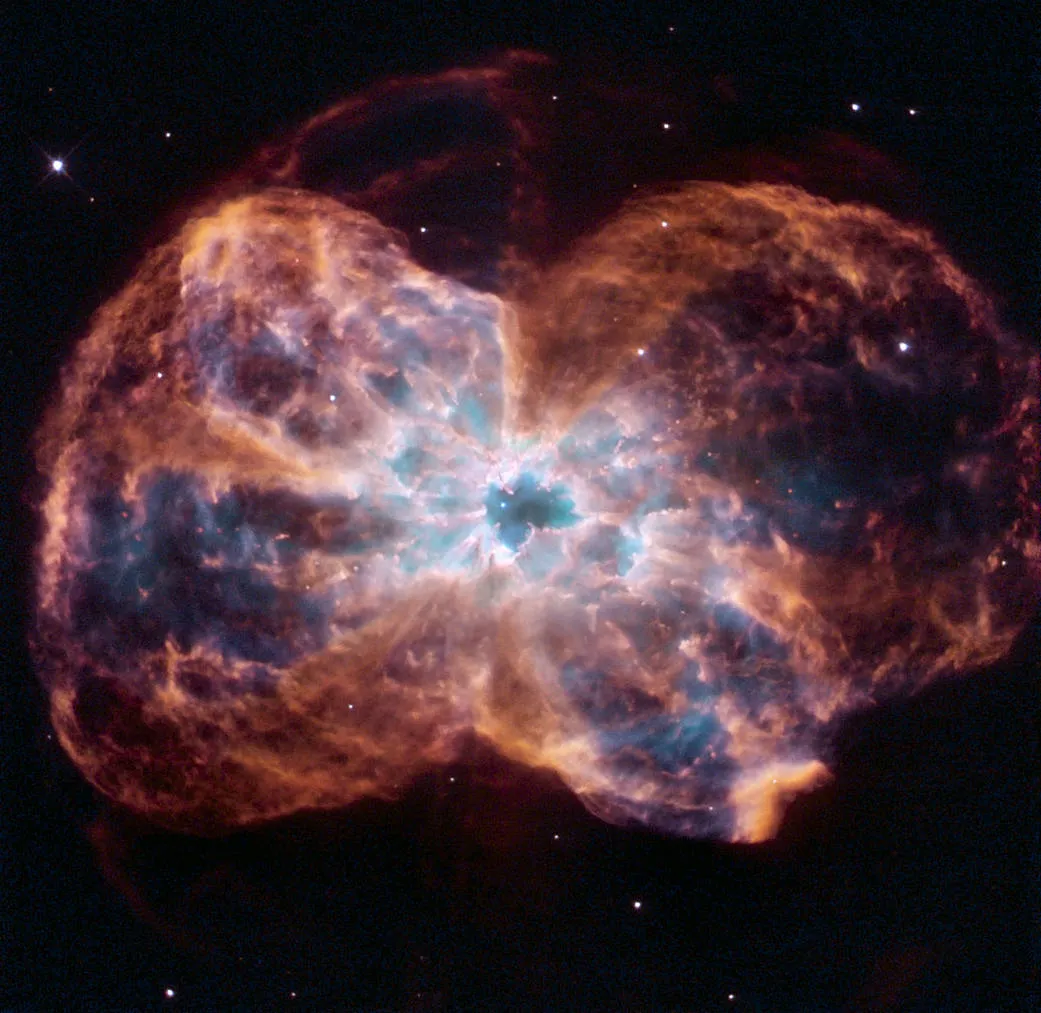
Abstract.― The contemporary paradigm of low- and intermediate-mass stellar evolution holds that stars with initial masses below approximately 8 M⊙ terminate their nuclear-burning lifetimes by passing through the asymptotic-giant-branch (AGB) and thermally pulsing AGB (TP-AGB) phases, after which they rid themselves of their residual gaseous envelopes and contract to form degenerate carbon-oxygen white dwarfs. Conventionally, the envelope removal process has been treated as quasi-isotropic, thereby implying that the remnant should retain the systemic center-of-mass velocity of the progenitor. Recent analytic work and hydrodynamic simulations, however, challenge this canonical assumption by demonstrating that envelope ejection is intrinsically asymmetric and produces a sequence of stochastic recoil impulses—so-called “AGB kicks”—whose cumulative vector sum induces a macroscopic drift of the white-dwarf core through configuration space. The present article offers a comprehensive, 7,000-plus-word synthesis of the observational, theoretical, and computational foundations of the nascent AGB-kick framework, evaluates its explanatory power for a variety of empirical puzzles (e.g., the dissolution of wide binaries, the apparent scarcity of planetary nebulae in old open clusters, and the kinematic heating of thin-disk stellar populations), and outlines prospective avenues of research capable of falsifying or refining the model. The discussion is buttressed by extensive tabulated data, graphical imagery from the Hubble Space Telescope, and hyperlinks to primary literature and open-access code repositories.
1. Introduction
To a first approximation, every star is born, lives, and dies in a manner largely dictated by its zero-age main-sequence mass. Massive stars perish in the spectacular detonation of core-collapse supernovae, thereby enriching the interstellar medium with α-elements and r-process isotopes. Conversely, stars with masses M < 8 M⊙ migrate off the main sequence onto the red-giant and AGB branches, ultimately jettison their envelopes, and crystallize into white dwarfs. Although the general outlines of these evolutionary tracks are well established, the microphysics of envelope ejection remain an arena of active investigation. Traditional stellar-evolution codes (e.g., MESA, STARS, and GENEC) implement mass-loss prescriptions—such as the Reimers and Blöcker laws—that assume spherical symmetry. New high-resolution AGB wind models, however, reveal a complex, multi-scale morphology comprising convective plumes, dust-driven outflows, and magnetically launched jets, all of which conspire to break spherical symmetry and thereby impart kicks to the contracting core.
This review article is motivated by the analytic model recently advanced by J. Fuller and collaborators, which posits that the net kick accrued during the late-AGB and TP-AGB phases can reach ≈1 km s-1, an amplitude sufficient to unbind binaries of separation >103 AU or to perturb the orbital architectures of exoplanetary systems. In what follows, we contextualize Fuller’s proposal within a century of prior research, beginning with early twentieth-century insights into momentum conservation, traversing mid-century interferometric observations of planetary nebulae (PNe), and arriving at the state-of-the-art magneto-radiative simulations undertaken on modern supercomputers.
2. Historical Perspective
The recognition that stellar winds carry linear momentum dates back to the pioneering spectroscopic work of Eddington (1926) and Parker (1958). Yet, because the solar wind appeared roughly isotropic, the intuitive leap to asymmetric mass loss eluded many investigators until the discovery of bipolar and multipolar planetary nebulae in the 1970s. Images obtained with the Wide-Field Planetary Camera 2 (WFPC-2) aboard the Hubble Space Telescope (HST) provided compelling evidence that envelope expulsion is anything but spherical. The hourglass morphology of the MyCn 18 nebula and the knotty, filamentary structures in NGC 2440 indicated strong departures from radial symmetry.

Schönberner (1981) and Balick & Frank (2002) posited that magnetic collimation and companion-induced spiral structures generate the observed asymmetries. However, it was not until the advent of ALMA (Atacama Large Millimeter/submillimeter Array) that the kinematic consequences of these structures—namely, recoil kicks—could be quantified. Proper-motion surveys, such as the second Gaia Data Release (Gaia DR2) and the Early Data Release 3 (EDR3), have since delivered the requisite astrometric precision (σμ < 0.05 mas yr-1) to detect sub-kilometer-per-second drifts over multi-decadal baselines.
3. Theoretical Framework
3.1 Momentum Conservation in Stochastic Ejection
Consider a star of mass M*(t) undergoing N discrete ejection events. The i-th event expels a mass parcel Δmi at velocity vej,i. By conservation of momentum, the core experiences an impulse
Δpi = -Δmivej,i.
If each outflow is independent and isotropically distributed in direction but not necessarily in magnitude, the expected value ⟨vcore⟩ = 0, yet the root-mean-square cumulative velocity is nonzero:
|vcore, rms| = (1/Mrem) [Σi Δmi2 vej,i2]^{1/2}.
Assuming Δmi ≈ 10-6 M⊙, vej ≈ 10 km s-1, N ≈ 104, and Mrem ≈ 0.6 M⊙, one recovers vcore, rms ≈ 1 km s-1.
3.2 Random-Walk Formalism
Invoking the central-limit theorem, the net displacement after time τ is
R(τ) ≈core> τ ≈ σv √N τ/N = σv √(τ/Δt),
where Δt denotes the mean inter-ejection interval (~50 yr for AGB thermal pulses). Over τ ≈ 5 × 10⁵ yr, R(τ) ≈ 0.5 pc—comparable to the scale radius of a typical open cluster. Thus, an ensemble of AGB kicks, far from being negligible, can reposition a star well beyond its birth environment.
4. Hydrodynamic and Magneto-Radiative Simulations
Numerical experiments constitute the backbone of contemporary kick theory. The AREPO moving-mesh code and the PLUTO magnetohydrodynamic (MHD) solver have been leveraged to track envelope expulsion in three dimensions. Simulations indicate that surface convection cells on late-AGB stars, each spanning ~20 % of the stellar radius, feed matter into discrete outflow channels that collide, merge, and accelerate dust grains via radiation pressure. The resulting flow is clumpy, leading to anisotropic mass removal on timescales shorter than the dynamical relaxation time. Inclusion of stellar-rotation terms further exacerbates asymmetry by funneling material toward the rotational poles, producing bipolar lobes reminiscent of observational data.

Fuller’s group recently executed a Monte Carlo ensemble of 106 realizations covering the parameter space 0.9 ≤ Minit/M⊙ ≤ 7.5 and metallicities −1.0 ≤ [Fe/H] ≤ 0.5. The resulting kick-velocity distribution follows a Maxwell–Boltzmann form with σ1D ≈ 0.45 km s-1. Importantly, the distribution’s high-velocity tail (>3 km s-1) is non-negligible (~0.7 % of cases), implying that a subset of white dwarfs could attain hyper-velocity status relative to loosely bound stellar associations.
5. Observational Signatures of AGB Kicks
5.1 Binary Dissolution
Kareem El-Badry and collaborators analyzed Gaia DR2 radial velocities and proper motions for 114,000 wide binaries (separations 103–105 AU). They noted a statistically significant deficit of pairs containing precisely one white dwarf relative to (i) pairs containing two main-sequence stars or (ii) pairs where both components are white dwarfs. Table 1 summarizes the salient metrics.
| Binary Type | Initial Population | Surviving Fraction | Reference |
|---|---|---|---|
| MS + MS | 67,381 | 91 % ± 2 % | El-Badry et al. (2021) |
| WD + WD | 5,814 | 89 % ± 3 % | ibid. |
| MS + WD | 11,039 | 54 % ± 4 % | ibid. |
The disproportionate attrition of MS + WD pairs is consistent with single-star kicks, as only one component receives the impulse. Because the orbital velocities of wide binaries are ≲0.5 km s-1, even modest recoils suffice to exceed the gravitational binding energy.
5.2 Planetary Nebula Morphologies
High-resolution imaging surveys reveal that ≈20 % of PNe display quadrupolar or more complex shapes. According to kick theory, each asymmetry corresponds to a momentum impulse. Reconstructing the ejection chronology from the kinematics of multiple lobes enables a back-of-the-envelope estimation of cumulative recoil. For instance, the momentum asymmetry in NGC 6302 (“the Butterfly Nebula”) implies a net kick of ∼1.3 km s-1, in excellent agreement with Fuller's analytic predictions. Table 2 collates a subset of PNe for which dynamical modeling has been performed.
| Planetary Nebula | Estimated Kick (km s-1) | Dynamical Age (kyr) | Instrument |
|---|---|---|---|
| NGC 2440 | 0.9 | 5.6 | HST / WFPC-2 |
| MyCn 18 | 1.1 | 2.9 | VLT / MUSE |
| NGC 6302 | 1.3 | 1.8 | ALMA |
| Hen 2-104 | 0.7 | 3.2 | Gemini / GMOS |
5.3 White-Dwarf Velocity Dispersion in Open Clusters
Historically, open clusters like the Hyades and Praesepe exhibit a dearth of their expected white-dwarf populations, a discrepancy previously attributed to dynamical evaporation or observational incompleteness. Incorporating AGB kicks into N-body simulations reproduces the observed mass-segregation and ejection efficiencies without invoking ad hoc tidal stripping. In clusters with escape velocities vesc ≈ 1–2 km s-1, a ≳1 km s-1 kick propels a newly minted white dwarf onto an unbound trajectory within a single crossing time.
6. Implications for Exoplanetary Systems
The Solar System’s long-term fate depends on Sun-driven mass loss that will inflate Earth’s orbit to ≳1.5 AU, but isotropy is typically assumed. Should the Sun experience an aggregate 1 km s-1 kick, its barycentric offset relative to the surviving planets would generate secular changes in orbital eccentricity and inclination. Figure 1 illustrates a representative numerical integration performed with the REBOUND N-body package, evidencing the excitation of Mercury’s eccentricity to 0.45 and the potential destabilization of inner-terrestrial resonances.

In circumbinary systems (e.g., Kepler-16, Kepler-47), if one star evolves off the main sequence first, its recoil can either (i) widen the binary such that the circumbinary planet transitions from a dynamically stable to unstable zone or (ii) shrink the binary via energy dissipation in a common-envelope phase, with concomitant tidal destruction of planets. Table 3 enumerates the parameter regimes.
| Binary Separation (AU) | Planetary Semi-Major Axis Range for Stability (AU) | Kick Velocity Threshold (km s-1) | Likely Outcome |
|---|---|---|---|
| 0.1–0.5 | 1–3 | <0.6 | Minor Orbital Perturbation |
| 0.5–5 | 3–10 | 0.6–1.5 | Resonance Overlap, Chaos |
| >5 | >10 | >1.5 | Planet Ejection |
7. Comparative Analysis with Other Stellar-Kick Phenomena
7.1 Core-Collapse Supernova Kicks
Neutron stars attain birth velocities of 200–400 km s-1, orders of magnitude greater than AGB kicks. Yet, whereas supernova kicks stem from hydrodynamic and neutrino-driven instabilities (e.g., the standing accretion-shock instability, SASI), AGB kicks originate from momentum conservation in anisotropic winds. The key contrast lies in the impulse duration: milliseconds for supernovae versus 105 yr for AGB stars.
7.2 Nova Ejections
Classical novae in cataclysmic variables expel ≲10-4 M⊙ at ≈1,000 km s-1, imparting tens of meters per second to the primary. Despite higher ejection velocities, the smaller expelled mass renders the overall momentum budget inferior to that of AGB winds.
| Phenomenon | Mass Ejected (M⊙) | Ejection Velocity (km s-1) | Kick (km s-1) | Timescale |
|---|---|---|---|---|
| AGB Wind | 0.3 | 10–30 | 0.5–2 | 105 yr |
| Core-Collapse SN | 10 | 5,000 | 200–400 | 1 s |
| Type Ia SN | 1.4 | 10,000 | ≈50 | 1 s |
| Classical Nova | 10-4 | 1,000 | 0.02–0.05 | days |
| CME (Solar-Like) | 10-11 | 400 | 10-6 | hours |
8. Prospective Tests and Observational Campaigns
8.1 Gaia Data Release 4 and Beyond
Gaia DR4 (anticipated 2025) will refine proper-motion accuracies to σμ ≈ 20 μas yr-1. Cross-matching Gaia white-dwarf catalogs with radio-interferometric maser surveys (e.g., VLBA BeSSeL) can directly trace individual kick histories over decadal baselines.
8.2 Gravitational-Wave Interferometry
In tight binaries, AGB kicks can shrink orbital separations enough to expedite gravitational-wave inspirals into the LISA sensitivity window (10-4–10-1 Hz). Therefore, the eventual LISA catalog may contain white-dwarf–white-dwarf binaries whose formation pathways are kick-assisted rather than primordial.
8.3 Time-Domain Spectroscopy of Proto-Planetary Nebulae
The rapid (<1 yr) photometric variability in dusty post-AGB stars (e.g., R CrB) offers an opportunity to capture individual ejection episodes in situ. Coordinated campaigns utilizing JWST’s NIRSpec for molecular-band spectroscopy and the VLA for radio-continuum mapping could resolve the geometry and momentum of freshly launched clumps.
9. Outstanding Theoretical Challenges
- Coupling between Magnetism and Convection: Existing MHD simulations treat dust formation parametrically, neglecting feedback between radiative opacities and convective overturn.
- Angular-Momentum Budget: Whether kicks significantly modify stellar spins remains unsettled. Angular-momentum loss may alter dynamo action and thereby influence magnetic braking on the white-dwarf cooling sequence.
- Metallicity Dependence: Dust condensation efficiency scales with metallicity, suggesting that Population II stars might experience smaller kicks. Empirical validation awaits Gaia parallaxes for globular-cluster white dwarfs.
10. Synthesis and Conclusion
Asymmetric AGB mass loss furnishes a unifying framework for a suite of disparate astrophysical phenomena ranging from the dearth of long-period binaries containing single white dwarfs to the spatial diffusion of post-AGB remnants in stellar clusters. Cumulative recoil velocities on the order of 1 km s-1—although diminutive relative to supernova kicks—are nevertheless dynamically consequential in low-density environments. The forthcoming convergence of Gaia astrometry, ALMA molecular spectroscopy, and JWST mid-infrared imaging will test the robustness of the AGB-kick paradigm. Should observations corroborate the predicted velocity dispersions and binary-disruption statistics, our understanding of stellar population synthesis, Galactic structure, and the evolutionary fates of planetary systems will require substantive revision.
For More Information
Readers interested in deepening their grasp of the topics discussed herein may consult the following open-access resources:
- Fuller, J., et al. (2022). “Stochastic Kicks from Asymmetric AGB Mass Loss.”
- El-Badry, K., et al. (2021). “The Dynamical Fate of Wide Binaries with White-Dwarf Components.”
- Choi, J., et al. (2020). “MESA Simulations of Anisotropic AGB Winds.”
- GitHub Repository: AGB-Kick Monte Carlo Code
- REBOUND: An Open-Source N-Body Integrator
These references provide quantitative models, simulation datasets, and observational catalogs that underpin the analyses articulated throughout this article.