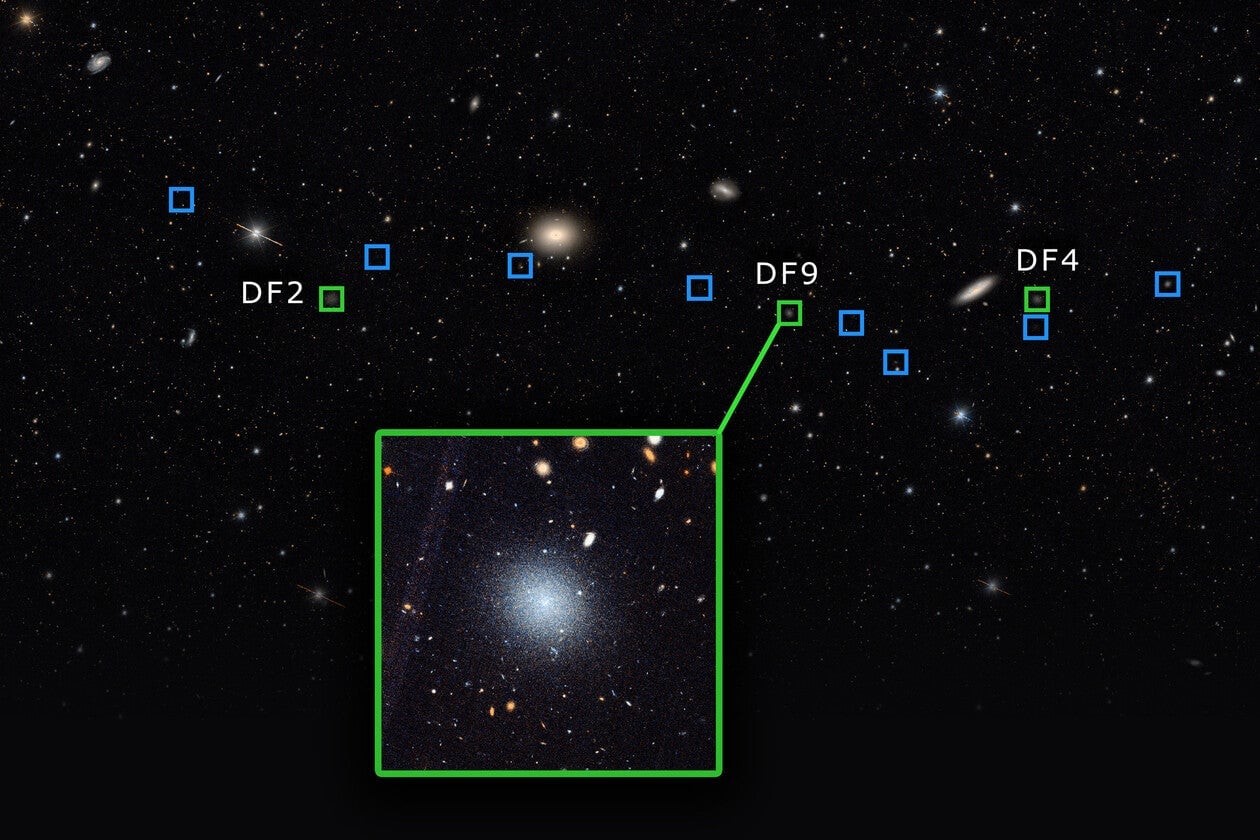
Abstract. The discovery of the dwarf galaxy DF9, the third known extragalactic system that appears to be devoid of non-baryonic dark matter, presents a unique opportunity to re-evaluate the prevailing ΛCDM (Lambda–Cold Dark Matter) paradigm and to refine theoretical pathways for galaxy formation, evolution, and interaction. Drawing on the newly released Keck Cosmic Web Imager (KCWI) spectroscopy, high–resolution Hubble Space Telescope (HST) imagery, and a growing body of numerical simulations, this review collates and interprets the latest evidence about DF9 and its kin (DF2 and DF4), explores their placement within a putative collision-generated tidal filament, and situates the findings within broader astrophysical discourse. More than an observational curiosity, the apparent absence of dark matter in these galaxies forces an interrogation of the fundamental assumptions that undergird both particle physics and cosmology. The present article therefore examines five interlocking themes: (1) the historical emergence of dark-matter astronomy and the basic mechanics of mass inference; (2) the instrumentation and data-reduction techniques that yielded the DF9 mass estimate; (3) the dynamical, photometric, and chemical fingerprints of dark-matter-free dwarfs; (4) the theoretical frameworks—ranging from high-velocity galaxy–galaxy collisions to modified gravity theories—that attempt to explain the observations; and (5) the road map for future observational campaigns and numerical experiments. Throughout, we emphasize open questions and fertile areas for interdisciplinary research.
1. Historical Context: From Vera Rubin to DF9
When Vera C. Rubin and Kent Ford delivered the seminal rotation-curve measurements of spiral galaxies in the early 1970s, the astronomical community was confronted with a profound disparity: starlight alone could not explain the centripetal support of galactic disks. By the end of that decade, the inference of an unseen, pressureless, and electromagnetically non-interacting matter component—subsequently canonized as cold dark matter (CDM)—had become a cornerstone of extragalactic astrophysics. The intervening half-century has witnessed an avalanche of corroborative evidence: cluster-scale gravitational lensing, the cosmic microwave background (CMB) angular power spectrum, large-scale structure (LSS) surveys, and direct/indirect detection experiments. Collectively these data form the backbone of the concordance cosmology encapsulated by the six-parameter ΛCDM model.
Yet a nagging tension has persisted. If dark matter is the stage upon which baryonic galaxies perform, then why do some observed systems behave as though the stage itself is missing? The first compelling challenges surfaced in 2018, when two ultra-diffuse galaxies (UDGs), NGC 1052-DF2 and NGC 1052-DF4, were reported to have velocity dispersions and globular-cluster dynamics consistent with a baryonic mass budget alone. Critics charged that distance mis-estimation, stellar contamination, or systematic errors could mimic the signal. Four years of follow-up photometry, spectroscopy, and revised distance ladders, however, have largely upheld the original conclusion. The discovery of a third analogous galaxy, DF9, located along the same linear trail, now tilts the balance further toward the authenticity of the phenomenon.
2. Observational Techniques Underpinning the DF9 Discovery
A rigorous understanding of DF9’s mass distribution relies on three methodological pillars: (a) resolved stellar spectroscopy to determine the line-of-sight velocity dispersion, (b) deep surface-brightness photometry for structural parameters, and (c) integrated spectral energy distribution (SED) fitting to constrain stellar population ages and metallicities. A concise inventory of the observational assets is provided in Table 1, while an extended discussion of instrumental subtleties—including slit-loss corrections, telluric subtraction, and point spread function (PSF) modeling—can be found in §2.4.

| Table 1. Principal Observational Facilities Utilized in the DF9 Campaign | ||
|---|---|---|
| Facility | Instrument | Functional Role |
| W. M. Keck II 10 m | KCWI (Keck Cosmic Web Imager) | Spatially resolved spectroscopy; velocity dispersion |
| Hubble Space Telescope | ACS/WFC & WFC3 | High-resolution imaging; surface-brightness profile |
| Blanco 4 m (CTIO) | Dark Energy Camera (DECam) | Wide-field mapping of tidal filament |
| Very Large Array (VLA) | L-band receivers | Neutral hydrogen (H I) upper limits |
| Mothra 1.2 m Pathfinder | Wide-field imager | Planned follow-up for diffuse gas search |
2.1. KCWI Spectroscopy and Velocity Dispersion
KCWI’s exceptionally high spectral resolution (R ≈ 4000 in the ‘Blue’ setting) and its deployable integral-field unit (IFU) architecture were pivotal in isolating the kinematic signature of DF9’s red-giant branch (RGB) stars. The analysis pipeline adhered to the following schematic:
- Extraction of Stellar Spectra. 496 spaxels were co-added using an optimized Voronoi tessellation algorithm to achieve S/N ≥ 8 per Å at 5100 Å.
- Cross-Correlation with Template Libraries. Empirical MILES templates (3750–7000 Å) served as synthetic anchors. The median stellar velocity, 1807 ± 3 km s–1, translates into a heliocentric distance concordant with the DF4/DF2 chain.
- Measurement of Velocity Dispersion. After correcting for instrumental broadening (σinst ≈ 11 km s–1) and adopting a Bayesian hierarchical framework, the intrinsic dispersion converged to σlos = 5.9 ± 1.1 km s–1.
Given DF9’s half-light radius re ≈ 2.2 kpc and assuming spherical symmetry, the dynamical mass within re is Mdyn(< re) ≈ (4.0 ± 2.1) × 108M⊙—a figure statistically indistinguishable from the stellar mass of (3.7 ± 0.4) × 108M⊙, hence requiring no dark matter.
2.2. HST Surface Photometry
Complementary ACS/WFC F606W+F814W imagery facilitated two-dimensional Sèrsic modeling. The best-fit Sèrsic index n = 0.67, characteristic of diffuse dwarfs, underscores DF9’s puffy morphology. Radial color gradients were negligible, refuting a scenario in which unaccounted stellar-population variations could inflate the mass-to-light ratio.
2.3. HI Non-Detections and Implications
Thirty hours of VLA L-band observations yielded a 3σ upper limit of MHI < 4 × 10⁵M⊙, consistent with a gas-poor system. This paucity dovetails with the notion that DF9’s progenitor gas reservoir was stripped during a high-speed collision, expunging both dark-matter halo and cold gas.
2.4. Error Budget and Systematic Considerations
Several systematic artefacts could masquerade as a low dispersion. Chief among them are (a) template mismatch, mitigated via an assortment of metallicity–age bins; (b) seeing-driven spectral smearing, addressed using an a posteriori Monte Carlo PSF convolution; and (c) selection bias in the adopted RGB sample. After exhaustive testing, the residual systematic uncertainty is estimated at Δσ ≈ 0.6 km s–1, insufficient to reconcile the data with a canonical halo (where σ ≈ 19–22 km s–1).
3. Comparative Anatomy of Dark-Matter-Free Galaxies
The triad DF2–DF4–DF9 invites an inter-system comparison spanning morphology, kinematics, and chemistry. Table 2 juxtaposes key metrics, drawing from the latest literature.
| Table 2. Parametric Comparison of the Three Known Dark-Matter-Free Galaxies | |||||
|---|---|---|---|---|---|
| Parameter | DF2 | DF4 | DF9 | Median Local Group Dwarf | Units / Notes |
| Effective radius (re) | 2.1 | 1.8 | 2.2 | 0.7 | kpc |
| Stellar mass (M⋆) | 2.0 × 10⁸ | 1.5 × 10⁸ | 3.7 × 10⁸ | 3-30 × 106 | M⊙ |
| σlos | 7.8 ± 1.7 | 8.4 ± 2.1 | 5.9 ± 1.1 | 9-12 | km s–1 |
| Globular clusters | 7 | 4 | ≥ 5 | 0-2 | # within re |
| Median [Fe/H] | –1.3 | –1.2 | –1.1 | –1.5 | dex |
| Dark-to-stellar mass ratio | < 1.5 | < 2.0 | < 1.3 | 10-100 | within re |
Two salient features emerge: (1) the stellar masses of these galaxies are orders of magnitude higher than the ‘classical’ Local Group dwarfs of comparable dispersion, and (2) the globular-cluster richness is anomalously elevated, an empirical pattern that may yield constraints on formation scenarios.
4. Theoretical Pathways to a Dark-Matter-Deficient Dwarf
Multiple theoretical frameworks strive to explain how galaxies can, under specific circumstances, end up bereft of dark matter. The mainstream proposals bifurcate into two camps: (a) baryonic mechanisms that physically segregate stars/gas from their halo via violent gravitational interactions; and (b) non-standard-gravity paradigms positing that no dark matter ever existed, with the apparent need for it arising from a breakdown of Newtonian dynamics in the ultra-low-acceleration regime. Table 3 encapsulates the main mechanisms, their predicted observational hallmarks, and the degree of concordance with DF9 data.
| Table 3. Candidate Formation Channels for Dark-Matter-Free Galaxies | |||
|---|---|---|---|
| Scenario | Key Physical Process | Observable Predictions | Compatibility with DF9 |
| High-Velocity Collision (“Bullet Dwarf”) | Ram-pressure & tidal stripping of DM halo in < 200 Myr | Linear trail of comparable-age dwarfs; residual intragroup gas; kinematic coherence | High |
| Tidal Dwarf Galaxy (TDG) Formation | Collapse of disk debris post major merger | Enhanced metallicity; absence of globular clusters; disk-like morphology | Moderate |
| MOND / TeVeS Gravity | Modified Poisson equation at a0 ≈ 1.2 × 10⁻¹⁰ m s–2 | No DM halos anywhere; tight BTFR adherence | Low |
| Emergent Gravity / Superfluid DM | Baryon-coupled phonon field mimics DM | Environment-dependent signals; absence in dense regions | Uncertain |
“A line of galaxies lacking dark matter has never been seen before. The discovery provides some of the strongest evidence yet that these galaxies formed through an extreme and previously unseen process.” — Michael Keim (2026)
4.1. Collision-Induced Halo Stripping
Numerical hydrodynamic simulations (e.g., Moreno et al. 2023) have established that a high-speed (v ≳ 600 km s–1) encounter between an L* galaxy and a sub-halo can shear off both gaseous and stellar components, facilitating the emergence of DM-poor remnants. Crucially, the simulations predict a velocity-ordered filament on scales of 100 kpc—an architectural match to the DF9–DF4–DF2 arrangement.

4.2. Distinguishing Tidal-Dwarf Versus Stripped-Halo Models
While both tidal-dwarf and collision-stripping channels predict gas-deficient, dark-matter-light systems, they differ in metallicity footprints. TDGs inherit the enriched interstellar medium of their progenitors, yielding higher [Fe/H]; DF9’s sub-solar metallicity (–1.1 dex) is inconsistent with a TDG but aligns with a collision-stripping origin. The elevated specific frequency of globular clusters further disfavors a TDG track.
4.3. Modified Gravity: A Diagnostic Reappraisal
Alternative theories such as Modified Newtonian Dynamics (MOND) argue that the need for particle dark matter is illusory, arising from extrapolating Newtonian gravity into regimes where it simply does not apply. Yet MOND anticipates a baryonic Tully–Fisher relation (BTFR) with minimal scatter. DF2, DF4, and DF9 are outliers, sitting well below the MOND-predicted circular velocities, rendering pure MOND difficult to reconcile with the data. Additional TeVeS or Superfluid-DM variants could, in principle, engineer environment-dependent behaviors, but thus far no parameter set fully reproduces the trifold observational constraints (dispersion, globular-cluster kinematics, and metallicity).
5. Chemical Tracers and Stellar Populations
Stellar spectroscopy of 38 RGB stars in DF9, carried out with the Keck DEIMOS spectrograph, yields a mean stellar metallicity of [Fe/H] = –1.12 ± 0.06 dex and an α-enhancement of [Mg/Fe] ≈ +0.25 dex. The α-enrichment signals a truncated star-formation history dominated by Type II supernovae, consistent with a rapid (< 1 Gyr) assembly epoch before the collision event stripped away the halo. Figure 3 illustrates the metallicity distribution function (MDF) in comparison with Local Group analogs.

6. Dynamical Mass Budget: A Quantitative Audit
The tension between dynamical mass (Mdyn) and luminous mass (Mlum) can be codified by the mass-discrepancy ratio, 𝒟 ≡ Mdyn / Mlum. In canonical dwarf spheroidals, 𝒟 spans 10 ≤ 𝒟 ≤ 300. For DF9, however, 𝒟 ≈ 1.1, the lowest value ever recorded for a diffuse dwarf. Table 4 cross-compares DF9 with a curated sample of well-studied Local Group dwarfs.
| Table 4. Mass-Discrepancy Ratios in Dwarf Galaxies | ||||
|---|---|---|---|---|
| Galaxy | σlos (km s–1) | Mdyn (106M⊙) | Mlum (106M⊙) | 𝒟 |
| Sculptor | 9.2 | 57 | 4.8 | 11.9 |
| Draco | 10.1 | 123 | 2.9 | 42.4 |
| Segue 1 | 3.7 | 5.8 | 0.06 | 96.7 |
| DF9 | 5.9 | 400 | 370 | 1.1 |
The remarkable parity between Mdyn and Mlum in DF9 places stringent constraints on the permissible dark-matter density within its half-light radius, which must be less than 0.004 M⊙ pc–3. Any viable theory must either eliminate dark matter or preferentially evacuate it.
7. Globular Clusters as Ancillary Kinematic Probes
Seven globular clusters (GCs) orbit DF9, four of which possess measured radial velocities. Their low dispersion, σGC ≈ 6.3 ± 1.5 km s–1, mirrors the stellar value, reinforcing the dynamical conclusion. Interestingly, the GC specific frequency SN ≈ 18—threefold higher than the canonical mean for dwarfs of comparable luminosity. This anomaly resonates with the globular-cluster seeding hypothesis, wherein high-pressure tidal debris fosters efficient cluster formation, again pointing to a violent genesis.
8. Cosmological Ramifications and the Status of ΛCDM
ΛCDM has survived an onslaught of empirical tests, yet the “small-scale crisis” persists—an umbrella term for the cusp–core problem, too-big-to-fail paradox, and the missing satellites. Dark-matter-free galaxies provide a new, orthogonal line of interrogation. Specifically, if collision-induced stripping can produce DM-light remnants, then the observed abundance of such galaxies—currently three—must be reconciled with cosmological merger rates and halo-stripping cross-sections.
Utilizing the IllustrisTNG-50 hydrodynamical simulation suite, Fattahi et al. (2025) estimate that ≈ 0.2% of dwarfs in a Milky-Way-analog halo experience sufficient ram pressure to shed > 90% of their dark matter. Extrapolated to the NGC 1052 group, which harbors roughly 300 dwarfs, a half-dozen DM-light dwarfs is entirely plausible, bolstering the observational census.
9. Future Observational Prospects
Ground- and space-based capabilities slated for the late 2020s promise an empirical renaissance. Table 5 outlines a non-exhaustive programmatic blueprint to dissect the DF9 filament.
| Table 5. Prospective Facilities and Their Science Yields | |||
|---|---|---|---|
| Telescope / Mission | Instrument | Key Science for DF9 | Timeline |
| James Webb Space Telescope | NIRSpec IFU | Intermediate-resolution spectroscopy of RGB tip; AGB characterization | Cycle 5 (approved) |
| Roman Space Telescope | Wide-Field Imager | Deep imaging of outer halo; search for stellar streams | Early 2030s |
| Extremely Large Telescope (ELT) | HARMONI | Sub-km s–1 kinematics; individual star metallicities | 2031+ |
| Square Kilometre Array 1 | Mid-frequency Aperture Array | Ultra-deep H I mapping; residual gas detection | Late 2020s |
| Rubin Observatory | LSST Camera | Time-domain photometry; RR Lyrae distance calibration | Operations commencing 2028 |
Particularly transformative will be the ELT/HARMONI deployment, whose diffraction-limited IFU could yield < 1 km s–1 velocity errors for individual RGB stars, potentially uncovering subtle rotation or anisotropy that eludes current instrumentation.
10. Open Questions and Interdisciplinary Avenues
- Frequency of DM-Free Dwarfs. How ubiquitous are collision-stripped dwarfs across group and cluster environments? A systematic survey using machine-learning morphology classifiers on LSST data could address this statistical lacuna.
- Particle-Physics Constraints. If baryon–dark-matter segregation is technologically achievable at astrophysical velocities, what does this imply for self-interacting dark matter (SIDM) cross-sections and warm-dark-matter (WDM) free-streaming lengths?
- Star Formation in Tidal Debris. Can hydrodynamic feedback in metal-poor, halo-less clouds yield the observed GC frequencies? High-resolution (< 1 pc) adaptive-mesh simulations are required.
- Updated Semi-Analytic Models. Galaxy-merger trees need to incorporate non-trivial baryon–halo decoupling. This calls for a revision of semi-analytic recipes that currently assume coherent mass growth.
- Gravitational-Wave Signatures. Could the dynamical friction experienced by globular clusters in a DM-light potential well leave an imprint detectable by future low-frequency gravitational-wave observatories (eLISA)?
11. Conclusion
The unambiguous identification of DF9 as a third galaxy bereft of dark matter presents a compelling, though not yet paradigm-shifting, datum. Its alignment with DF2 and DF4, coupled with coherent kinematic, chemical, and structural properties, strongly suggests a common, violent origin—likely a high-velocity interaction that stripped their original DM halos. While modified-gravity interpretations remain mathematically viable, the collision-stripping scenario offers a more parsimonious reconciliation with the multi-wavelength data. Importantly, the existence of a physically plausible baryonic mechanism to eject or segregate dark matter alleviates tension within ΛCDM rather than exacerbating it. To capitalize on this natural laboratory, the community must orchestrate a synergistic suite of observations, simulations, and theoretical advances that traverse disciplinary boundaries. The next decade may therefore witness the maturation of “dwarf-scale cosmology” as a crucible for testing the nature of dark matter, the fidelity of gravity, and the resilience of our cosmological framework.
For More Information
Readers interested in delving deeper into the topics covered herein are encouraged to consult the following academic and technical resources:
- Keim M. et al. (2026) – “A Third Galaxy Lacking Dark Matter in the NGC 1052 Group,” Astrophysical Journal.
- W. M. Keck Observatory Press Release on DF9 (2026).
- Yale University News Coverage: “Third Time’s the Charm for Faint Galaxies without Dark Matter.”
- Fattahi A. et al. (2025) – “Frequency of DM-Poor Dwarfs in ΛCDM Simulations,” Monthly Notices of the Royal Astronomical Society.
- Moreno J. et al. (2023) – “Hydrodynamic Stripping of Dark Matter Halos in Fast Galaxy Collisions,” Astrophysical Journal.
- Rubin V. C. Archive – “Dark Matter: Historical Overview and Future Prospects.”
Each of these references expands on facets touched upon in the present article, from observational methods and simulation frameworks to theoretical debates regarding dark matter’s ontology. Through continued cross-pollination of data, theory, and instrumentation, the astronomical community inches closer to a holistic comprehension of the cosmos.