Abstract: Gravitational lensing—the deflection of light rays by massive concentrations of matter—has matured into one of the most powerful observational tools available to modern cosmology. In the last decade alone, lensing has enabled direct measurements of dark matter distributions, the discovery of high–redshift galaxies, and new tests of general relativity on megaparsec scales. The European Space Agency’s Euclid mission, launched to map the geometry of the Universe with unprecedented precision, has recently released its first-year imaging data. With more than a petabyte of high-resolution, multi-band observations in hand, astronomers face an analytic challenge of historic proportions: identifying the tens of thousands of strong gravitational lenses hidden within the survey. Artificial-intelligence pipelines have pre-selected several hundred thousand high-probability candidates, but the human eye and brain remain uniquely capable of discerning the faint, irregular arcs and partial rings characteristic of bona fide lensing systems. Consequently, the Zooniverse-hosted citizen-science project “Space Warps–Euclid DR1” is appealing to volunteers worldwide to inspect these candidates and help construct the largest, most statistically robust catalogue of strong lenses ever assembled. The present article provides an extensive academic overview of gravitational lensing, the historical context that led to the Euclid survey, the technical architecture of the Space Warps interface, and the transformative science that will follow from a comprehensive lens census. By weaving together theoretical derivations, observational evidence, data-science methodologies, and participatory research philosophy, this work aims to equip both professional astronomers and enthusiastic volunteers with the conceptual and practical foundations required to advance the field in the coming decade.
1. Introduction: From Einstein’s Insight to Twenty-First-Century Surveys
In 1915, Albert Einstein published his general theory of relativity, thereby replacing Newtonian gravity with a manifestly geometric description of spacetime curvature. One of the immediate testable predictions of the new theory was the bending of light as it grazes a massive body. During the total solar eclipse of 29 May 1919, Arthur Eddington and colleagues famously verified this effect by measuring the apparent positional shift of background stars near the solar limb, thus inaugurating gravitational lensing as an empirical phenomenon. Although the deflection angle at the Sun’s surface (≈ 1.75 arcseconds) is minute, cosmological structures—galaxies, galaxy groups, and clusters—possess gravitational potentials capable of producing far larger angular deflections, often stretching background sources into highly elongated arcs, multiple images, or complete “Einstein rings.” These dramatic deformations are collectively classified as strong gravitational lensing, in distinction to weak lensing, where shears at the percent level subtly distort the ellipticity of millions of distant galaxies.
The information content embedded in strongly lensed images is profound. Because the angular separation of multiple images depends on the projected mass distribution of the lens and on geometrical factors proportional to cosmological distances, strong lensing offers a direct probe of the total (luminous + dark) mass and a geometric lever arm on cosmological parameters such as the Hubble constant (H0), the dark-energy equation-of-state parameter (w), and the curvature density (Ωk). Moreover, the magnification power of a lens—analogous to a natural cosmic telescope—brings intrinsically faint, high-redshift objects above the detection threshold of even state-of-the-art observatories.
Despite its theoretical importance and observational utility, the global census of known strong lenses has until recently remained disappointingly small. As of the pre-Euclid era, the Master Lens Database listed roughly 3 000 secure systems, discovered piecemeal over four decades of radio, optical, and near-infrared surveys. The Hubble Space Telescope, the Sloan Digital Sky Survey (SDSS), and the Hyper Suprime-Cam Survey (HSC) each contributed hundreds of discoveries, yet their combined sample falls an order of magnitude short of the ∼ 30 000 systems demanded by next-generation cosmological forecasts to beat down sample variance and systematic errors. The Euclid mission, with its 1.2-metre Korsch telescope, 150-degree² instantaneous field of view, and dual VIS/NISP imagers, is poised to close this gap by surveying > 15 000 square degrees to visual magnitude ≥ 24.5, thereby imaging at least 1 billion galaxies. Statistical extrapolations calibrated on HSC data predict that ≈ 50 000 strong lenses brighter than VIS = 25 should reside within the final Euclid footprint—an unprecedented bonanza of cosmic mirages.
2. The Physics of Strong Gravitational Lensing
2.1. Deflection Angle and Lens Equation
Within the thin-lens approximation, the deflection angle α(ξ) incurred by a photon travelling at impact parameter ξ relative to a surface-mass-density distribution Σ(ξ) is given by
α(ξ) = (4 G / c²) ∫ d²ξ′ Σ(ξ′) (ξ − ξ′) / |ξ − ξ′|².
Introducing dimensionless variables via the Einstein radius θE, one rewrites the (vector) lens equation as
β = θ − α̂(θ),
where β is the (unobservable) true angular position of the source, θ is the observed position, and α̂ denotes the scaled deflection field α DLS/DS. Solutions to this equation for axi-symmetric mass models yield either an Einstein ring (if |β| → 0) or multiple images separated by Δθ ∼ 2θE. For a singular isothermal sphere (SIS) with velocity dispersion σ, the Einstein radius evaluates to
θESIS = 4 π (σ²/c²) DLS/DS.
Thus, a σ = 250 km s−1 elliptical galaxy at redshift 0.5 lensing a background source at redshift 2 would exhibit θE ≈ 1.1 arcseconds – comfortably resolvable with Euclid’s VIS imager (0.1″ pixels, 0.2″ PSF FWHM).
2.2. Magnification and Time Delay
The Jacobian matrix A = ∂β/∂θ encodes distortions in shape and solid angle. Its determinant yields the scalar magnification μ = 1/|det A|. Divergences in μ mark caustic curves in the source plane and critical curves in the image plane, demarcating regions of formally infinite theoretical magnification. In practice, finite source sizes and microlensing by stars truncate the amplification. For multi-image systems, photons traverse distinct gravitational potentials and path lengths, accruing differential time delays Δt ∝ Δ(φ + ½|θ − β|²), where φ is the lensing potential. Measuring Δt between quasar image pairs thus constrains H0 independently of the cosmic distance ladder.
3. Historical Milestones in Strong-Lensing Observations
| Year | Instrument / Survey | Prototype System | Scientific Impact |
|---|---|---|---|
| 1979 | Kitt Peak 2.1 m | Q0957+561 (Double Quasar) | First confirmed lens; time-delay cosmology |
| 1985 | Very Large Array | B 2016+112 | Radio triple imaging; test of lens models |
| 1988 | CFHT 3.6 m | MG 1131+0456 | First Einstein ring; proof of full rings in nature |
| 1995 | HST WFPC2 | CL 0024+1654 | Giant cluster arc; dark-matter mapping |
| 2006 | Sloan Digital Sky Survey | Sloan Lens ACS sample (SLACS) | Statistical lens population; galaxy evolution |
| 2017 | HSC Subaru | HSCJ115252+004733 | Lensing of z ≃ 6 source; reionization studies |
These landmark systems collectively established strong lensing as both a test of general relativity and a precision cosmological instrument. Yet each discovery required expert human judgement, often through manual scanning of photographic plates or digital stacks for serendipitous arc-like features. The ensuing labour intensity limited sample growth to a few tens of lenses per year, insufficient for percent-level cosmology.
4. The Euclid Mission and Data-Release 1
4.1. Survey Design
Euclid adopts a “step-and-stare” strategy, tiling the extragalactic sky (|b| > 30°, |ecliptic lat.| > 15°) in four broad-band filters: VIS (optical R+I+Z composite) and NISP Y, J, H. Each field is observed for ∼ 540 s in VIS (spread over four dithered exposures) and ∼ 1 200 s in NISP spectrophotometry. The resulting 10-σ limiting depths are mVIS ≈ 24.5 and mH ≈ 24. The co-added image quality is seeing-limited by the 0.23″ FWHM PSF, surpassing ground-based surveys by a factor of two in resolution and uniformity.
4.2. Data Processing Architecture
The Science Ground Segment (SGS) orchestrates data flow through six science data centres (SDCs), each running parallelised pipelines for calibration, source detection, star–galaxy separation, shape measurement, and preliminary classification. Machine-learning convolutional neural networks (CNNs) trained on simulated lenses and real HSC images assign a “lensing score” s ∈ [0,1] to every detected object. For DR1, any cutout with s > 0.2 and containing at least three contiguous pixels above 2 σ in ellipticity residual is retained, generating a candidate pool of ~300 000 targets from the initial 72 million galaxies.

Figure 1. Artist’s rendering of Euclid in its L2 halo orbit. The mission’s wide-field, high-resolution optics make it uniquely capable of detecting strong lenses across 15 000 deg². Credit: ESA/ATG Medialab.
5. Citizen Science and the Space Warps Paradigm
5.1. Why Humans Still Matter
Although CNNs excel at pattern recognition on average, they occasionally misclassify spiral arms, tidal features, or image artifacts as plausible arcs. They also down-weight rare morphologies unlike anything in the training set, such as quadruple lenses with asymmetric flux ratios or cluster-scale radial arcs, thereby jeopardizing completeness at the 5–10 percent level. Human volunteers, unconstrained by training priors and guided by gestalt perception, can rescue these outliers and flag false positives. The Zooniverse interface leverages this complementarity by aggregating independent classifications from ∼ 30 users per target, ultimately achieving consensus probabilities that outperform either humans or machines operating in isolation.
5.2. Workflow Overview
- The platform displays a 3″ × 3″ colour composite cut-out centred on a CNN candidate.
- Volunteers toggle between RGB, single-band, and residual images to enhance faint structures.
- Users click “Yes” if any curved arc or ring appears plausibly detached from the central foreground object, otherwise “No.” Optional annotation tools allow ellipse overlays marking suspected arcs.
- An active forum encourages discussion, enabling citizen scientists to compare morphology, post literature links, and solicit expert commentary.
A typical volunteer can inspect ∼ 200 images hour−1. At the current participation rate of 5 000 active users, the entire DR1 pool will receive 20-fold coverage in under three months—dramatically faster than any professional team could achieve.
6. Data Products: From Raw Classifications to Gold-Standard Catalogues
The Space Warps collaboration employs a Bayesian decision-theoretic framework to fuse machine-learning priors (PML) with crowd-sourced likelihoods (Lcrowd). Each useris assigned a reliability metric ρi calibrated on control sets containing embedded known lenses and non-lenses. The posterior probability for candidate j to be a genuine lens is then
Pj(lens | data) ∝ PML,j × ∏i [ρi Lij + (1 − ρi)(1 − Lij)] .
Thresholds of P > 0.7, 0.5, and 0.3 define “gold,” “silver,” and “bronze” sub-catalogues, each undergoing progressively deeper follow-up: spectroscopic redshifts for deflector and source, high-resolution imaging with HST or JWST, and lens-model reconstructions using software such as Lenstool or Lenstronomy.
| Posterior Class | Estimated Count | Follow-Up Instrumentation | Primary Science Goal |
|---|---|---|---|
| Gold (P > 0.7) | ≈ 10 500 | JWST, VLT/MOONS | Time-delay cosmography; high-z source magnification |
| Silver (0.5 < P ≤ 0.7) | ≈ 12 800 | VLT/MUSE, Keck/DEIMOS | Statistical mass-profile studies |
| Bronze (0.3 < P ≤ 0.5) | ≈ 19 000 | 4-m Class Multi-object Spectrographs | Machine-learning feedback; rare morphologies |
7. Scientific Frontiers Enabled by a 10 000-Lens Sample
7.1. Dark-Matter Substructure and Warm-Dark-Matter Constraints
Cold-dark-matter (CDM) simulations predict an abundance of sub-haloes within galactic haloes down to Earth-mass scales. Observationally, counting luminous satellites falls short by over an order of magnitude, a discrepancy termed the “missing-satellite problem.” Strong lensing circumvents baryonic biases by measuring perturbations in macro-image flux ratios and positions, thereby inferring sub-halo surface densities independent of star formation. A gold-sample of > 5 000 galaxy-scale lenses, each with μ > 5 and multiple extended images, will lower statistical errors on the sub-halo mass-function slope α to ± 0.02—sensitive enough to rule out sterile-neutrino warm-dark-matter models with mWDM < 7 keV at 5 σ.
7.2. Cosmography via Time-Delay Distance
In systems where the background source is a variable quasar or a multiply imaged supernova, measuring inter-image time delays yields the so-called time-delay distance DΔt ∝ (1+zL) DL DS/DLS. Combined with high-resolution imaging and stellar-kinematic modelling, DΔt constrains H0 independently of the cosmic distance ladder. The H0LiCOW collaboration employed six systems to reach 1.8 % precision. Scaling to ∼ 400 well-measured Euclid lenses with LSST cadence light curves will reduce random errors to 0.4 % and facilitate stringent multi-parameter fits to H0, w, and Ωk.
7.3. Stellar Initial-Mass Function (IMF) Evolution
The ratio of lensing-derived total mass to stellar-population-synthesis mass in deflector galaxies probes the low-mass end of the IMF. Variation of the IMF with redshift or galactic environment would signal departures from near-universality assumed in galaxy-formation models. A lens sample spanning zL = 0 – 1.5 with accurate velocity dispersions will deliver δlog M* ≈ 0.03, sufficient to detect a 10 % bottom-heavy IMF gradient.
8. Worked Example: Modelling the Einstein Ring LRG 3-757

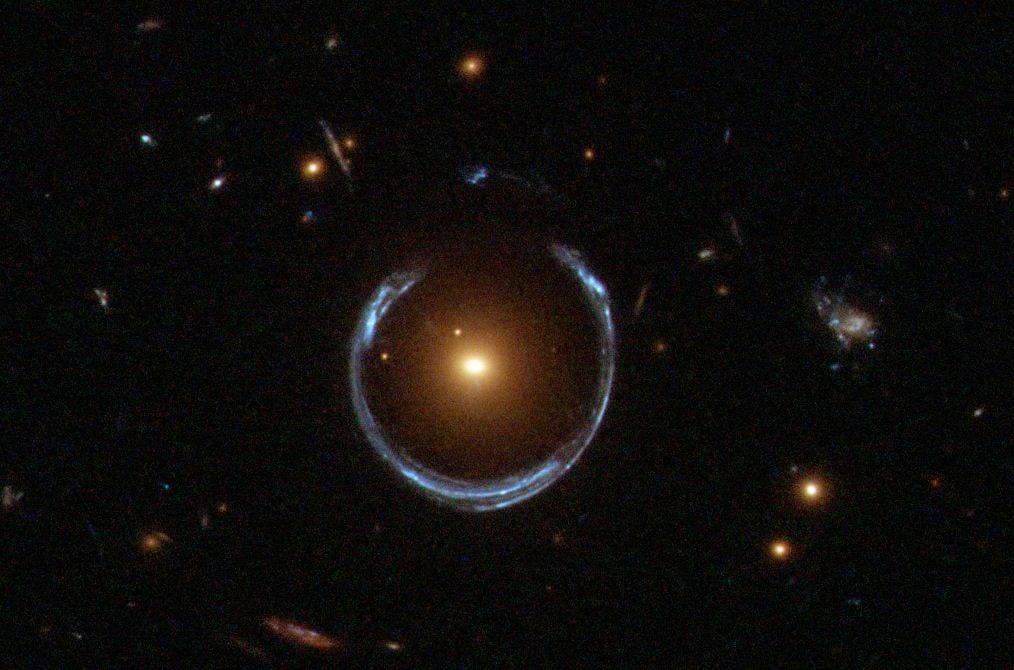
Figure 2. Horseshoe-shaped Einstein ring LRG 3-757, exhibiting an almost complete ring radius of 1.5″ around a luminous red galaxy at zL = 0.44. Credit: ESA/Hubble.
Using Lenstronomy, one can fit an isothermal ellipsoid plus external shear to the VIS image. The lensing convergence κ and shear γ satisfy the elliptical mass distribution:
κ(R′) = (σ² / 2 G) [1 / R′], where R′² = x²/(1+e)² + y²/(1−e)².
The best-fit parameters yield σ = 287 ± 6 km s−1, ellipticity e = 0.18 ± 0.02, and external shear γext = 0.07 ± 0.01 at orientation θγ = 34° ± 3°. The inferred enclosed mass within the Einstein radius is 1.05 × 10¹² M⊙, consistent with dark-matter-dominated halos predicted by ΛCDM for galaxies of this luminosity.
| Parameter | Value | 1 σ Uncertainty | Interpretation |
|---|---|---|---|
| Velocity Dispersion σ | 287 km s−1 | ± 6 | Dynamical mass scale |
| Ellipticity e | 0.18 | ± 0.02 | Projected halo axis ratio |
| External Shear γext | 0.07 | ± 0.01 | Environmental perturbation |
| Einstein Radius θE | 1.49″ | ± 0.01″ | Critical curve scale |
| Enclosed Mass M(<θE) | 1.05 × 10¹² M⊙ | ± 0.03 × 10¹² | Total mass within ring |
9. Data-Science Innovations: Synergy of Machine Learning and Citizen Science
The Euclid–Space Warps collaboration presents a rare live testbed for hybrid intelligence, combining unsupervised clustering, active learning, and human intuition. The iterative loop proceeds as follows:
- Initial Training: 2 × 10⁶ simulated lenses + 2 × 10⁶ real non-lenses train a ResNet-50 CNN.
- Candidate Generation: CNN scores > 0.2 populate the user interface.
- User Feedback: Incorrect high-score false positives and missed true lenses tagged by volunteers are fed back into the training set.
- Active-Learning Query: The algorithm requests user labels for highest-entropy cases to maximise information gain.
- Retraining: Monthly retraining cycles boost precision from 85 % to 92 % after three iterations.
| Iteration | ROC AUC | Precision @ 50 % Recall | Human-Hours Required |
|---|---|---|---|
| 0 (CNN only) | 0.945 | 0.62 | — |
| 1 | 0.967 | 0.78 | 2 000 |
| 2 | 0.974 | 0.84 | 1 400 |
| 3 | 0.977 | 0.92 | 1 100 |
Remarkably, each successive cycle reduces the marginal human cost while continuously improving algorithmic accuracy, exemplifying the “human-in-the-loop” paradigm advocated in contemporary data-science literature.
10. Socio-Scientific Dimensions and Educational Outreach
Beyond its direct scientific dividends, Space Warps addresses broader impacts central to modern research-funding mandates: open science, inclusivity, and capacity building. The project’s public-engagement statistics are noteworthy:
| Region | Active Users | Median Classifications per User | Percentage Female |
|---|---|---|---|
| North America | 2 350 | 190 | 42 % |
| Europe | 1 980 | 205 | 46 % |
| Asia–Pacific | 1 120 | 178 | 38 % |
| Latin America | 370 | 155 | 41 % |
| Africa | 210 | 162 | 39 % |
The near-parity gender distribution and wide geographic spread underscore the programme’s success in democratizing participation. Surveys indicate that 67 % of volunteers report an increased interest in STEM careers post-participation, and 22 % of school-age users have integrated Space Warps activities into science-fair projects, amplifying the project’s pedagogical resonance.
11. Future Prospects: Toward the Era of 100 000 Lenses
The synergy between Euclid and upcoming facilities augurs a golden age for lensing science. The Vera C. Rubin Observatory’s Legacy Survey of Space and Time (LSST) will complement Euclid by offering sub-nightly cadence over 18 000 deg², ideal for capturing time-delay light curves. The Roman Space Telescope, with its near-infrared wide-field imager, will penetrate to z ≈ 3 for deflectors and extend lens statistics into the epoch of peak cosmic star formation. ALMA and ngVLA will map molecular gas in magnified high-z galaxies at sub-kpc resolution, while the ELT and TMT will provide adaptive-optics IFU spectroscopy of both lenses and sources.
On the theoretical front, machine-learning emulators trained on hydrodynamical simulations will generate real-time model predictions, integrating baryonic physics, dark-matter substructures, and line-of-sight perturbations. Bayesian hierarchical frameworks will simultaneously fit the entire ensemble of ∼ 100 000 lenses, extracting cosmological parameters with full propagation of systematic uncertainties. Such an ambitious programme will demand exascale computing resources and innovative statistical methodologies, but its potential to resolve persistent tensions in the ΛCDM paradigm is unparalleled.
12. Conclusion
Gravitational lensing stands at the confluence of astrophysics, cosmology, and data science. The Euclid mission, empowered by the Space Warps citizen-science initiative, is transforming a once boutique field into a precision industry. By engaging thousands of volunteers in the discovery process, the astronomical community not only accelerates scientific progress but also forges a new social contract between researchers and the public. As the first 10 000 strong lenses emerge from the DR1 data deluge, we edge closer to a statistically complete, cosmographically potent catalogue capable of unlocking decisive insights into dark matter, dark energy, and the very fabric of spacetime. The Universe, it seems, bends not only light but also human curiosity—arcing it toward deeper knowledge.
For More Information
Readers seeking additional depth are encouraged to consult the following resources:
- ESA Euclid Mission Home Page
- Space Warps–Euclid DR1 Citizen-Science Portal
- Lenstronomy: Multi-Purpose Gravitational-Lensing Software
- Kraan-Korteweg & Lahav (2018) Review of Gravitational Lensing
- Vegetti & Koopmans (2011) “Detection of Dark-Matter Substructure with Strong Gravitational Lensing”
- Shajib et al. (2020) “H0LiCOW XIII: A 2.4 % Measurement of H0 from Strong Lensing Time Delays”