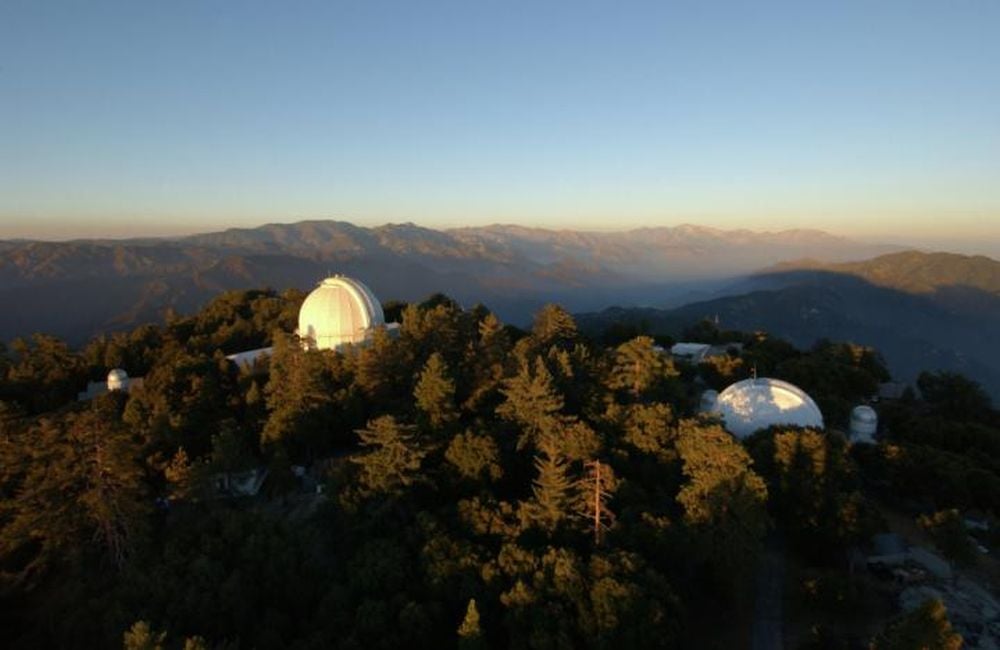
Georgia State University’s Center for High Angular Resolution Astronomy (CHARA) stands as a beacon in the field of astrophysics, adeptly navigating the intricate cosmos with its cutting-edge technology and unparalleled observational capabilities. As CHARA embarks on its third decade, we reflect on its remarkable contributions and explore the potential discoveries that await us in the coming years.
A Brief Overview of CHARA's Evolution
Established to create a new frontier in stellar studies, CHARA serves as a six-telescope optical interferometer located at Mt. Wilson, California. Its inaugural observations commenced two decades ago, shaping a narrative of progress and unprecedented scientific achievement shared through over 276 published papers. This extensive body of research has catalyzed advancements in our understanding of stellar evolution, physical characteristics of stars, and circumstellar phenomena.
Foundational Achievements
The history and development of CHARA can be traced through several milestone publications. Among the earliest was the pioneering paper led by Hal McAlister, focused on the luminous star Regulus. This groundbreaking research showcased CHARA's ability to perform interferometric measurements, providing significant insights into the phenomenon of gravity darkening in rapidly rotating stars. This breakthrough not only laid the foundation for future studies but also established CHARA as a vital tool in the domain of optical interferometry.
CHARA's Contributions to Stellar Physics
Over the years, CHARA has facilitated numerous discoveries and provided invaluable data that continue to shape our understanding of the universe. Below are some notable contributions:
| Contribution | Description | Significance |
|---|---|---|
| Measurement of Stellar Sizes | Determining the physical sizes of a wide range of stars. | Enhances existing stellar evolution models. |
| Imaging Stellar Features | Producing images of star surfaces and their structures. | Provides insights into star composition and behavior. |
| Study of Circumstellar Disks | Resolving disks around Be stars. | Illuminates material ejection mechanisms from stars. |
| Rapidly-Rotating Stars | Research on the effects of rapid rotation on stellar shapes. | Reveals the deformation and gravity darkening effects. |
| Nova Explosions | Imaging and analyzing Nova fireballs post-explosion. | Expands understanding of explosive stellar events. |
Deepening our Understanding of Nova Explosions
One of the most remarkable capabilities of CHARA is its ability to image Nova explosions. This phenomenon occurs in binary star systems where one star is a white dwarf. The white dwarf accumulates hydrogen from its companion star, leading to explosive outbursts. By employing stellar interferometry, CHARA achieved the first images of Nova during the early fireball stage, providing unprecedented insight into the expansion and evolution of ejected material.
This research figure demonstrates CHARA's ability to measure the expansion of the Nova fireball from Nova Delphinus 2013 (V339 Del), indicating clumpy structure within the fireball.
Recent Advancements and Upgrades
In pursuit of remaining at the forefront of modern astrophysics, CHARA has implemented numerous upgrades in technology and instrumentation. A significant recent development was the addition of a seventh mobile telescope, expanding the array's baseline from 330 meters to 550 meters. This upgrade enhances the interferometer's capabilities to resolve even larger stars and delve deeper into the mysteries of their evolutions and characteristics.
In conjunction with the National Science Foundation's $3.5 million grant awarded in 2024, these enhancements will usher in new research opportunities. The array is not only poised for groundbreaking results regarding stars and planets but also has potential insights into distant active galaxies.
Future Directions: What Lies Ahead for CHARA?
As CHARA transitions into its third decade, the prospect of unveiling the cosmos’ myriad secrets continues to excite the astronomical community. Future research directions include:
- Improving the measurement techniques for rapidly-rotating stars.
- Expanding studies on circumstellar disks to understand their properties and dynamics.
- Continuing to explore Nova explosions and the processes underlying their phenomena.
- Collaborating with missions like Gaia to enrich stellar evolution models.
- Facilitating public outreach and educational initiatives to inspire the next generation of astronomers.
Impact on Exoplanetary Research
Exoplanet research has gained significant momentum, particularly regarding the conditions under which these planets form and evolve. Since stars are the cornerstone of planetary systems, understanding their properties is vital.
“Without understanding stars, we'll never understand planets,” stated Theo ten Brummelaar, highlighting the intrinsic link between stellar and planetary science. CHARA’s detailed observations contribute immensely to the growing knowledge regarding stars that host exoplanets, thereby enriching our understanding of the potential for life beyond Earth.
An HR diagram of stars, many of which host exoplanets, showcasing CHARA's contributions to stellar science over the past two decades.
Conclusion: A Bright Future Awaits
Reflecting on the accomplishments of CHARA thus far and the promising outlook for its future, the center stands as a testament to the power of innovation in astrophysics. The continuous evolution of CHARA signifies not only progress in observational capabilities but also an unwavering commitment to advancing our comprehension of the universe.
“It’s astonishing how much the array has revealed to us about the stars and their lives,” remarked Douglas Gies, current CHARA Director. As we turn our gaze to the cosmos, the potential for new discoveries lies ahead, reminding us of our ability to unravel the complexities of existence one star at a time.
For More Information
- National Science Foundation: CHARA Array
- Georgia State University
- Understanding the CHARA Array: A Comprehensive Overview
- CHARA Array - Wikipedia
- CHARA Research Papers Archive
With decades of achievements behind it, we look forward eagerly to what secrets the CHARA Array will reveal in its ongoing quest to illuminate the nature of stars and the universe.