The interstellar medium (ISM) is a fascinating and complex region, acting as the cradle of star formation. It is composed predominantly of gas and dust, primarily hydrogen, and can be found distributed throughout the vast emptiness between stars in a galaxy. The ISM features various densities, ranging from highly diffuse regions with sparse atoms to dense molecular clouds, which are fundamental in the process of star formation. This article will embark on a detailed exploration of one intriguing category of ISM clouds, known as Very High Velocity Clouds (VHVCs), and their internal structures, specifically looking into their filaments and implications for star formation processes.
What are Very High Velocity Clouds (VHVC)?
Very High Velocity Clouds are a particular type of cloud found in the ISM that move at velocities significantly faster than the local standard of rest. This unique movement isolates them from their surrounding environment and makes them less susceptible to gravitational influences from nearby stars and interactions within crowded galactic regions.
Understanding the dynamics of VHVCs not only sheds light on the evolution of the ISM but also raises important questions about the initial stages of star formation. The isolation and unique properties of VHVCs make them pivotal targets for astronomers seeking to understand how the structure of these clouds evolves over time.
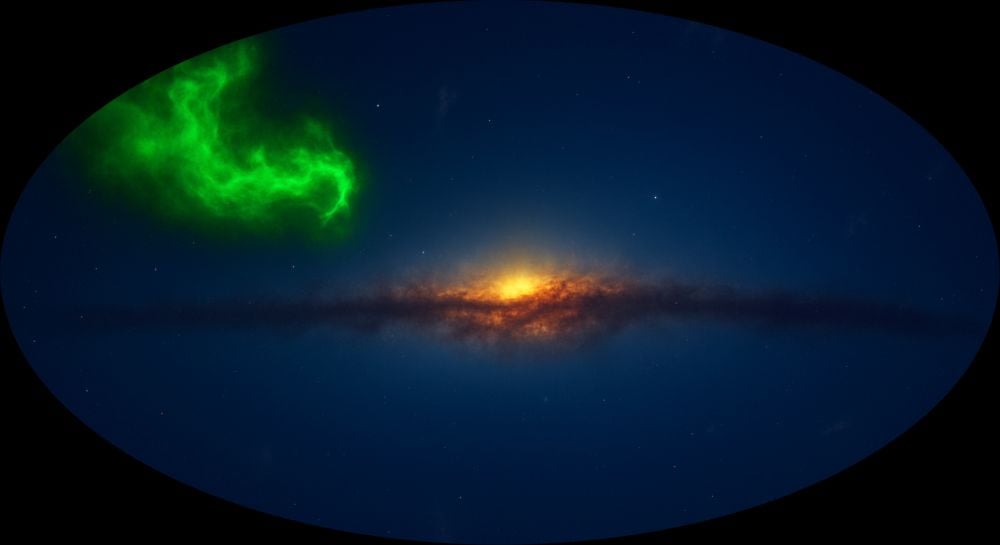
The Study of VHVC G165
Recent research focusing on a specific VHVC, designated G165, utilized observations from China's Five-hundred-meter Aperture Spherical Radio Telescope (FAST). The findings reveal complex phenomena within this cloud, including a network of intertwined filaments that deviate from previously held assumptions of featureless cloud dynamics. The study is encapsulated in the paper titled "A network of velocity-coherent filaments formed by supersonic turbulence in a very-high-velocity H i cloud," led by Xunchuan Liu from the Shanghai Astronomical Observatory. This work contributes significant insights into the transitional phases of molecular cloud evolution.
Insights and Results
The observations presented in the study indicate that VHVCs such as G165 showcase intricate internal structures defined by the presence of warm neutral medium (WNM) gas. At temperatures between 6000 and 10,000 Kelvin, this medium plays a crucial role in the cloud's evolution. Below is a summary table of the key findings associated with G165:
| Finding | Description |
|---|---|
| Internal Structure | A complex network of filaments revealed through observations by FAST. |
| Temperature | The cloud's gas exists primarily in the warm neutral medium phase at temperatures between 6000 and 10,000 K. |
| Filament Characteristics | Filaments are tangled, presenting as twisted and intersecting structures in the gas composition. |
| Supersonic Turbulence | The internal turbulence is driven by supersonic magnetohydrodynamic processes. |
This image shows the G165 Very High Velocity Cloud in context, illustrating its position in relation to the Large and Small Magellanic Clouds and other relevant cosmic structures.
Critical Phases in the Interstellar Medium
The ISM transitions through various phases of density and temperature, each contributing uniquely to the overall processes of star formation. The WNM phase in which G165 primarily resides is crucial because, although it exists outside traditional star-forming comfort zones due to its higher temperature, it represents an earlier evolutionary status compared to more established HVCs. This distinction is vital as it allows astronomers to pinpoint how structures within clouds can lead to future star-forming regions.
The Importance of Filament Networks
Identifying and tracking the filament networks within VHVCs like G165 offers insightful revelations about the fundamental mechanisms behind star formation. The intricate web of filaments serves as a potential precursor or interface between naively chaotic gas clouds and the organized structures characteristic of mature star-forming regions.
"This study illustrates that Very High Velocity Clouds can exhibit similar filamentary structures to molecular clouds, suggesting pathways to star formation that occur even in the absence of significant gravitational influences." – Xunchuan Liu, Lead Author
Mechanisms Behind Filament Formation
The research team elucidated that these filaments within G165 are likely created by shock compression fueled by supersonic magnetohydrodynamic turbulence. To enhance their understanding of the filamentary structures across multiple velocity layers, they implemented a series of magnetohydrodynamic simulations. These simulations helped them discern how varying turbulence levels impact filament development.
Magnetohydrodynamic Simulations
The simulations were conducted at subsonic, transonic, and supersonic levels, particularly highlighting that the supersonic turbulence generated thin filaments. Below is a table illustrating key aspects of the simulations:
| Turbulence Type | Description | Results Observed |
|---|---|---|
| Subsonic | Slow-moving gas where shock compression effects are minimal. | Little filament formation; structures remain dispersed. |
| Transonic | Gas moving at speeds comparable to sound, leading to moderate displacement. | Moderate filament structure with some degree of organization. |
| Supersonic | Rapid movement where turbulence creates substantial compression and structure. | Formation of slim filaments with complex profiles and significant velocity variation. |
This figure shows the network of filaments that define G165's internal structure, highlighting three typical filaments represented in different colors.
Conclusion and Implications for Future Research
The findings from the G165 study provide compelling evidence that VHVCs are far more dynamic and structured than previously realized. This research underscores the significance of filament networks in the quest for understanding star formation processes within the ISM, particularly in clouds that do not conform to gravitationally-dominated structures.
As research progresses, the implications of these discoveries extend beyond just the characterization of filaments within VHVCs. Future studies may open avenues investigating how our broader cosmological models of star formation can adapt to account for complex behaviors in different velocity clouds. Moreover, pinpointing connections between the dynamics in VHVCs and the subsequent evolution of molecular clouds could provide crucial insights into the lifecycle of interstellar materials.
References
- A network of velocity-coherent filaments formed by supersonic turbulence in a very-high-velocity H i cloud. Nature Astronomy (2025)
- Magnetohydrodynamics - Wikipedia
- Filament Formation and Star Formation Mechanisms (2010)
- The Role of ISM in Star Formation (2014)
- Press Release on the G165 Study - Chinese Academy of Sciences
In achieving a deeper understanding of the universe's interstellar components, the study of clouds like G165 plays a critical role in unraveling the complexities of star formation. The future of astrophysical research will undoubtedly benefit from these foundational insights.