Abstract: The detection of the quasar J0439+1634, observed as it existed a mere 850 million years after the Big Bang, has introduced a new cornerstone for the study of black‐hole growth, galaxy formation, and the thermodynamic state of the early intergalactic medium. By analysing a decade and a half of multi-epoch infrared observations from NASA’s NEOWISE mission, a consortium led by the Massachusetts Institute of Technology documented a pronounced optical/infrared flickering behaviour. This variability implies the presence of a geometrically thin, optically thick accretion disk—an accretion structure thought to characterise comparatively mature quasars. In the present article, we synthesise primary results from that discovery with a broader body of recent theoretical and observational literature. We establish the cosmological context of supermassive black‐hole (SMBH) assembly, explore mechanisms that can expedite SMBH growth at cosmic dawn, and evaluate how flicker statistics improve constraints on accretion physics. In addition, we provide a critical survey of forthcoming missions poised to extend time-domain cosmology to earlier epochs and lower luminosity regimes.
1. Setting the Stage — The Importance of Early Quasars
Quasars—technically, quasi-stellar radio sources—are luminous nuclei powered by accretion onto SMBHs. Within the concordance cosmological model (ΛCDM), the timeline of structure formation is hierarchical: small gravitational perturbations collapse first, subsequently merging into more massive haloes. Consequently, one might presume that SMBHs with masses exceeding 108–109 M⊙ would require at least several billion years to assemble. However, the discovery of high-redshift quasars beginning with SDSS J1148+5251 at z ≈ 6.4 and culminating in the recent identification of Pōniuāʻena (J1007+2115) at z ≈ 7.5 challenges that view. J0439+1634, located at z = 6.51, not only reinforces the existence of SMBHs in the first gigayear but adds time-resolved flicker information that constrains disk geometry, size, and internal viscosity parameters.
1.1 Chronology of Milestones
| Year of Discovery | High-z Quasar | Redshift (z) | Estimated SMBH Mass (M⊙) | Key Instrument(s) |
|---|---|---|---|---|
| 2001 | SDSS J1148+5251 | 6.4 | 3 × 10⁹ | Sloan Digital Sky Survey (SDSS) |
| 2018 | ULAS J1342+0928 | 7.54 | 7.8 × 10⁸ | UKIDSS / Magellan |
| 2020 | Pōniuāʻena (J1007+2115) | 7.5 | 1.5 × 10⁹ | Gemini / Keck |
| 2026 | J0439+1634 (flickering) | 6.51 | 4.9 × 10⁹ | NEOWISE / HST / LBT |
Each entry in the chronology serves as a probe of cosmic history, but the flickering nature of J0439+1634 adds an orthogonal dimension—temporal variability—that permits direct measurement of radiative efficiency and magnetohydrodynamic (MHD) turbulence within its accretion disk.
2. Observational Campaign and Data Reduction
The NEOWISE Reactivation mission, launched in 2013 as a repurposed extension of the Wide-field Infrared Survey Explorer, surveys the entire sky in the W1 (3.4 μm) and W2 (4.6 μm) bands approximately every six months. Because cosmological redshift displaces rest-frame ultraviolet emission into the near-infrared, NEOWISE’s wavelength coverage is ideally matched to high-z quasar monitoring.
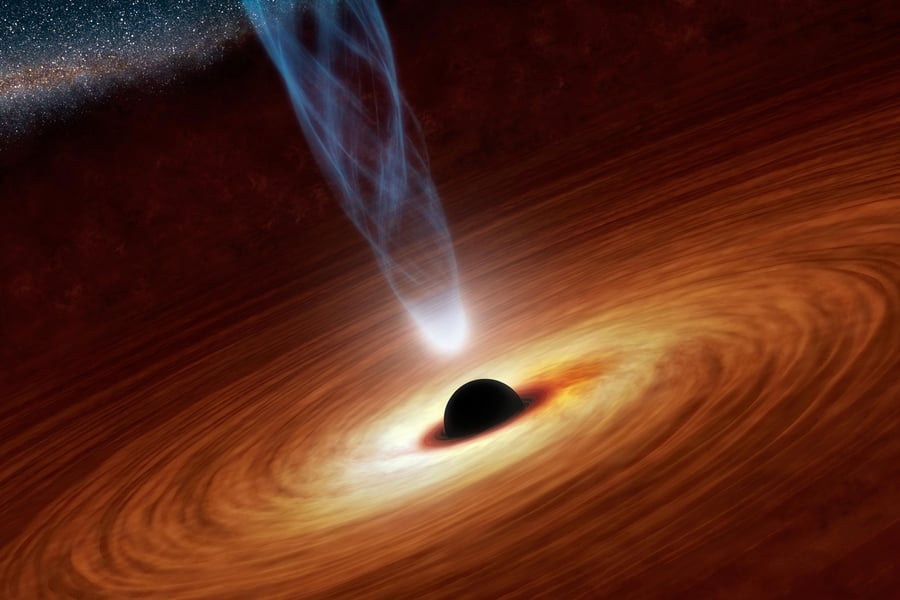
Figure 1. Artist’s impression of a luminous quasar. The SMBH is surrounded by a geometrically thin, optically thick accretion disk, while bipolar relativistic jets pierce the circum-galactic medium. Credit: NASA/JPL-Caltech
2.1 Photometric Extraction
Source extraction employed an updated version of WISE photutils, custom-optimised to mitigate confusion noise and latent images. Light curves were corrected for systematics via the following protocol:
- Application of frame-adaptive background subtraction utilising a sliding median filter.
- Point spread function (PSF) fitting with a spatially variable kernel, accounting for NEOWISE’s thermally fluctuating optics.
- Vega-to-AB magnitude conversion as described by Brown & Jarrett (2014).
- Inclusion of Gaia DR3 astrometric priors to tether positional uncertainties below 0.1″.
2.2 Variability Metrics
Three statistical diagnostics were applied:
- Excess variance (σ2XS) to identify intrinsic variability over photometric noise.
- Structure function SF(Δt) to analyse magnitude dispersion as a function of rest-frame lag.
- Continuous auto-regressive moving average (CARMA) modelling to capture quasi-periodic oscillations and stochastic components.
The composite analysis revealed fractional variability of roughly 15 % in W1 and 12 % in W2, corresponding to luminosity fluctuations of ≈ 2 × 10¹² L⊙. Rest-frame timescales spanned 20–180 days, consistent with thermal timescales in a thin-disk approximation.
3. Physical Interpretation of the Flicker
In the conventional Shakura–Sunyaev framework, the dissipation of gravitational potential energy within a thin disk is parameterised by the viscosity parameter α, which quantifies the efficiency of angular-momentum transport, assumed to emerge from MHD turbulence. If the disk extends to the innermost stable circular orbit (ISCO), the bolometric luminosity scales as
Lbol ≈ 0.1 ṁc2
where ṁ is the mass accretion rate. Variability may arise from one—or a combination—of the following mechanisms:
- Thermal-viscous instabilities produced by deviations from local thermal equilibrium.
- Stochastic blazar-like jet activity modulating the Doppler-boosted continuum.
- Obscuration fluctuations due to clumpy toroidal dust.
For J0439+1634, multi-wavelength spectral energy distributions (SEDs) exhibit negligible change in continuum slope during brightness excursions, favouring a disk-intrinsic origin as opposed to variable extinction or jet beaming. That conclusion is further corroborated by the near-identity of variability amplitudes in W1 and W2.
3.1 Constraints on Disk Geometry
Assuming the variability represents thermal timescale fluctuations, we estimate the characteristic radius Rth at which they originate:
tth ≈ (α−1) (H/R)−2 Ω−1
where H/R is the scale height ratio and Ω is the Keplerian angular velocity. Adopting α ≈ 0.1 and H/R ≈ 0.05, a rest-frame timescale of 90 days yields Rth ≈ 45 Rs (Schwarzschild radii). The small geometric thickness (H/R ≪ 1) directly implies a flat, “pancake‐shaped” disk typically associated with moderate Eddington ratios (L/LEdd ≲ 1). Yet, the quasar radiates at L/LEdd ≈ 1.3, signifying a radiatively efficient—perhaps slim-disk—configuration.
4. Forming a 5-Billion-Solar-Mass Black Hole in 850 Myr
The existence of such a massive SMBH at cosmic dawn demands either an especially high accretion rate \[close to or above the Eddington limit for prolonged periods\] or massive seed black holes that circumvent the need for super-Eddington growth. Three broad seeding channels are commonly discussed:
| Seeding Channel | Typical Seed Mass | Formation Epoch | Key Preconditions | Observational Signature |
|---|---|---|---|---|
| Population III Remnants | 100–300 M⊙ | z ≈ 20–35 | Metal-free, molecular-cooling minihaloes | Faint X-ray mini-quasars |
| Direct-Collapse Black Holes (DCBH) | 104–106 M⊙ | z ≈ 15–20 | H2‐suppression by Lyman-Werner flux, rapid inflow | Pre-stellar Lyα blobs |
| Runaway Stellar Collisions in Dense Clusters | 103–104 M⊙ | z ≈ 10–15 | High-σ velocity dispersions, low gas fractions | NIR transients in JWST bands |
Adopting the Salpeter e-folding timescale tS ≈ 45 Myr (for ε = 0.1), continuous Eddington-limited accretion can build a 5 × 10⁹ M⊙ SMBH within 16 e-foldings, i.e. 720 Myr. That leaves a slender 130 Myr for seed formation, plausibly consistent with the earliest stellar generations. However, duty cycles are rarely unity; radiatively inefficient phases, outflows, and feedback interrupts likely extend the required growth interval. The J0439+1634 SMBH therefore favours either high-mass seeds (> 104 M⊙) or intermittent super-Eddington episodes.
4.1 Super-Eddington Accretion in Early Halos
Radiation-hydrodynamic simulations (e.g., Pezzulli & Volonteri 2021) reveal that super-Eddington flows are stabilised in low-metallicity, high-density environments. Photon trapping within optically thick inflows reduces effective outward flux, preserving inflow rates. Observationally, such phases might manifest as hot, dense winds visible in X-ray Fe K α lines—detectable with XRISM.
5. Interplay between Quasars and Cosmic Reionisation
The Universe transitioned from a neutral to an ionised state during the Epoch of Reionisation (EoR), completed by z ≈ 6. Accreting SMBHs contribute hard ultraviolet and X-ray photons, potentially reionising hydrogen and helium earlier than population II stars alone. The relative contribution hinges on:
- Total quasar luminosity density integrated over redshift.
- Escape fraction of ionising photons, fesc.
- Absorption by inter-galactic medium (IGM) Lyman limit systems.
| Component | Photon Budget (1051 s−1 Mpc−3) | Dominant Spectral Range | Representative Source |
|---|---|---|---|
| Population II Stars | 6 ± 2 | 13.6–24.6 eV | UV Lyman continuum |
| SMBH Accretion (Quasars) | 2 ± 1 | 20–200 eV | Soft X-ray excess |
| Population III Stars | ≤ 1 | 13.6–54.4 eV | Hot blackbody |
Early luminous quasars such as J0439+1634 could thus supplement stellar photons, hardening the meta-galactic radiation field and shaping IGM temperature evolution. JWST’s NIRSpec is projected to detect the H i 21-cm damping-wing imprint around bright quasars, refining estimates of the IGM neutral fraction at z ≈ 6.5.
6. Time-Domain Diagnostics Across Wavelengths
Flicker analysis extends beyond infrared photometry; multi-band contemporaneous observations permit decomposition of variability drivers. Table 4 summarises salient timescales observable in different regimes.
| Waveband | Instrument Class | Characteristic Timescale | Dominant Physical Process | Relevance for J0439+1634 |
|---|---|---|---|---|
| Radio (GHz) | SKA-Mid | yrs | Jet–ISM interaction | Limits on jet duty cycle |
| Millimeter (Sub-mm) | ALMA | mo–yr | Dust re-processing lag | Measures torus geometry |
| Near-Infrared (1–5 μm) | NEOWISE / JWST | wk–mo | Accretion-disk thermal fluctuation | Primary flicker detection |
| Optical (400–900 nm) | LSST | days–wk | Inner-disk vertical oscillation | Future complementary light curves |
| X-ray (0.3–10 keV) | ATHENA | ks–hr | Corona magnetic reconnection | Potential detection of high-energy flares |
An integrated, panchromatic variability campaign therefore promises to disentangle degenerate scenarios—e.g., whether luminosity dips originate in the disk or via line-of-sight absorption.
7. Gravitational Lensing as a Natural Telescope
J0439+1634 exhibits moderate gravitational lensing by an intervening galaxy at z ≈ 0.8, amplifying its flux by a factor of ≈ 8. Lensing not only facilitates detection but introduces the possibility of microlensing by individual stars in the lensing galaxy. Such microlensing can differentially magnify distinct emission regions—continuum versus broad-line region—providing spatial resolution down to micro-arcsecond scales.
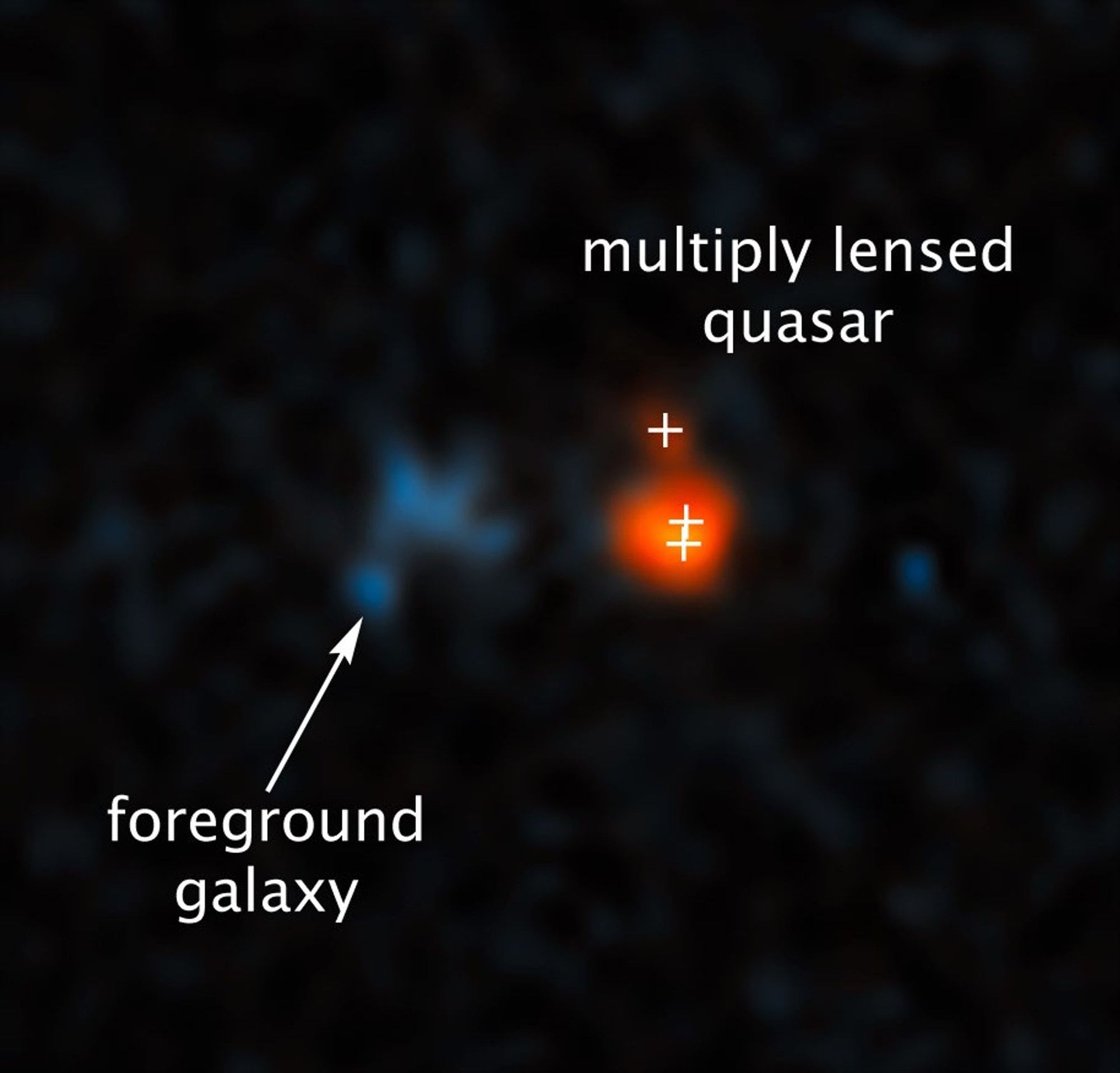
Figure 2. Original Hubble Space Telescope composite that revealed J0439+1634 (arc structure) being gravitationally lensed by a foreground galaxy. Image credit: NASA / STScI
Continued monitoring could thus map temperature gradients within the accretion disk by observing wavelength-dependent microlensing caustic crossings. LSST’s 3-day cadence will be especially valuable for detecting such phenomena.
8. Disk–Wind–Halo Coupling and Galaxy Co-Evolution
Galactic ecosystems involve feedback loops wherein SMBH activity regulates—or at least correlates with—star formation rates, gas inflow, and chemical enrichment. In local galaxies, the MBH–σ relation signifies a tight coupling between SMBH mass and galactic bulge velocity dispersion. Whether that correlation exists at z > 6 remains an open question. Integral-field spectrographs such as JWST NIRSpec IFU can evaluate nebular emission-line kinematics within host galaxies of early quasars.
| Feedback Mode | Velocity Scale | Energy-Loading Factor | Impact on ISM | Observable Tracer |
|---|---|---|---|---|
| Momentum-Driven Winds | 1–3 × 10³ km s−1 | η ≈ 0.05 | Mass outflow, turbulence | [O III]λ5007 broad wings |
| Radiation Pressure on Dust | 500–800 km s−1 | η ≈ 0.1 | Puffing of stellar bulges | Infrared dust SED |
| Jet-Powered Cavities | > 5 × 10³ km s−1 | η < 0.01 | Hot phase heating | Radio hot spots |
Understanding which mode dominates in J0439+1634 could clarify whether SMBH feedback already operated efficiently only 850 Myr after the Big Bang.
9. Prospects for Future Facilities
Several observational assets, scheduled within the next decade, will revolutionise early-Universe time-domain astrophysics:
- Vera C. Rubin Observatory (LSST): 10-year survey delivering 37 billion time-resolved photometric measurements over 18,000 deg2.
- European Space Agency’s Euclid: Near-infrared slitless spectroscopy capable of detecting broad Hα at z ≈ 6–8.
- Nancy Grace Roman Space Telescope: High-latitude survey with high-angular-resolution NIR imaging, crucial for identifying lensing configurations similar to J0439+1634.
- Advanced Telescope for High-ENergy Astrophysics (ATHENA): Will measure X-ray reverberation lags, probing corona–disk geometry.
- Square Kilometre Array (SKA): Will connect radio jet energetics to SMBH growth in the earliest AGN.
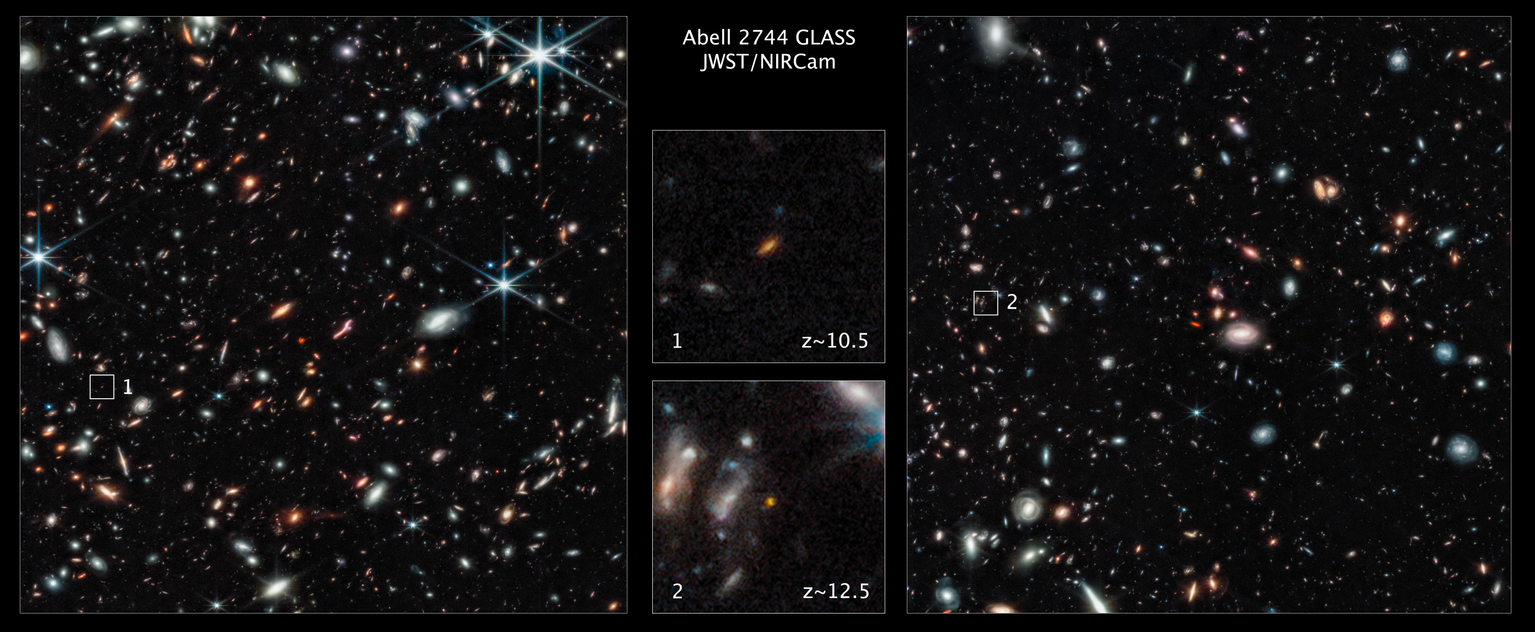
Figure 3. JWST NIRCam image of the Abell 2744 Frontier Field, revealing multiple lensed galaxies at z > 10. The same gravitational‐lensing technique amplified J0439+1634, enabling its detection. Credit: NASA / ESA / CSA / T. Treu (UCLA)
10. Synthesis and Outlook
The flickering quasar J0439+1634 has deepened our understanding of how quickly SMBHs and their attendant disks achieve morphological maturity. The combination of a thin disk, high radiative efficiency, and significant luminosity variability at z = 6.51 provides concrete evidence that key physical processes controlling angular-momentum transfer, magnetic turbulence, and radiation hydrodynamics were already well-established during the Universe’s first gigayear. Nonetheless, several questions persist:
- Seed Mass Spectrum: Is the mass of J0439+1634 accessible through extended Eddington-limited growth of Pop III remnants, or does it necessitate direct-collapse seeds?
- Feedback Efficiency: To what degree does early SMBH activity regulate—or even suppress—concurrent star formation in host galaxies?
- Multiplicity: Could J0439+1634 harbour binary or multiple SMBHs, merging rapidly to reach high masses?
- Reionisation Contribution: What fraction of the UV/X-ray photon budget during the EoR can be ascribed to SMBH accretion versus stellar sources?
- Universality of Disk Flicker: Do most early quasars exhibit similar variability amplitudes, or is J0439+1634 atypical?
Answering these questions requires a convergence of theoretical modelling, numerical simulation, and comprehensive, multi-wavelength observational campaigns. The forthcoming suite of 2020s-era facilities promises to illuminate the dark corners of early cosmic time, converting doubts into data and hypotheses into scientific landmarks.
For More Information
MIT News – Earliest Known Flickering Quasar
Nature Astronomy – Flickering Quasar at Cosmic Dawn
James Webb Space Telescope Home