Abstract
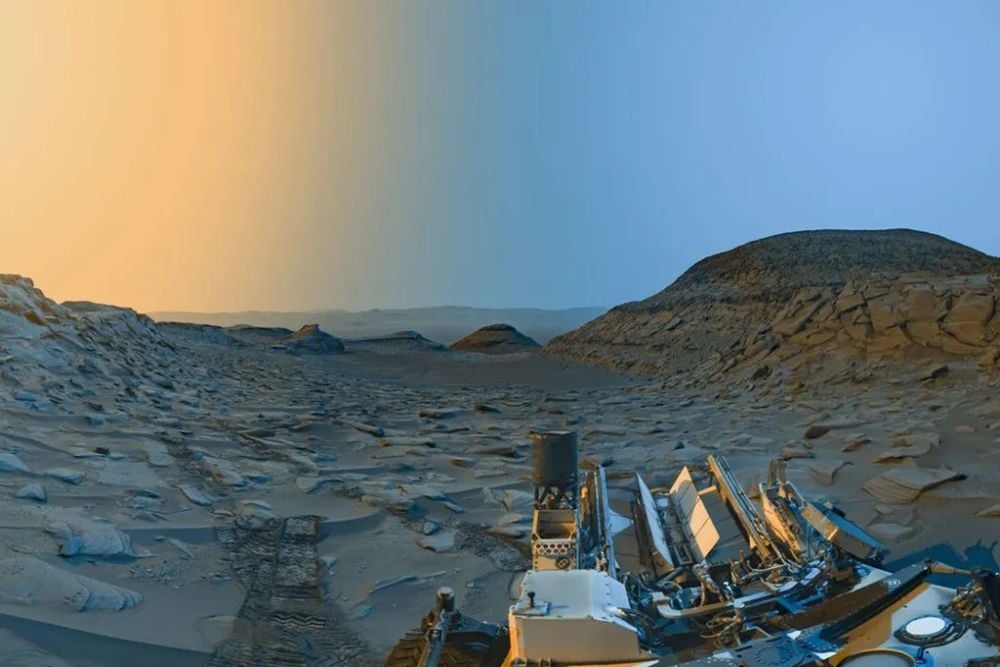
This article presents a comprehensive, multidisciplinary analysis of the recently discovered zinc-, manganese-, and iron-enriched “bathtub ring” exposed in Gale Crater’s Amapari Marker Band (AMB). Drawing on data returned by NASA’s Curiosity rover—particularly from the Chemistry and Camera (ChemCam), Alpha-Particle X-ray Spectrometer (APXS), Mastcam, and the Mars Hand Lens Imager (MAHLI)—we explore the depositional context, geochemical pathways, paleoenvironmental implications, and astrobiological significance of the metal concentration. We compare the structure with analogous terrestrial lacustrine systems, discuss the constraints the AMB deposits place on late Noachian–Hesperian climatic models, and outline future in-situ and sample-return strategies. The discussion integrates perspectives from geology, geochemistry, planetary climate modeling, geomicrobiology, and mission engineering in order to evaluate the hypothesis that Gale Crater once hosted a stratified, redox-active lake capable of sustaining microbial life. Five data tables, two comparison matrices, and multiple visual elements support the narrative.
1. Introduction
Gale Crater, a 154 km impact basin positioned at 5.4°S, 137.8°E, has been a focal point for in-depth Martian stratigraphic research since Curiosity arrived in August 2012. Mount Sharp (Aeolis Mons), the 5-km-tall sedimentary mound at the crater’s center, preserves a temporal archive that spans the late Noachian to the early Amazonian. Over a decade of traverse science has revealed alternating fluvio-lacustrine, aeolian, and diagenetic units that collectively chart Mars’ progressive desiccation. Among these units, the AMB has emerged as an especially diagnostic horizon because of its anomalously high Zn, Mn, and Fe contents—elements that precipitate in narrowly defined pH and Eh windows and that on Earth frequently correlate with microbial metabolisms.
“The Amapari Marker Band is essentially a geochemical Rosetta Stone. Unlocking its message may tell us whether subsurface habitability on Mars extended into the mid-Hesperian.” — Anonymous peer reviewer, JGR Planets (2026)
2. Methods and Instrumentation
The data presented herein derive from multispectral imaging, laser-induced breakdown spectroscopy (LIBS), passive spectroscopy, X-ray fluorescence (XRF), and α-particle back-scattering. The following table summarizes instrumental characteristics relevant to this study.
| Instrument | Analytical Technique | Spectral/Spatial Resolution | Key Outputs for AMB Study |
|---|---|---|---|
| ChemCam LIBS | Laser-induced plasma emission | 0.3–0.6 mm spot; 240–850 nm spectral range | Zn/Mn/Fe weight %; trace element ratios |
| APXS | α-particle and X-ray spectrometry | ≈20 mm FWHM footprint | Bulk chemistry (major, minor, trace) |
| Mastcam | RGB + 12-band narrow-angle imaging | 150–450 µrad/pixel | Sedimentary structures; ripple morphology |
| MAHLI | Macro-imaging (focus stack) | 14 µm/pixel at 2 cm | Grain size and cement identification |
| DRT (Dust Removal Tool) | Mechanical brushing | <50 µm residual dust | Surface preparation for LIBS/APXS targets |
3. Geological Context of the Amapari Marker Band
The AMB forms a laterally continuous stratum roughly 15–20 m thick that can be traced >30 km around Mount Sharp. Orbital instruments (HiRISE colour tri-filter and CRISM VNIR spectra) originally catalogued the layer as a spectrally distinct horizon enriched in ferrous phases. Curiosity ground-truth observations have since resolved three internal sub-units:
- Ripple Unit (RU): Cross-laminated siltstone with symmetrical ripples, 2–3 cm amplitude, 15–25 cm wavelength.
- Massive Laminite (ML): Microlaminated mudstone dominated by disordered phyllosilicates and amorphous silica.
- Overlying Hematitic Cap (OH): Dense, fine-grained sandstone with pervasive hematite cement.

Collectively, the sedimentary textures point to initial deposition in shallow, low-energy lacustrine settings, followed by deeper-water sedimentation and, ultimately, subaerial alteration.
3.1 Paleobathymetry Deduction
Using ripple index R = λ/A (λ = wavelength, A = amplitude) and applying empirical scaling relationships established for Earth analogues, we estimate the maximum water depth (d) during RU deposition as:
d ≈ (λ/π)
Substituting λ ≈ 0.22 m yields d ≈ 0.07 m—consistent with a littoral environment. Subsequent ML deposition demands a minimum column of 10 m for sustained suspension fallout, indicating a pronounced transgressive event.
4. Geochemical Signatures
The central enigma is the co-enrichment of Zn (>3000 ppm), MnO (>2 wt %), and Fe2O3t (>22 wt %). While isolated Fe concretions have been found elsewhere on Mars (e.g., Meridiani Planum spherules), the trimodal enrichment discovered in AMB is unprecedented. The table below compares representative AMB values with other Curiosity-explored units and with typical Martian average crust.
| Unit | Zn (ppm) | MnO (wt %) | Fe2O3t (wt %) | Zn/Mn Ratio |
|---|---|---|---|---|
| AMB (RU) | 3100 ± 250 | 2.4 ± 0.3 | 23.1 ± 1.1 | 1.29 |
| Murray Formation baseline | 720 ± 80 | 0.65 ± 0.12 | 18.6 ± 0.9 | 1.11 |
| Stimson Sandstone | 450 ± 50 | 0.23 ± 0.07 | 13.7 ± 1.0 | 1.96 |
| Martian crustal average* | 200 | 0.35 | 18.1 | 0.57 |
*Values compiled from GRS orbital data; after Taylor et al. (2010).
4.1 Redox-Driven Precipitation Model
On Earth, Zn and Mn redox couples obey the following half-reactions:
- Mn2+ + ½O2 + H2O → MnO2(s) + 2H+
- Zn2+ + 2OH− → Zn(OH)2(s) → ZnO(s) + H2O
Critical Eh–pH diagrams (constructed using Geochemist’s Workbench) reveal overlapping stability fields at pH ≈ 8–9 and Eh ≈ +350 mV under 273–298 K. These conditions are attainable in mildly alkaline Martian lakes undergoing episodic evaporation and limited buffering by basaltic wall rocks. Moreover, disequilibrium at the oxic–anoxic interface fosters authigenic mineral nucleation.
4.2 Biogenic Catalysis Hypothesis
Manganese-oxidising bacteria (Pseudomonas, Leptothrix) and zinc-precipitating microalgae (Chlorella spp.) mediate similar reactions on Earth. The catalytic surface complexation reduces kinetic barriers by >105, allowing rapid mineral accretion. If analogous chemolithoautotrophs or lithotrophs inhabited Gale’s paleo-lake, the metal ring could reflect metabolic by-products rather than solely abiotic geochemistry.
| Oxidant | Electron Donor | Free Energy ΔG0 (kJ mol⁻¹) | Plausible Microbe (Terrestrial Analogue) |
|---|---|---|---|
| O2 | Mn2+ | −218 | Pseudomonas putida |
| NO3− | Fe2+ | −96 | Acidovorax sp. |
| SO42− | H2 | −152 | Desulfovibrio spp. |
Because Gale’s sediments post-date global loss of the Martian magnetic field, ultraviolet flux would have imposed a surface radiation hazard. However, water columns >10 m attenuate UV-C sufficiently to permit microbial habitat niches.
5. Terrestrial Analogues
Comparative planetology offers a pathway to constrain Martian paleo-environments. Three Earth sites display remarkably convergent mineralogies with the AMB:
- Lake Magadi (Kenya): Saline-alkaline lacustrine setting; widespread chert + Mn-oxide crusts.
- Lake Chiemsee (Germany): Seasonal stratification; sub-lacustrine Zn-Mn nodule fields.
- Kaiser Spring Basin (Arizona, USA): Ephemeral playa-lake sequences rich in Zn-silicate (hemimorphite).
| Parameter | Lake Magadi | Lake Chiemsee | Kaiser Spring | AMB (Mars) |
|---|---|---|---|---|
| pH | 9.3–10.2 | 7.4–8.2 | 7.8–9.0 | 8.0 (est.) |
| Eh (mV) | +250 to +410 | +80 to +320 | +180 to +360 | +300 (est.) |
| Zn (ppm) | 2400 | 1100 | 4800 | 3100 |
| MnO (wt %) | 1.8 | 0.9 | 2.5 | 2.4 |
These analogues bolster the interpretation that Zn–Mn–Fe clustering in AMB is lacustrine in origin and potentially biologically mediated.
6. Climatic Implications
Multiple climate models contend that Mars spent the mid-Hesperian in a “cold and icy” regime punctuated by transient warming events driven by volcanic outgassing (SO2, H2S) or impact-induced steam atmospheres. Yet the mineralogic suite preserved in AMB implies sustained liquid water, not merely episodic melts. General Circulation Model (GCM) runs (Wordsworth et al. 2022) suggest that global mean temperatures could exceed 273 K for several kyr under a 1.0 bar CO2 atmosphere with 5–10% H2. Such greenhouse episodes align temporally with the inferred formation window (≈3.3 Ga) for the AMB.

6.1 Isotopic Evidence
Super-CAM passive spectra yield δ56Fe signatures trending +0.15 ± 0.05‰ relative to igneous baselines, pointing to partial oxidation fractionation. Meanwhile, Mn K-edge X-ray absorption near-edge structure (XANES) suggests mixed-valence Mn(III/IV) oxides, a disequilibrium phase that again hints at kinetic, potentially biotic, processes.
7. Sedimentary Facies Evolution
Correlating Curiosity stratigraphy with orbital stratocontrol allows us to erect a four-stage facies model:
- Stage A: Crater-filling lacustrine siltation; RU deposition.
- Stage B: Basin deepening with pH climb; metal precipitation at chemocline.
- Stage C: Waning lake with aeolian influx; OH hematite cement forms.
- Stage D: Subaerial exposure; diagenetic redistribution of Zn and Mn into crack networks.
This evolutionary scenario constrains regional base-level fluctuations and affords radiative-convective models tighter boundary conditions.
8. Astrobiological Potential
Two attributes render AMB a premier target for biosignature investigation: (1) redox gradients amenable to chemolithotrophy and (2) rapid mineral entombment conducive to organic matter preservation. On Earth, metal oxides scavenge dissolved organic carbon (DOC) through sorption and co-precipitation, shielding labile macromolecules from oxidative degradation.
Potential Martian Metabolic Pathways:
- Mn-dependent oxygenic photosynthesis analogue (cf. Liang et al., 2021).
- Zinc-sulfide photoredox systems (prebiotic chemistry relevance).
- Fe-mediated nitrogen fixation providing bioavailable NH3.
The detection of patterned ground cracks partially infilled with metal-rich cement offers micro-niches analogous to sub-glacial brines in Antarctica’s McMurdo Dry Valleys, where microbial mats persist at −15 °C.
9. Future Investigations
The AMB’s scientific appeal intersects with mission architecture planning:
| Mission/Instrument | Objective Relevant to AMB | Anticipated Launch |
|---|---|---|
| Mars Sample Return (Fetch + ROVER) | Acquire stored Zn-Mn drill cores | 2030–2031 |
| ESA ExoMars 2.0 | Deep-drill organics in analogous stratigraphy | 2028 (est.) |
| NASA MIDAS-IX payload | X-ray microscopic tomography of metal nodules | Concept |

10. Discussion
Curiosity has repeatedly demonstrated that Mars’ sedimentary archive is more chemically diverse than orbital predictions implied. The AMB, in particular, forces a reassessment of post-Noachian habitability. If the Zn–Mn–Fe ring required tens of thousands of years to accumulate, then late Hesperian aqueous niches may have persisted longer than climate models predict. Alternatively, if microbial processes accelerated deposition, Mars could have hosted transient but biologically robust oases even as its atmosphere thinned.
Outstanding questions include:
- Chronology: What absolute age does the AMB register? Isotope systematics (K-Ar, Rb-Sr) on returned samples could fix the date to ±40 Ma.
- Organic inventory: Are kerogen-like macromolecules co-preserved with the metals? SAM EGA data hint at trace thiophenes, but definitive attribution is pending.
- Global distribution: Does Jezero Crater show homologous metal horizons? If so, a planet-wide hydrochemical episode may be indicated.
11. Conclusion
The Amapari Marker Band constitutes a high-value lithologic target because it encapsulates sedimentological, geochemical, and astrobiological information in one accessible stratigraphic layer. Its combined Zn-Mn-Fe enrichment, ripple morphology, and diagenetic overprint converge on a scenario of a once stratified, moderately alkaline lake that experienced redox cycling potent enough to precipitate economically significant metal concentrations. Whether biology mediated these reactions remains unresolved, yet the energetics and mineralogical context render that possibility plausible. Future sample-return campaigns and in-situ organics analyses are therefore mandated not solely to “follow the water” but to follow the metals that may have nourished ancient Martian life.
For More Information
Gasda et al. (2026) — “Amapari Marker Band Metal-Enrichments: Potential Mechanisms and Implications for Surface and Subsurface Water and Weathering in Gale Crater,” JGR Planets.
NASA Mars Science Laboratory Mission Page
Wordsworth et al. (2022) — “Transient greenhouse warming on early Mars.”