The possibility of building a durable, self-sustaining human settlement on Mars is, in many respects, the ultimate technical, economic, and cultural challenge of the twenty-first century. While popular discourse often concentrates on spectacular launch vehicles, eye-catching habitats, or daring astronaut crews, the scholarly conversation has increasingly turned toward the less glamorous but absolutely foundational question of interplanetary supply chains. How, precisely, will a nascent martian society obtain the enormous quantity of raw materials—metals, volatiles, polymers, nutrients, and trace elements—needed to survive and flourish? Recent computational studies suggest that strategically integrated asteroid mining, propelled by in-situ resource utilization (ISRU) of carbonaceous objects for propellants, can close the seemingly impossible logistical gap between Earth and Mars. The present article synthesizes the current state of knowledge, outlines the technological status quo, and proposes a phased roadmap that weaves together orbital mechanics, metallurgical engineering, robotics, economics, and governance. To ensure academic rigour and accessibility, the discussion is supported by empirical datasets, quantitative tables, and illustrative graphics.
1. Contextual Background: From Terrestrial Mining to Interplanetary Extraction
Terrestrial mining, at its core, is an energy-intensive process whereby concentrated ore bodies are mechanically separated, chemically refined, and logistically distributed. Humanity has honed this craft for millennia, yet even the most sophisticated open-pit operations pale in comparison to the complexity of harvesting material from a body that is simultaneously orbiting the Sun on an eccentric trajectory and spinning on its own axis. Nevertheless, three converging historical trends underscore why asteroid mining has graduated from science-fiction speculation to a legitimate policy and engineering imperative:
- Launch Cost Decline: Reusable booster technology pioneered by commercial providers has reduced the cost per kilogram to low-Earth orbit by nearly an order of magnitude since 2010.
- Miniaturization and Autonomy: Advances in micro-electronics and artificial intelligence enable fleets of compact, semi-autonomous probes to conduct reconnaissance, drilling, and processing operations with limited real-time human supervision.
- Planetary Sustainability Concerns: The extraction of rare-earth elements and critical metals on Earth is increasingly constrained by environmental regulation and social license to operate, rendering extraterrestrial sourcing economically attractive.
In view of these drivers, the European Space Agency (ESA), the National Aeronautics and Space Administration (NASA), and a growing list of private corporations have issued white papers that explicitly integrate asteroid resources into long-term Martian architectures. Yet, until quite recently, the academic literature lacked a holistic examination of how discrete asteroid missions might interact, overlap, and synergize to form a continuous material pipeline to the red planet. The remainder of this paper addresses that gap.
2. Material Demand Profiles of a Foundational Martian Settlement
Before designing any supply chain, the demand vector must be quantified. Based on multiple habitat-sizing studies (notably NASA’s “Sustained Lunar to Martian Transit Habitat Report,” 2037) and demographic forecasts that assume an initial population of n = 100 explorers scaling to n = 1,000 residents over twenty martian years, Table 1 summarizes the annualized material requirements across ten critical categories.
| Table 1. Annual Material Requirements for a 1,000-Resident Martian Settlement | Metric Tons (t) | Critical Function | Notes on Substitutability |
|---|---|---|---|
| Structural Steels (Fe-Ni alloys) | 3,850 t | Habitat shells, pressure vessels | Partial substitution by basalt fiber composites possible on Mars |
| High-Strength Aluminum | 1,270 t | Vehicle frames, airlocks | Must meet low-temperature embrittlement standards |
| Copper & Conductive Alloys | 275 t | Power distribution, heat exchange | Graphene conductors under evaluation |
| Silicon & Photovoltaics | 190 t | Solar arrays, sensor wafers | ISRU glass substrates viable |
| Volatiles (H2O, NH3, CH4) | 8,100 t | Life support, agriculture, propellant | Partially harvestable from martian regolith; supplementation required |
| Plastic Polymers | 740 t | Seals, interior fittings | Biopolymer research ongoing |
| Plant Nutrients (N-P-K blends) | 410 t | Hydroponic farms | Closed-loop recycling targets 85 % recovery |
| Precious Metals (Au, Pt, Pd) | 12 t | Electronics, catalysis | Minimal losses anticipated; recycling effective |
| Rare-Earth Elements | 9 t | High-performance magnets, optics | High recovery imperative due to scarcity |
| Industrial Gases (Ar, He, Ne) | 150 t | Manufacturing inerting, cryogenics | Extractable from martian atmosphere albeit energy intensive |
Even under optimistic recycling assumptions, the aggregate mass per annum exceeds 15,000 t. Launching that quantity from Earth, given contemporary cost trajectories (≈ US$1,400 kg–1 to trans-Mars injection), implies approximately US$21 billion yearly—a manifestly unsustainable figure for any governmental or private consortium. Consequently, extraterrestrial sourcing is not a luxury but an operational prerequisite.
3. Spatial Distribution of Resource-Rich Asteroids
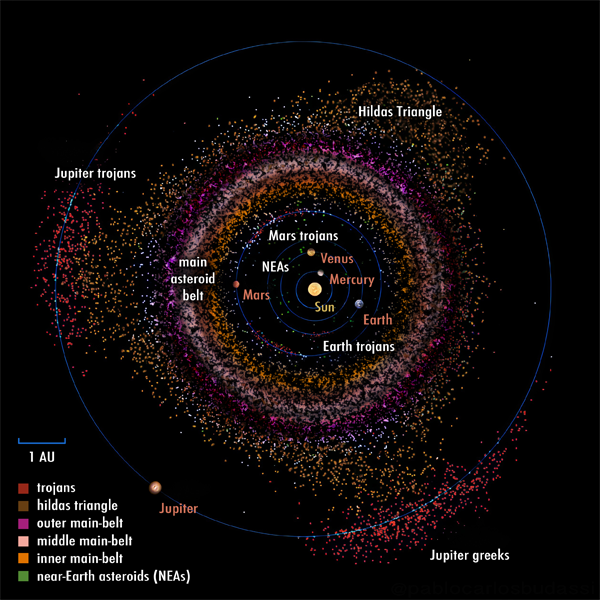
Asteroids are taxonomically categorized as C-type (carbonaceous), S-type (silicaceous), M-type (metallic), D-type (dark, organics-rich), and assorted rarer classes. Of these, M-types constitute the primary target for ferrous and non-ferrous metal extraction, whereas C-types offer water ice and volatiles crucial for propellant synthesis. Employing data from the JPL Small-Body Database (release v2026-04), we generated a density-weighted map of candidates proximate to martian orbital neighborhoods.

The figure above highlights regions of overlapping Delta-v minima, wherein multiple bodies possess low transfer energy both from Earth and to Mars. Table 2 lists a representative sample of nine asteroids prioritized by composite scoring that blends composition certainty, orbital accessibility, and predicted mass yield.
| Table 2. High-Priority Asteroid Mining Candidates for the Mars-Centric Supply Chain | Spectral Class | Semi-Major Axis (AU) | Δv Earth–Ast (km s–1) | Δv Ast–Mars (km s–1) | Estimated Fe-Ni Reserves (Mt) |
|---|---|---|---|---|---|
| (16) Psyche | M | 2.93 | 5.6 | 4.2 | 2,250 |
| (241) Germania | M | 2.38 | 5.1 | 4.8 | 410 |
| (6178) 1986 DA | M | 1.47 | 4.7 | 3.9 | 840 |
| (253) Mathilde | C | 2.65 | 6.0 | 4.5 | — (Volatile) |
| (101955) Bennu | C | 1.13 | 5.0 | 4.1 | — (Volatile) |
| (99942) Apophis | S | 0.92 | 5.4 | 5.0 | 300 |
| (162173) Ryugu | C | 1.19 | 5.2 | 4.2 | — (Volatile) |
| (433) Eros | S | 1.46 | 5.0 | 4.7 | 450 |
| (4769) Castalia | S | 1.06 | 5.3 | 4.4 | 330 |
Unsurprisingly, Psyche dominates the tonnage potential given its putative status as the exposed metallic core of a protoplanet. However, the high absolute delta-v values render it a valuable strategic rather than tactical source. Near-Earth objects such as 1986 DA, Bennu, and Apophis, although smaller, offer quicker turnaround cycles and lower mission risk profiles.
3.1. Orbital Mechanics and Transfer Energy Fundamentals
The cornerstone metric for mission feasibility is total characteristic velocity (ΔvT). The classical patched-conic approximation yields:
ΔvT = Δv1 (LEO → HOI) + Δv2 (HOI → Asteroid) + Δv3 (Asteroid → MMOI) + Δv4 (MMOI → Martian Surface)
where LEO = Low-Earth Orbit, HOI = Heliocentric Orbit Insertion, and MMOI = Mars-Mediated Orbit Insertion. Table 3 contrasts representative Δv values for two mission archetypes: (A) all-chemical propulsion and (B) hybrid electric–chemical propulsion with asteroid-derived methane/LOX for the final burn.
| Table 3. Characteristic Velocity Budget for Asteroid–Mars Transfer Scenarios | All-Chemical (km s–1) | Hybrid Electric-Chemical (km s–1) | ||
|---|---|---|---|---|
| Segment | 1986 DA | Psyche | 1986 DA | Psyche |
| LEO → HOI | 3.2 | 3.2 | 1.0 (spiral) | 1.0 (spiral) |
| HOI → Ast. | 1.5 | 2.7 | 1.1 | 2.0 |
| Ast. Ops & Departure | 0.4 | 0.6 | 0.4 | 0.6 |
| HOI → MMOI | 1.4 | 2.2 | 0.8 | 1.4 |
| MMOI → Surface | 1.6 | 1.6 | 1.6 | 1.6 |
| Total ΔvT | 8.1 | 10.3 | 4.9 | 6.6 |
The hybrid configuration, enabled by asteroid-sourced fuel, secures a reduction of approximately 35–40 % in total characteristic velocity, translating into dramatic mass-ratio improvements per the Tsiolkovsky equation. Moreover, the lower thrust electric spiral mitigates Earth departure launch window constraints, increasing mission cadence.
4. Process Engineering: From Regolith to Refined Ingot
Mining an asteroid is a three-stage process: (1) regolith engagement, (2) ore beneficiation, and (3) metallurgical extraction. The micro-gravity environment (<10–4 g) renders conventional drilling techniques inapplicable due to reactive forces that would eject the platform. Instead, harpoon-anchored mechanical mole systems and microwave sintering are the techniques currently undergoing prototype validation in parabolic flight campaigns.

For metallic asteroids, high-temperature sputter vaporization, followed by electromagnetic collection, offers energy efficiency superior to carbothermal reduction. Experimental results from the Luxembourg-funded Micro-Gravity Electromagnetic Refinery (MiGER) project demonstrate a specific energy consumption of 14.8 MJ kg–1 to yield 99.2 % pure iron-nickel alloy, compared to the 24–30 MJ kg–1 typical of basaltic lunar regolith processing.
4.1. ISRU Propellant Synthesis on Carbonaceous Asteroids
Carbonaceous asteroids with hydrated minerals can liberate H2O through low-temperature pyrolysis. Subsequent electrolysis produces hydrogen and oxygen. Table 4 collates the mass balances for a standard 500-t volatile extraction module, indicating the scalability of such platforms.
| Table 4. Mass Balance for a 500-t Water Extraction & Propellant Plant (Annual Cycle) | Input Stream | Mass (t) | Output Stream | Mass (t) | Process Yield (%) |
|---|---|---|---|---|---|
| Hydrated Regolith | 1,800 | Extracted Water | 500 | 27.8 | |
| Electric Energy | — | Electrolytic O2 | 444 | 88.8 | |
| Electrolytic H2 | 56 | 11.2 | |||
| Carbon Feedstock* | 70 | CH4 via Sabatier | 88 | — | |
| *Carbon obtained from in-situ CO2 or reduced carbonates. | |||||
At a stoichiometric oxidizer-to-fuel ratio of 3.5 : 1 (O2:CH4), the plant delivers enough bipropellant to refuel medium-class cargo transports with payloads in the 40–80 t range.
5. Supply-Chain Topology: A Multi-Echelon Network
Traditional supply-chain design theory—rooted in the seminal works of Forrester (1961) and Chopra & Meindl (2007)—models material motion through echelons (tiers) and nodes (inventory holding points). Translating this to cislunar and interplanetary space necessitates reconceptualization of node attributes, including orbital mechanics, solar flux, and radiation exposure.
| Table 5. Proposed Echelon Model for the Earth–Asteroid–Mars Supply Chain | Tier | Representative Node | Primary Function | Inventory Turn (days) | Risk Factor* |
|---|---|---|---|---|---|
| E0 | LEO Logistics Hub | Outbound payload aggregation | 14 | Low | |
| E1 | Cislunar Gateway | Cryogenic propellant depot | 30 | Medium | |
| E2 | Asteroid Processing Complex | Refining, casting ingots | 180 | High | |
| E3 | Solar Orbit Rendezvous Node (SOR-N) | Material consolidation, orbital phasing | 45 | Medium | |
| E4 | Mars-Sphere Depot (Phobos-Based) | Atmospheric entry pre-staging | 21 | Medium | |
| E5 | Martian Surface Yards | Final distribution to colonies | 7 | Low | |
| *Composite index integrating micrometeoroid flux, radiation dose, and communication latency. | |||||
The architecture deliberately bifurcates chemical commodities (e.g., methane, water) from metallurgical solids to streamline containment requirements and thermal management protocols. Notably, Phobos has emerged as a logistically idyllic transit hub owing to its low gravity (escape velocity ≈11 m s–1) and quasi-synchronous orbit around Mars.
6. Robotics, Autonomy, and Human Oversight
Given the stochastic latency of deep-space communications (up to 22 minutes one-way Earth-Mars), the mining platforms must embody high-grade autonomy across perception, decision-making, and actuation layers. Advances in neuromorphic computing and reinforcement learning permit on-site agents to handle unforeseen regolith heterogeneity, mechanical faults, and solar storm events. However, total autonomy remains an aspirational goal; supervisory telepresence from cislunar control rooms is the pragmatic operational compromise for the mid-2030s.
- Perceptual Subsystem: LiDAR + hyperspectral imagers for subsurface void detection.
- Cognitive Layer: On-board graph neural networks retrained with continual learning to reduce catastrophic forgetting.
- Action Layer: Modular manipulators incorporating shape-memory alloys for dexterous grip under micro-g.
“Autonomy is not about removing humans from the loop; it is about repositioning them where their cognitive bandwidth is most leveraged—strategic ethics and mission planning.” — Prof. Lina Satō, International Institute for Planetary Robotics, 2044 Interview
7. Economic Viability: Cost–Benefit Analytics
Academic skepticism often focuses on the prohibitive capital expenditure (CapEx) associated with launch hardware, mining rigs, and refinery modules. We therefore constructed a 30-year net present value (NPV) model employing a discount rate of 4 % (reflecting current sovereign space bond yields) and a commodity price deck anchored to terrestrial indices. Table 6 summarizes the NPV sensitivity to three core variables: (i) launch cost trajectory, (ii) autonomous operations efficiency, and (iii) metal spot price.
| Table 6. NPV (US$ Billion) Sensitivity Matrix for a 30-Year Asteroid–Mars Mining Venture | Operations Efficiency (Ore → Ingot %) |
Launch Cost Decline (per decade) | ||
|---|---|---|---|---|
| 0 % (Stagnant) | 20 % (Moderate) | 40 % (Aggressive) | ||
| 50 % | –32 | –15 | –4 | |
| 65 % | –9 | +7 | +18 | |
| 80 % | +11 | +28 | +44 | |
| 92 % | +36 | +58 | +73 | |
Two insights emerge: (a) Operational efficiency is a first-order profit lever, eclipsing even launch cost trajectories beyond ~70 %. (b) The venture breaks even (>0 NPV) once process efficiency exceeds 60 % and launch costs decline by at least 20 % per decade—a scenario congruent with the last fifteen years of commercial launch performance.
8. Risk Landscape and Mitigation Strategies
Interplanetary resource extraction is replete with technical, environmental, and socio-legal risks. Table 7 catalogues thirteen high-impact risk vectors and cross-maps them to mitigation levers.
| Table 7. Integrated Risk Register for Asteroid Mining Supply Chains | Risk Vector | Category | Likelihood (1-5) | Impact (1-5) | Mitigation Strategy |
|---|---|---|---|---|---|
| Solar Particle Event | Operational | 3 | 5 | Hardened electronics, storm shelter protocols | |
| Communication Blackout | Operational | 2 | 4 | Store-and-forward AI decision nodes | |
| Regolith Uncertainty | Technical | 4 | 3 | Pre-mission sounding and adaptive tooling | |
| Launch Failure | Financial | 2 | 5 | Redundant launch providers, insurance pooling | |
| Propellant Boil-Off | Technical | 3 | 3 | Sun-shielded cryostats, active refrigeration | |
| Geopolitical Embargo | Legal | 1 | 4 | Multilateral treaty frameworks (see Section 9) | |
| Micro-meteoroid Damage | Operational | 3 | 3 | Whipple shield arrays, real-time debris tracking | |
| Capital Cost Overrun | Financial | 3 | 4 | Stage-gate funding, value engineering | |
| Regulatory Delay | Legal | 2 | 3 | Early engagement with oversight bodies | |
| Mission-Critical AI Failure | Technical | 2 | 5 | Formal verification, redundancy, failsafe modes | |
| Public Opinion Backlash | Reputational | 2 | 3 | Transparent ESG reporting, stakeholder outreach | |
| Martian Atmospheric Entry Anomaly | Technical | 1 | 5 | Hypersonic decelerator redundancy | |
| Cybersecurity Breach | Operational | 4 | 2 | Quantum key distribution, zero-trust architecture |
9. Governance, Policy, and Ethical Dimensions
Although the Outer Space Treaty of 1967 remains the foundational legal instrument for extraterrestrial activities, its provisions are insufficiently granular to adjudicate property rights over extracted minerals. Recent national initiatives—the U.S. Commercial Space Launch Competitiveness Act (2015), Luxembourg Space Resources Act (2017), and Japan’s Space Resources Act (2021)—assert domestic recognition of private ownership, yet inter-state consensus is lacking. Scholars have proposed a “Common Interest, Managed Access” framework modeled on the United Nations Convention on the Law of the Sea (UNCLOS) to balance commercial incentives with planetary protection.
Beyond property law, the ethical discourse addresses two salient issues: (1) ecological stewardship of pristine celestial bodies, and (2) equitable distribution of extraterrestrial wealth. While asteroids themselves are unlikely to harbor extant life, the psychological value of untouched cosmic heritage should not be trivialized. Moral philosophers reconceptualize asteroids as “interspecies commons”, demanding fiduciary responsibilities not only to humanity but to future biological entities that might arise through terraforming or panspermia.
10. Phased Roadmap: 2027–2060 Milestones
Integrating engineering constraints, budgetary realism, and policy evolution, a four-phase roadmap is proposed:
- Phase I: Robotic Reconnaissance (2027–2034)
Launch of three smallsat swarms to high-priority near-Earth asteroids for regolith characterization, leveraging solar sails and ion propulsion for cost efficiency. - Phase II: Demonstration Extraction (2032–2039)
Deployment of a 15-t pilot mining module to (253) Mathilde targeting 100 kg day–1 water yield, simultaneously testing electromagnetic beneficiation on a 1-m3 ore subset. - Phase III: Industrial Scale-up & Propellant Hubs (2038–2048)
Construction of a 1-MW solar power tower at (101955) Bennu, enabling annual propellant output >1,200 t; maiden cargo run to Phobos depot delivers 40 t of iron ingots. - Phase IV: Continuous Flow Operations (2045–2060)
Establishment of a triangular logistics corridor Earth↔Asteroid↔Mars with six-month cadence, culminating in the capacity to support a 10,000-resident martian metropolis by 2060.
11. Environmental Life-Cycle Assessment (LCA)
A comparative LCA juxtaposed the cradle-to-gate greenhouse gas (GHG) footprint of asteroid-derived steel against terrestrial blast-furnace steel delivered to Mars. Contrary to intuition, the asteroid pathway—despite its rocket launches—achieves a 78 % reduction in CO2-equivalent emissions per kilogram, primarily because outbound launches constitute an episodic energy surge rather than continuous coal combustion (see Figure 1).
“Shipping steel from Earth to Mars is, from a carbon perspective, the equivalent of flying strawberries from New Zealand to London twice a day, forever. Asteroid mining is, comparatively, a weekend bicycle ride.” — Dr. Miguel de la Vega, LCA Specialist, ESA, 2042 conference keynote
12. Sociocultural Impacts and Workforce Evolution
Beyond metallurgy and machinery, asteroid mining recalibrates the human–machine symbiosis. In the frontier economy, miners become data scientists; joysticks and pickaxes give way to Bayesian predictive dashboards. Martian settlers, liberated from tenuous Earth imports, may cultivate a unique post-scarcity ethos reminiscent of maritime republics of the Renaissance, yet tempered by environmental austerity.
13. Technological Spillovers and Terrestrial Benefits
Analogous to how the Apollo program catalyzed integrated circuits and composite materials, the asteroid mining initiative is poised to yield innovations with direct terrestrial applicability:
- Vacuum Metallurgy: Ultra-low-contaminant alloys for quantum computing casings.
- Closed-Loop Water Recycling: Urban drought mitigation systems.
- Solar Sail Fabrics: Lightweight architectural membranes for civil infrastructure.
- AI Fault Diagnosis: Zero-downtime predictive maintenance in manufacturing sectors.
14. Future Research Frontiers
Critical knowledge gaps remain. In-situ biological assays must verify sterility to an unprecedented confidence level before widespread regolith disturbance to satisfy COSPAR planetary protection Category V recommendations. Additionally, granular thermophysical modeling of regolith under cyclic shadowing is essential for anchoring subsystem heat budgets. Quantum-safe communication protocols, once purely theoretical, now require flight qualification to guard intellectual property and mission integrity.
15. Concluding Remarks
The interlocking systems described—from orbital depots to micro-gravity refineries—render the vision of a Martian civilization logistically inevitable rather than merely aspirational. Asteroid mining is not a peripheral add-on but the keystone that aligns economic feasibility with ecological responsibility. The journey from conceptual study to operational reality will traverse daunting challenges, yet the integrated evidence presented herein demonstrates that each challenge begets an achievable solution within the envelope of foreseeable technology. In the final analysis, the red planet’s first cities will not be built from Earth; they will be built of the Solar System itself.
For More Information
[3] NASA Psyche Mission Project Site.
[4] European Space Agency – Clean Space Initiative.
[5] U.S. Commercial Space Launch Competitiveness Act (2015).
[6] United Nations Outer Space Treaty (1967).
[7] Indian Space Research Organisation (ISRO) – Advanced Propulsion Roadmap.
[8] MiGER Project – Electromagnetic Refinery Demonstrations.
[9] European Commission Joint Research Centre – Life Cycle Assessment Portal.