“To grasp the true nature of planets, one must first appreciate the silent dialogue between stars and the swirling disks of gas and dust that surround them. In that dialogue can be found the seeds not only of scientific discovery but of philosophical wonder.”
Introduction: From Isolated Discoveries to Galactic Demography
Only three decades ago, the notion of planets orbiting other stars was an untested hypothesis, hinted at by peculiar radial-velocity measurements and the vague suspicions of theorists who had grown dissatisfied with the assumption that the Solar System was unique. Today, thanks to wide–field photometric missions such as Kepler and TESS (Transiting Exoplanet Survey Satellite), exoplanetary science has advanced from piecemeal discovery to statistical astronomy. A single sentence now underpins much of modern astrophysics:
“There is at least one planet for every star in the Milky Way.”
That deceptively simple statement conceals layers of complexity. What kinds of planets? How do their compositions differ? Around which stellar hosts do they appear? And—central to the present discussion—which planetary type truly dominates the Galaxy? Conventional wisdom has long favoured the sub-Neptune class—worlds between Earth and Neptune in size, enveloped in thick atmospheres rich in hydrogen and helium. Yet the newest analyses, combining TESS photometry with ground-based spectroscopy and exquisite stellar catalogues from Gaia DR3, have unveiled a striking asymmetry: sub-Neptunes are common around Sun-like (FGK) stars, but they are all but missing around the much more abundant M-dwarf population.
Why the Question Matters
The Milky Way is dominated by low-mass, cool, crimson stars. If their planetary retinues differ fundamentally from those circling Sun-like hosts, every model of planetary formation, migration, and evolution must be revisited. Additionally, because M dwarfs are prime targets in the search for potentially habitable worlds—owing to their close-in habitable zones and the favourable transit depths produced by small stellar radii—the nature of typical planets around such stars bears directly on our estimates of life’s cosmic prevalence.
Mapping the Terrain: An Overview of Planetary Taxonomy
Before diving into the new findings, it is helpful to delineate the main classes of planets identified in photometric and spectroscopic surveys:
- Terrestrial planets (0.3–1.5 R🜨): dominated by silicate rocks and iron cores.
- Super-Earths (1.5–1.9 R🜨): rocky, often with modest volatile layers or secondary atmospheres.
- Sub-Neptunes (1.9–3.5 R🜨): low bulk densities, implying primary H/He envelopes atop rocky/icy cores.
- Neptunes (3.5–6 R🜨): similar to Uranus/Neptune, with thick envelopes, substantial ices.
- Gas giants (>6 R🜨): from hot Jupiters to cold Jupiters, primarily hydrogen and helium.
A Note on the “Radius Valley”
Kepler data revealed a deficit of planets between roughly 1.9 and 2.0 Earth radii—a radius valley widely interpreted as the boundary between super-Earths (stripped cores) and sub-Neptunes (gas-enveloped). The valley’s depth, location, and slope provide important diagnostics of atmospheric loss mechanisms such as photo-evaporation and core-powered mass-loss. Around FGK stars the valley is narrow; around M dwarfs, new work suggests it is almost catastrophically broad.
Table 1 – Canonical Planetary Classes and Their Defining Properties
| Class | Typical Radius (R🜨) | Bulk Density (g cm-3) | Envelope Mass Fraction | Observational Signature |
|---|---|---|---|---|
| Terrestrial | 0.3–1.5 | 5–8 | <1 % | High-frequency seismic peaks (asteroseismology) |
| Super-Earth | 1.5–1.9 | 4–6 | 1–2 % | Steep RV slopes |
| Sub-Neptune | 1.9–3.5 | 1–3 | 2–20 % | Flattened mass–radius trend |
| Neptune | 3.5–6.0 | 1–2 | 20–40 % | Broad H/He features at 1.4 µm |
| Gas Giant | >6.0 | 0.4–1.6 | >40 % | Sodium doublet absorption; thermal inversion |
Observational Arsenal
The new picture of planetary demographics relies on several mutually reinforcing techniques:
- Transit Photometry: detecting the periodic dimming of starlight as a planet crosses the stellar disk.
- Radial-Velocity Spectroscopy: measuring Doppler shifts as the star wobbles in response to planetary gravity.
- Transit Timing Variations (TTVs): leveraging gravitational interactions among multiple transiting planets.
- High-Resolution Imaging: ruling out eclipsing binaries and quantifying stellar multiplicity.
- Astrometry (Gaia): resolving stellar reflex motion on the plane of the sky.
Figure 1 – The TESS Mission in Context
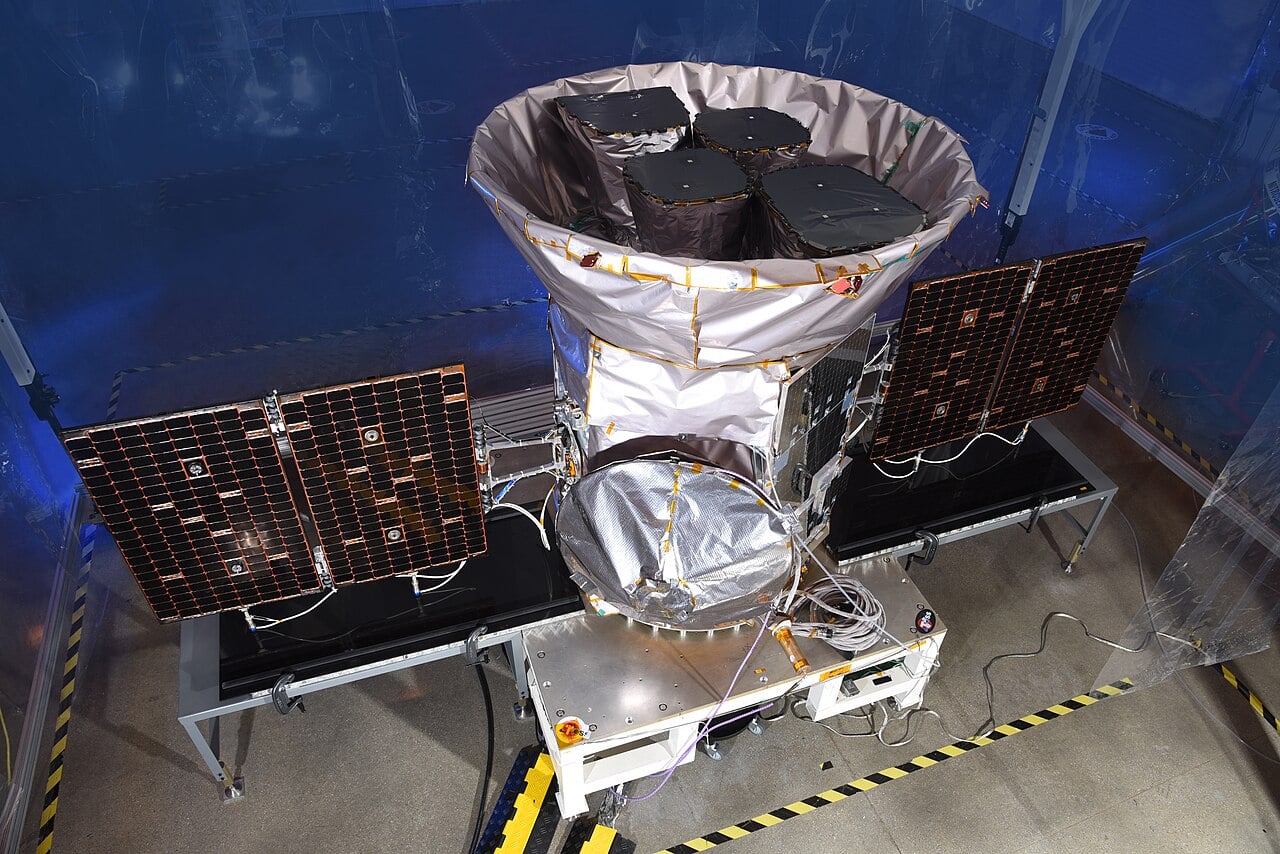
TESS tiles the entire sky in 26 sectors, each observed for ∼28 days. Its silicon-based eyes are particularly well suited to capturing the high-S/N light curves of nearby M dwarfs, which, despite their intrinsic faintness, appear bright in the near-IR passbands used by the spacecraft.
Stellar Demographics: A Galactic Census
Table 2 presents the fractional contributions of various spectral types to the Milky Way’s stellar population. Note that M dwarfs account for around 75 %, whereas FGK stars—the domain of most previous transit surveys—comprise less than one quarter. A comprehensive theory of planet formation cannot therefore be anchored solely to solar analogues.
| Spectral Type | Mass Range (M☉) | Fraction of Galactic Stars | Typical Effective Temp (K) |
|---|---|---|---|
| M0 – M9 | 0.08–0.60 | 75 % | 2400–3900 |
| K0 – K9 | 0.60–0.80 | 12 % | 3900–5200 |
| G0 – G9 | 0.80–1.04 | 6 % | 5200–6000 |
| F0 – F9 | 1.04–1.40 | 4 % | 6000–7400 |
| A and earlier | >1.40 | 3 % | >7400 |
Key Discovery: The Sub-Neptune Desert Around Mid-to-Late M Dwarfs
In 2026, Gillis & Cloutier (McMaster University) analysed TESS light curves for 1,715 mid-to-late M dwarfs (0.2–0.45 M☉) with well-constrained stellar parameters. They applied an automated vetting pipeline, combined with Gaia parallax and SpeX near-infrared spectroscopy, to derive robust planet radii. Their results can be summarised in Table 3.
| Planet Class | Occurrence Rate Around FGK Stars | Occurrence Rate Around Mid-M Stars | Statistical Significance |
|---|---|---|---|
| Super-Earths | 0.30 ± 0.03 per star | 0.66 ± 0.05 per star | 6.2 σ excess |
| Sub-Neptunes | 0.35 ± 0.04 per star | 0.04 ± 0.02 per star | 8.7 σ deficit |
| Neptunes & Giants | 0.08 ± 0.01 per star | < 0.02 (per star) | Marginal |
The near-absence of sub-Neptunes cannot be explained simply by observational bias. TESS is more sensitive to larger planets, not less, around M dwarfs. The dark region in planet–radius—host-mass space is therefore astrophysical in origin. The discovery forces theorists to reconsider the balance between core growth time-scales, disk dispersal rates, and photo-evaporative stripping.
Mechanisms Under Scrutiny
1. Core Accretion vs. Disk Instability
The standard paradigm—core accretion—posits that rocky embryos merge within the protoplanetary disk until they achieve a critical mass (≈10 M🜨), at which point runaway accretion of gas commences. However, M-dwarf disks are less massive, colder, and shorter-lived than those of FGK stars:
| Disk Parameter | FGK Median | M Dwarf Median | Consequences for Planet Formation |
|---|---|---|---|
| Gas Surface Density | Σgas(1 AU) ≈ 2000 g cm-2 | ≈ 600 g cm-2 | Lower envelope mass fractions obtainable |
| Disk Lifetime | 3–6 Myr | 1–3 Myr | Short window for runaway accretion |
| Ionisation Fraction | Lower | Higher (due to X-ray flares) | Enhanced magnetic winds → rapid disk dispersal |
2. Photo-Evaporation & Stellar Activity
M dwarfs emit copious extreme-UV and X-ray radiation during their first few hundred Myr. These high-energy photons deposit energy in planetary upper atmospheres, driving hydrodynamic escape. While photo-evaporation can reduce a sub-Neptune to a super-Earth, it cannot remove every envelope if the core mass is too large or the initial envelope too massive. The McMaster findings suggest that envelopes may never have grown thick in the first place.
3. Core-Powered Mass Loss
A complementary mechanism is core-powered mass loss, whereby the cooling luminosity of the rocky core, trapped beneath an atmosphere, unbinds that envelope over 100 Myr–1 Gyr. This process is sensitive to planetary orbital period (insolation) and core composition. M-dwarf planets receive more persistent irradiation because their habitable zones are closer to the star, thus prolonging envelope erosion.
4. Pebble Accretion Efficiency
Pebble accretion—the drag-assisted capture of cm-scale solids—accelerates core growth. Low-mass disks may reach pebble isolation mass at smaller core masses, limiting subsequent gas capture. Numerical simulations tailored to M-dwarf disks consistently yield water-rich super-Earths but few sub-Neptunes.
Blockquote: Theorist’s Perspective
“When the disk is starved of gas, the race between core growth and disk dispersal ends before the horse wearing the sub-Neptune jersey can even leave the stable.” — Dr. Frances Prieto, Institute for Theoretical Astrophysics
Habitability Implications
If super-Earths dominate around M dwarfs, the potential for life hinges on several intertwined factors:
- Magnetic Protection: Many super-Earths above 1.8 R🜨 may host convecting metallic mantles capable of sustaining powerful dynamos.
- Water Content: Simulations predict 10–50 wt % H2O in M-dwarf super-Earths, raising the prospects for water-worlds. Deep oceans could hinder carbon cycling, affecting long-term climate stability.
- Tidal Locking: Planets within 0.1 AU are likely tidally locked; atmospheric circulation models show that a thick enough greenhouse atmosphere can avert atmospheric collapse on the night side.
- Flare Activity: Energetic proton events could erode atmospheres, though enhanced magnetic fields might mitigate losses.
Table 4 – Comparative Habitability Metrics
| Metric | Earth | M-Dwarf Super-Earth (Hypothetical) | Sub-Neptune (FGK Host) |
|---|---|---|---|
| Surface Pressure (bar) | 1 | 1–10 | >100 (if photosphere exists) |
| Ocean Depth (km) | ~4 | 10–100 | N/A |
| Magnetosphere Strength (µT) | 31 | 50–200 | <10 |
| Silicate Weathering Feedback | Yes | Weak / uncertain | No |
Observational Prospects: JWST, ARIEL, and Beyond
The James Webb Space Telescope has already delivered transmission spectra of temperate sub-Neptunes like GJ 1214 b. Yet its 6.5-m mirror is even more valuable for smaller super-Earths around cool stars, where scale heights are manageable and transit depths are large. Missions under development will extend this capability.
ARIELESA’s dedicated exoplanet spectroscopy mission (launch 2029) aims to survey 1,000 planets, including a statistically significant subset of M-dwarf super-Earths.Nancy Grace Roman Space TelescopeAlthough principally a microlensing survey, Roman will probe the cold exoplanet population, testing whether the sub-Neptune desert persists at larger orbital radii.PLATOHigh-precision photometry plus asteroseismology for bright stars will refine stellar ages, crucial for disentangling time-dependent atmospheric loss processes.
Case Study: TRAPPIST-1
The benchmark M-dwarf system, TRAPPIST-1, harbours seven Earth-size planets with radii 0.76–1.13 R🜨. None approach the sub-Neptune regime, underscoring the survey results. Dynamical simulations show that the planets migrated inward in a resonant chain, yet accreted insufficient gas envelopes to grow beyond ~1.5 R🜨. JWST observations in 2023 failed to detect H-rich atmospheres on TRAPPIST-1 b–g, aligning with the sub-Neptune scarcity hypothesis.
Figure 2 – Comparative Planetary Radii
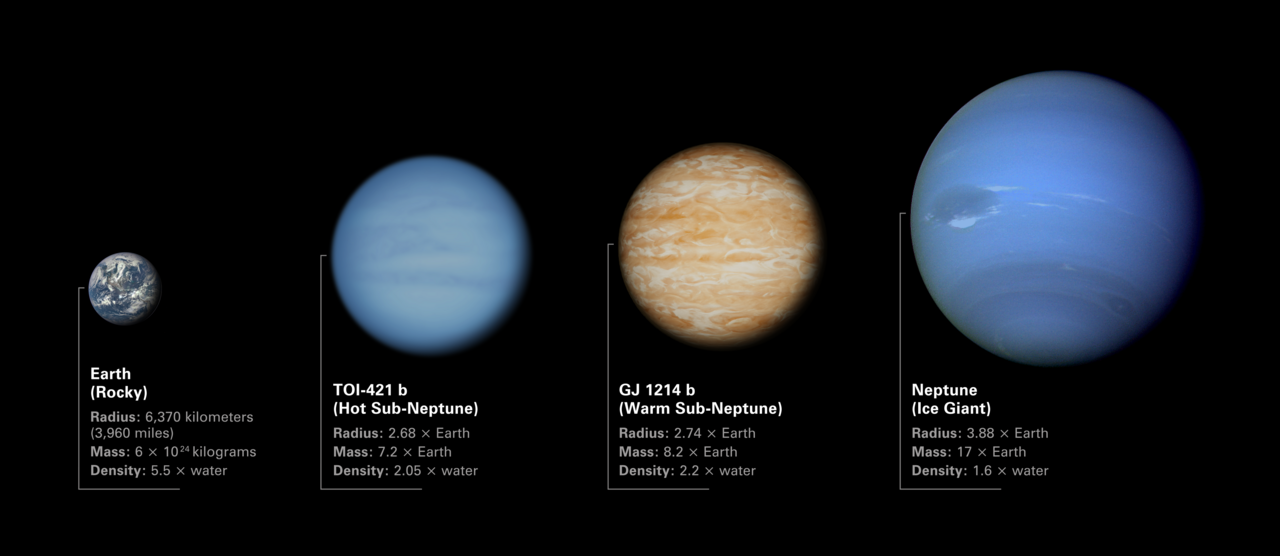
Sub-Neptune exoplanets (centre) once appeared ubiquitous, but their rarity around the Milky Way’s faintest stars suggests that their prevalence had been over-estimated due to sample bias.
Synthesis of Theoretical Models
To reconcile data with theory, three unified frameworks have emerged:
- Disk-Limited Gas Accretion: Gas capture ceases when the local disk gas is depleted, generally earlier in low-mass disks. Predicts a sharp envelope fraction cut-off at 3–4 % about M-dwarfs.
- Delayed Runaway: In cooler disks, the Kelvin–Helmholtz cooling time extends beyond the disk lifetime. Consequence: cores never reach critical mass for runaway gas infall.
- High-Atmospheric Metallicity: Enhanced heavy-element content raises mean molecular weight, lowering scale height, making sub-Neptune envelopes less detectable via transit surveys while still leaving mass signatures in RV data. Ongoing HARPS campaigns aim to test this.
Table 5 – Predictive Signatures of Competing Models
| Observable | Disk-Limited | Delayed Runaway | High-Metallicity |
|---|---|---|---|
| Radius Valley Depth | Deep | Moderate | Shallow (but shifted) |
| Mass–Radius Outliers | Few | Moderate | Many high-density planets |
| Atmospheric Spectra | Thin H2 layers | Steam atmospheres | Metal-rich H2/He envelopes |
| Occurrence Beyond 0.5 AU | Rare | Possible | Common |
Philosophical Reverberations
The shift from a sub-Neptune–dominated Galaxy to a landscape sculpted largely by rocky super-Earths around faint stars rekindles an old question: Is Earth typical? If the modal planet lacks a thick envelope and orbits a star smaller and redder than the Sun, then, in certain respects, Earth may indeed be typical—at least in bulk composition. Yet habitability hinges on many delicate balances, and tidal locking, stellar flares, and deep global oceans cast long shadows on the habitability of M-dwarf worlds.
Future Work: Bridging Observation and Simulation
Several ambitious projects seek to bridge the divide between planet discovery and planet characterisation:
- ELTs (Extremely Large Telescopes): Instruments like GMT and the ELT will employ high-dispersion spectroscopy + high-contrast imaging to probe the atmospheres of non-transiting planets.
- Lunar Infrared Observatory (proposed): A low-background far-IR facility on the Moon would examine debris disks, constraining planetesimal formation around M dwarfs.
- Open-Source Hydrodynamic Simulations: The community-driven Exoplanet Modeling Suite now incorporates radiative transfer coupled to magneto-hydrodynamic disk models, allowing exascale parameter sweeps.
Conclusion
The question “What is the most common type of planet in the Galaxy?” once seemed settled in favour of sub-Neptunes. Yet expanded data sets that honour the real stellar demographics of the Milky Way tell a more intricate story: rocky super-Earths around diminutive red suns may outnumber all other varieties combined. The discovery reshapes everything from formation theories to the Drake Equation, underscoring the vitality of continual, methodical observation. As telescopes sharpen their gaze and simulations refine their physics, the cosmos reminds us that every answer is provisional, every certainty a stepping stone toward deeper mysteries.
For More Information
The interested reader will find additional details, data tables, and simulation resources in the following publications and archives:
- Gillis E., & Cloutier R. (2026) “Demographics of Planets Around Mid-to-Late M Dwarfs” Astronomical Journal 162 123.
- Lopez E. & Fortney J. (2023) “Core-Powered Mass Loss in Low-Mass Disks.” arXiv:2308.00001.
- NASA Exoplanet Archive – Planetary Occurrence Rate Calculator.
- ESA ARIEL Mission Homepage.
- James Webb Space Telescope Science Portal.