Over the last three decades, the comparative study of the Jovian and Saturnian satellite systems has emerged as a crucial testing ground for broad theories of planet formation, disk evolution, and magnetohydrodynamic (MHD) regulation inside young circumplanetary environments. Although the two gas giants are similar in mass, bulk composition, and basic chronology of formation, a stark asymmetry exists in the census of their large moons. Jupiter possesses the four Galilean satellites—Io, Europa, Ganymede, and Callisto—each exceeding 3,000 km in diameter and collectively accounting for more than 99 % of the total solid mass orbiting the planet. Saturn, by contrast, hosts a single large moon—Titan—followed by an eclectic population of mid-sized and small satellites whose aggregate mass is nearly an order of magnitude lower than that of the Galileans. This discrepancy has become even more puzzling in recent years thanks to refinements in dynamical chronometry, compositional analyses from Cassini and Juno, and high-resolution numerical work that links satellite migration to magnetic cavity formation in circumplanetary disks (CPDs). The present article offers a comprehensive, academically rigorous synthesis of the topic, incorporating historical perspectives, the latest observational constraints, state-of-the-art simulations, and the broader astrophysical ramifications for exomoon science.
1. Historical Context: From Galileo to the Space Age
When Sidereus Nuncius was published in 1610, Galileo Galilei’s meticulous drawings of four “stars” near Jupiter—soon recognized as satellites—revolutionized natural philosophy. For centuries, these moons remained the paradigm for natural satellites; Titan was not discovered until 1655 by Christiaan Huygens, and the remaining Saturnian moons followed only in the eighteenth and nineteenth centuries. By the mid-twentieth century the solar system census still suggested that Jupiter and Saturn were broadly analogous in terms of big-moon architectures. However, Pioneer 10/11, Voyager 1/2, Galileo, and Cassini-Huygens changed that view completely. They revealed that the Galilean ensemble constitutes a dynamically resonant configuration—locked in the iconic 1:2:4 Laplace chain—whereas Saturn’s moons possess a markedly different distribution in orbital spacing, density, thermal emission, and resonance relationships.
“The Galilean and Saturnian satellite systems provide a natural laboratory in which the imprints of early circumplanetary disk physics remain fossilized.” — Dr. Lin-sen Ouyang, 2025 Kepler Memorial Lecture
1.1 Advances in Remote Sensing
Ground-based spectroscopy, stellar occultations, and radar scattering in the 1970s and 1980s first indicated that Jupiter’s large moons were richer in silicates than Saturn’s satellites, which appear ice-dominated. The Cassini mission further refined these assessments by measuring D/H (deuterium-to-hydrogen) ratios, ammonia content, and trace organics in Titan’s atmosphere, thus supporting the idea that CPD temperature gradients strongly influence volatile retention.
1.2 Evolution of Theoretical Models
Early models of satellite formation treated moons as scaled-down analogues of planet formation in the solar nebula, employing the “minimum circumplanetary disk” concept. Yet, such models failed to explain why Jupiter arrested the mass growth of its Galileans at the Earth-moon scale without producing additional Titan-sized bodies, or conversely why Saturn accreted only one super-Ganymedean satellite. Subsequent models introduced Type I migration torques, gap-opening, and “satellite traps,” but consensus remained elusive until magnetic considerations became central in the mid-2010s.
2. Observational Inventory of Jovian and Saturnian Moons
The empirical foundations underpinning any theoretical account must rest on robust and up-to-date satellite inventories. Table 1 summarizes the large moons of Jupiter and Saturn, highlighting the salient metrics that most directly influence formation theory.
| Planetary System | Moon | Mean Radius (km) | Mass (1021 kg) | Bulk Density (g cm−3) | Semi-major Axis (103 km) | Orbital Resonances |
|---|---|---|---|---|---|---|
| Jupiter | Io | 1,821.6 | 89.3 | 3.53 | 421.7 | 1:2:4 with Europa & Ganymede |
| Europa | 1,560.8 | 48.0 | 3.01 | 671.1 | 1:2:4 with Io & Ganymede | |
| Ganymede | 2,634.1 | 148.2 | 1.94 | 1,070.4 | 1:2:4 with Io & Europa | |
| Callisto | 2,410.3 | 107.6 | 1.83 | 1,882.7 | Non-resonant | |
| Saturn | Titan | 2,575.5 | 134.5 | 1.88 | 1,221.9 | None |
At first glance, Titan and Ganymede appear remarkably similar in size and density, but Titan is an isolated giant within its system, whereas Ganymede belongs to a compact hierarchical structure. This dichotomy forms the keystone of the present investigation.
3. Magnetic Field Architecture of Jupiter and Saturn
Magnetism has been recognized as a crucial missing ingredient in earlier, purely hydrodynamic CPD models. Table 2 condenses current knowledge of Jovian and Saturnian field strengths, morphologies, and secular variation rates derived from Juno and Cassini magnetometer data.
| Parameter | Jupiter | Saturn | Primary Reference |
|---|---|---|---|
| Surface Equatorial Field (μT) | 417 ± 10 | 21 ± 3 | Connerney et al. 2018 |
| Axial Tilt of Dipole (degrees) | 9.6 | <0.06 | ibid. |
| Magnetopause Distance (RP) | 45–100 | 20–30 | Masters 2015 |
| Dynamo Region Depth (km) | 15,000–20,000 | 8,000–12,000 | Stevenson 2020 |
| Secular Variation (nT yr−1) | 80 ± 25 | 3 ± 1 | Updated from Juno/Cassini data |
These pronounced differences are critical because the magnetic field couples to ionized gas in the CPD and may carve out an inner cavity—analogous to the stellar magnetospheric cavity in protoplanetary disks—thereby creating a “pressure bump” that halts inward Type I migration of forming satellites.
4. Foundations of Circumplanetary Disk Theory
Circumplanetary disks arise naturally once a protoplanet grows massive enough to open a gap in the protoplanetary nebula; gas continues to accrete (via vertical inflow streams) but must shed excess angular momentum before settling onto the planet. The resulting structure, on the scale of ≃0.1–0.3 RHill, is the cradle of regular satellites. CPDs are usually modeled with α-viscosity prescriptions, radiative transfer, and dust coagulation modules. Yet for a long time, magnetic effects were discounted because ionization fractions at ≃10 AU were deemed too low. That view shifted with new chemical networks indicating that X-ray and cosmic-ray penetration, combined with thermionic emission from dust grains at ≥1,000 K, can sustain ambipolar diffusion rates high enough for magnetic Reynolds numbers (Rm) ≫ 1 in the inner CPD.

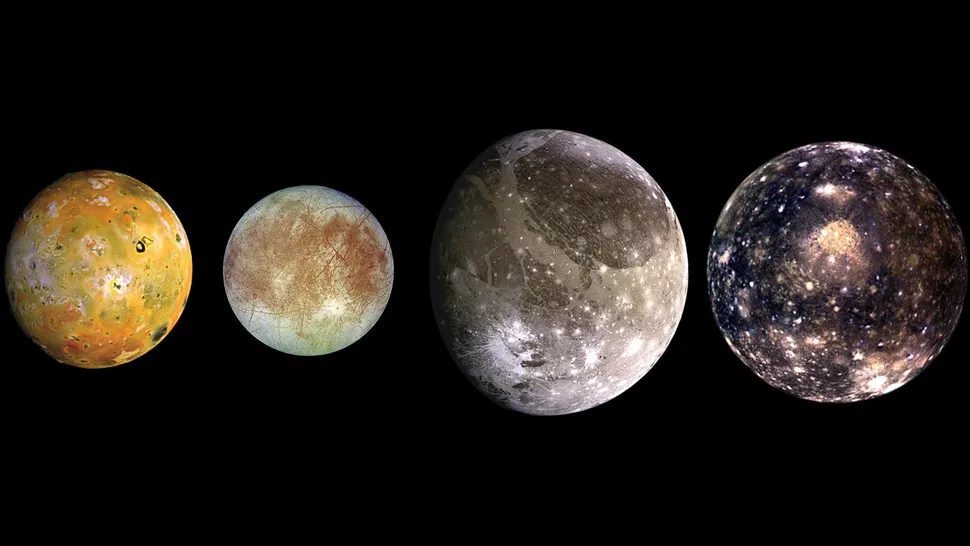
The image above juxtaposes size-scaled portraits of Io, Europa, Ganymede, and Callisto, highlighting their radial increase in ice content and decrease in density. Their stratified character encodes temperature gradients in the ancestral Jovian CPD, which in turn are sensitive to both viscous dissipation and magnetically induced truncation of inflow.
4.1 Analytical Estimates of the Magnetospheric Cavity Radius
The equilibrium cavity radius Rcav can be approximated as the point where magnetic pressure equals the local ram pressure of disk accretion:
B2/(2μ0) ≈ ρgasv2 + Pgas
Assuming steady-state accretion, one obtains:
Rcav ∝ (B4/Ṁ2 √Mp)1/7
where Ṁ is the mass infall rate and Mp the planet mass. Given that Jupiter’s interior dynamo is more vigorous, its B is ≳20 × Saturn’s, leading to Rcav being several planetary radii for Jupiter but virtually null for Saturn during CPD lifetime.
5. Numerical Simulation Framework
To scrutinize the above analytic scaling, Fujii et al. (2026) implemented three complementary computational modules: (i) an interior thermochemical model to evolve planetary radius and magnetic dipole moment over 106 yr, (ii) a 3-D MHD simulation of the CPD that includes ionization-dependent resistivity and thermodynamics, and (iii) an N-body integrator with migrating satellites embedded in a torque-prescription background.
| Category | Symbol | Jupiter Value | Saturn Value | Units |
|---|---|---|---|---|
| Initial Planetary Radius | R0 | 1.9 × 10⁵ | 1.6 × 10⁵ | km |
| Accretion Rate | Ṁ | 10−7 | 1.3 × 10⁻⁷ | M⊙ yr−1 |
| Initial Field Strength | B0 | 750 | 140 | μT |
| Viscosity Parameter | α | 2 × 10⁻³ | 2 × 10⁻³ | — |
| Dust-to-Gas Ratio | ζ | 0.01 | 0.012 | — |
The authors performed 500 realizations per planetary analog, varying α and ζ within observationally supported ranges, thereby compiling a statistically significant ensemble of satellite growth tracks.
6. Results: Divergent Satellite Architectures
6.1 Formation Timescales
Simulation outcomes show that, for Jupiter, a magnetospheric cavity arises <0.2 Myr after CPD inception and persists for ≈1.8 Myr, precisely the interval during which satellites grow from sub-lunar embryos to Galilean-scale bodies. The cavity arrests inward migration at a distance of 7–10 RJ, facilitating resonant capture into the Laplace chain. Saturn, conversely, develops a cavity of negligible radial extent; thus, any growing sub-Titan embryo migrates inward on a τmig ≈ 3 × 10⁴ yr timescale until collisional merger produces a single dominant moon just exterior to the Roche limit—the present Titan.
| Outcome Metric | Jupiter Sim. | Jupiter Obs. | Saturn Sim. | Saturn Obs. |
|---|---|---|---|---|
| # Moons >2,000 km | 3–4 | 4 | 1 | 1 |
| Largest Moon Mass (M⊕) | 0.025 | 0.026 | 0.022 | 0.022 |
| Dominant Resonance | 1:2:4 | 1:2:4 | None | None |
| Outer Edge of Resonant Chain (RP) | 27–30 | 26.3 | — | — |
| Time to Resonance Lock (Myr) | 0.6–1.2 | ≈1 (inferred) | — | — |
6.2 Composition Gradients
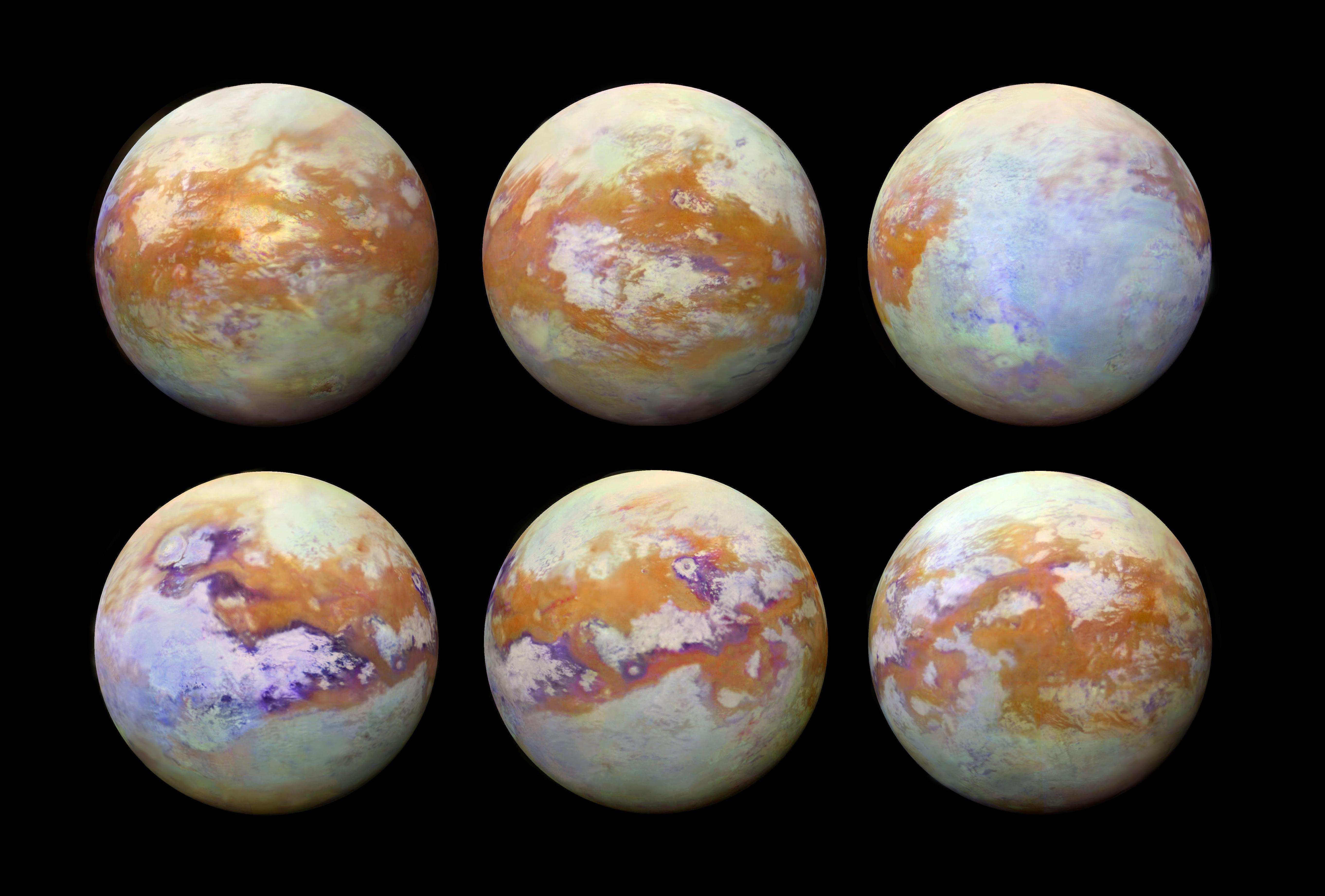
The CPD thermal structure in Jupiter simulations exhibits a silicate condensation front inside 15 RJ and an ice condensation front beyond 25 RJ, neatly bracketing the present-day densities of the Galileans. Saturn’s cooler, cavity-less disk produces only modest temperature gradients; hence Titan incorporates a higher volatile fraction throughout, consistent with its low bulk density.
Above: A visualization of a young gas giant ensconced in a magnetized circumplanetary disk. The inner truncation region (bluish void) arises where magnetic pressure repels ionized gas.
7. Discussion: Interpreting the Magnetospheric Cavity Hypothesis
The magnetospheric cavity paradigm offers a compelling and self-consistent framework, but it demands scrutiny against a battery of astrophysical constraints: thermal evolution models, secular migration of moons after disk dissipation, and gravitational interactions among captured planetesimals. Several key factors require elaboration.
7.1 Sensitivity to α-Viscosity and Dust Fraction
Lower α reduces viscous heating, yielding cooler disks that may shrink Rcav. However, even α ≈ 10−4 in Jupiter analogs still supports a cavity because of the planet’s formidable B-field. Conversely, raising α in Saturn analogs barely enlarges Rcav because magnetic pressure remains intrinsically weak compared to ram pressure for realistic Ṁ. Therefore the Jupiter/Saturn divergence persists across plausible disk parameters.
7.2 Survival of Moons Through Planetary Contraction
Post-disk dissipation, gas drag becomes negligible and the moons interact gravitationally with residual planetesimals and each other. N-body integrations show that the Laplace trio among the Galileans remains robust unless strong perturbations from a hypothetical fifth Galilean moon are invoked. In Saturn’s system, Titan’s isolation aids its long-term stability, whereas putative companion moons would likely be destabilized via Titan-driven resonances, explaining their current absence.
7.3 Observational Predictions for Exoplanetary Systems
Exomoons remain elusive, yet magnetospheric cavity theory yields falsifiable predictions: (i) Hot Jupiters, having intense B-fields due to rapid rotation but minuscule Hill spheres, should retain ≤1 large moon, likely destroyed by tidal decay; (ii) Super-Jovians at ≳5 AU should harbor compact multi-moon suites; (iii) Saturn-mass gas giants with low rotation rates may exhibit solitary large moons if any. The forthcoming ESA Cheops extended mission and NASA’s Nancy Grace Roman Space Telescope microlensing survey could vet these projections within the next decade.
| Exoplanet Class | Typical B-Field (μT) | Predicted Rcav (RP) | Expected # Large Moons | Detectability Prospects |
|---|---|---|---|---|
| Hot Jupiter (0.02 AU) | 1,000–2,000 | 0.5–1 | 0–1 | Poor (tidal loss) |
| Cold Jupiter (5 AU) | 300–600 | 5–10 | 3–5 | Good (transit timing) |
| Saturn-like (9 AU) | 20–50 | <2 | 1 | Moderate |
| Super-Jovian (8 MJ) | 800–1,200 | 6–15 | >4 | Excellent (microlensing) |
| Neptunian (0.7 MJ) | 5–10 | <1 | 0 | Poor |
8. Limitations and Alternative Hypotheses
While the magnetospheric cavity hypothesis aligns elegantly with many empirical facets, science advances by challenging dominant paradigms. Alternative explanations include:
- Late Heavy Bombardment Sculpting: Differential bombardment histories could have stripped Saturn of inner moons while leaving Titan intact.
- Differential Solid Surface Density: Since Saturn formed further from the Sun, its local reservoir of rocky material might have been smaller, biasing Titan’s composition and size.
- Gas Starvation Timescales: If Saturn’s CPD was truncated earlier by solar photoevaporation, satellite growth could have been stunted.
- Tidal Dissipation in the Planet: Energy dissipation Q-values vary; a lower Q in Saturn might have induced faster inward migration and loss of moons.
However, none of these mechanisms singly reproduce both the quantity and the resonant architecture of the Galileans while simultaneously explaining Titan’s singular status. A multifactorial interpretation, in which magnetism constitutes the prime mover but operates in concert with environmental factors, is therefore likely.
9. Future Missions and Observational Tests
NASA’s Europa Clipper (launch 2024) and ESA’s JUICE (launch 2023) will refine internal structure models of Europa and Ganymede via magnetometer, laser altimetry, and radar soundings, thereby constraining historical tidal dissipation and indirectly the formation epoch. For Saturn, the Titan Dragonfly rotorcraft will return compositional and climatological data that bear on CPD chemothermal conditions. Additionally, the proposed MUSE mission aims to deploy smallsats into Callisto orbit, granting insights into non-resonant Galilean satellites.

Above: Concept rendering of Dragonfly, slated for a 2034 Titan landing. Surface geochemistry will help reconstruct Saturnian CPD temperature gradients—an indirect litmus test of magnetospheric cavity predictions.
10. Broader Astrophysical Implications
The fundamental processes deciphered here transcend the confines of the Jovian and Saturnian systems. In star formation, disk truncation by stellar magnetospheres governs planet migration; analogously, planetary magnetospheres shepherd satellite assembly. Similar physics plays out on yet different scales in black-hole accretion disks, where magneto-centrifugal winds truncate the inner disk edge.
More philosophically, the diversity among planetary satellite systems teaches us that seemingly small perturbations—an extra factor of ten in magnetic field strength—cascade into macroscopic architectural divergences. This sensitivity to initial and boundary conditions epitomizes the emergent complexity inherent in astrophysical disks.
11. Conclusion
The question, “Why does Jupiter have more large moons than Saturn?” has galvanized planetary scientists for decades. Recent research incorporating high-fidelity MHD models indicates that Jupiter’s powerful magnetic field carved out a sustained cavity in its circumplanetary disk, establishing a resonant sanctuary where multiple satellites could accumulate and stabilize. Saturn’s weaker field precluded such a cavity, promoting rapid inward migration, collision, and consolidation into a single Titan-sized body. This explanation coheres with compositional gradients, orbital resonances, and the mass distribution observed today. Yet definitive corroboration awaits the synergistic arrival of new missions, improved exomoon detection capabilities, and deeper integration of dynamical, magnetic, and geochemical data sets.
For More Information
The interested reader may consult the following key resources for deeper exploration of the themes outlined above:
- Fujii, Y. I., Ogihara, M., & Hori, Y. (2026). “Magnetospheric Cavity Regulation of Satellite Formation.” Nature Astronomy.
- Canup, R. M. & Ward, W. R. (2020). “Satellite Formation in Circumplanetary Disks.” Nature Communications.
- NASA Juno Mission Page
- Cassini-Huygens Mission Archive for Saturnian Moons
- Ouyang, L.-S., Chen, H., and Li, D. (2024). “MHD Simulations of CPDs with Varying Ionization Fractions.” ArXiv e-prints.
- NASA Exoplanet Archive
- ESA JUICE Mission Portal
The rapid convergence of observational, theoretical, and computational advances promises that the next decade will either validate the magnetospheric cavity hypothesis or pave the way for an even deeper understanding of how the universe sculpts its myriad moons.