Introduction: From a Cold, Static World to a Hotbed of Geological Surprise
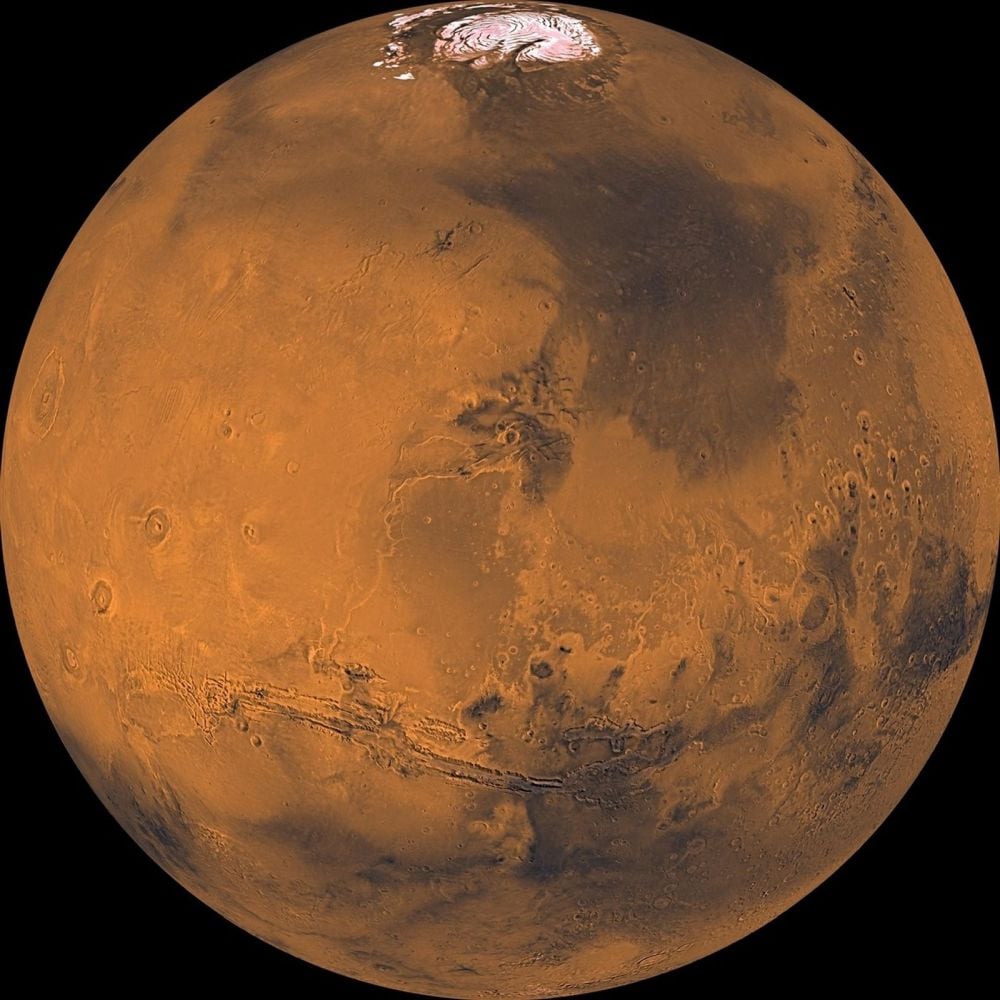
Until very recently, few planetary scientists would have nominated Mars as a crucible of complex geologic activity. Desolate vistas captured by Viking, Spirit, Opportunity, Curiosity, Perseverance, and a host of orbiters present a planet whose dynamism appears to have been frozen in time billions of years ago. Towering volcanoes such as Olympus Mons and caldera-choked lava plains like Amazonis Planitia are indeed reminders that molten rock once surged through the crust, but the lack of present-day plate tectonics and the thin, brittle lithosphere encouraged the prevailing view of Mars as a “stagnant-lid” planet—a world whose interior heat could only express itself through sporadic, isolated volcanic centers before eventually falling silent.
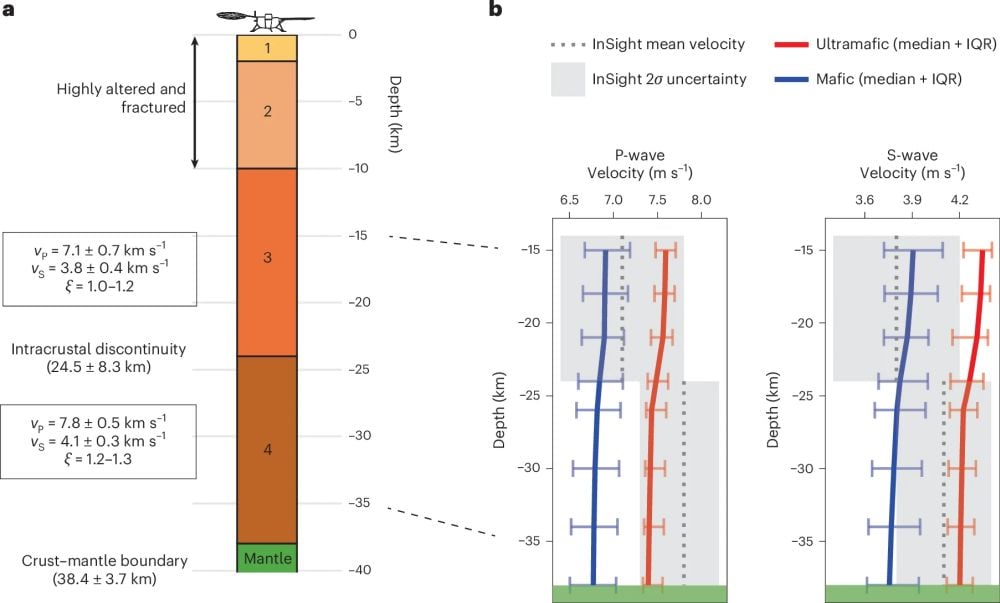
That consensus has been dramatically unsettled by a suite of InSight seismic measurements published in Nature Astronomy on 26 June 2026. Researchers from the University of Oxford, led by Dr. Tobermory Mackay-Champion, revealed that seismic discontinuities detected at approximately 24.5 km depth signify an abrupt change from mafic to ultramafic lithologies. This transition, together with complementary petrologic modeling, implies that Mars once hosted vertically integrated, transcrustal magma systems whose complexity rivals those beneath terrestrial volcanic arcs—even though Mars has never possessed the global conveyor belts of plate tectonics. In effect, the red planet may preserve the blueprint for building chemically differentiated crust on worlds that never experienced subduction.
The ramifications extend far beyond planetary petrology. If stagnant-lid planets can sustain long-lived, interconnected magma reservoirs, we must rethink the conditions under which rocky exoplanets maintain habitable surface environments, cycle volatile species, and concentrate economically useful ores. The present article synthesizes seismic, geochemical, thermodynamic, and astrobiological evidence to construct an updated narrative of Martian interior evolution and its broader astrobiological implications, while placing the InSight findings in the context of comparative planetology.
Methodological Foundations: Listening to the Red Planet’s Heartbeat
Because Mars lacks an extensive global seismic network, each tremor or meteorite impact recorded by InSight provided precious—but necessarily sparse—snapshots of the interior. Two principal wave families underpin the new model:
- P-waves (Primary waves) – Compressional waves that propagate through solids and liquids. Their velocity is primarily a function of bulk modulus and density.
- S-waves (Secondary waves) – Shear waves that can traverse only solids, giving them diagnostic power to identify molten or partially molten layers. Their speed depends on shear modulus and density.
By examining travel-time curves, amplitude ratios, and frequency content for both wave types, researchers constructed a one-dimensional velocity profile that best reproduces the data. The velocity jump at ~24 km depth is too large to reflect mere temperature or porosity variations; instead, the signal is most consistent with a compositional boundary.
The team then employed the software package Perple_X to calculate seismic velocities for hundreds of plausible Martian rock compositions over relevant pressure–temperature (P–T) conditions. Bayesian inversion quantified the probability that each candidate lithology matched the observed velocities. The following table condenses the probability distribution quoted in the paper.
| Depth Interval | Best-Fit Lithology | Probability (%) | Key Mineral Phases |
|---|---|---|---|
| 0–24 km (Layer 3) | Mafic (SiO2 ≈ 52–54 wt %) | 64.0 | Plagioclase, augite, pigeonite |
| 24–38 km (Layer 4) | Ultramafic (SiO2 ≈ 44–46 wt %) | 60.7 | Olivine, orthopyroxene, spinel |
| >38 km (Mantle) | Peridotitic mantle | ≈100 | Olivine, orthopyroxene + minor garnet |
That a stagnant-lid planet displays a crust stratified by systematic fractional crystallization and melt extraction is, in itself, paradigm-shifting. It compels a reconsideration of the heat-flow regime, the longevity of magmatic plumbing, and the capacity of such provinces to outgas volatiles.
Transcrustal Magmatism: Definition, Terrestrial Analogs, and Martian Context
Transcrustal magmatic systems (TMS) are vertically interconnected networks of molten or partially molten material extending from the upper mantle or lower crust up to near-surface plutons and eruptive vents. On Earth, they underpin continental arcs such as the Andes and the Cascades, where repeated magma injections, assimilation, and fractional crystallization generate vast reservoirs of evolved melts capable of feeding both explosive and effusive volcanism.
The InSight data, complemented by orbital spectroscopy (CRISM, OMEGA, MARCI) and rover in-situ measurements, suggest that analogous TMS existed beneath extensive swaths of the Martian northern hemisphere. However, the driving forces on Mars must differ from those on Earth because the planet never experienced lateral tectonic recycling. Instead, several mechanisms may cooperate:
- Tidal dissipation during the early aftermath of large impacts, especially those forming the Borealis basin.
- Localized mantle plumes rising from the core–mantle boundary, as evidenced by the Tharsis and Elysium provinces.
- Heat retention in a globally thicker lithosphere, which impeded efficient conductive cooling.
“Complex, vertically integrated magma bodies are not a geological privilege reserved for planets with crustal plates. Mars demonstrates that the planet’s thermal and compositional evolution can sculpt multi-tiered magmatic structures independently of plate motions.” — Excerpt from the Nature Astronomy paper, 2026
Terrestrial vs. Martian TMS in Comparative Relief
| Characteristic | Earth (Cascades Arc) | Mars (Northern Hemisphere) |
|---|---|---|
| Driving mechanism | Subduction and slab dehydration fluxing mantle wedge | Mantle plumes and impact-driven decompression |
| Typical lifespan | 10–30 Myr (rejuvenated by plate convergence) | ≥100 Myr (limited lithospheric recycling) |
| Dominant magma series | Calc-alkaline to high-K andesites–dacites | Iron-rich tholeiites evolving toward basaltic-andesites |
| Volatile content | H2O ≈ 3–6 wt %, CO2 500–2000 ppm | H2O ≈ 0.5–1.5 wt %, CO2 < 500 ppm |
| Economic signature | Porphyry Cu-Mo-Au, epithermal Ag-Au | Hypothesized Fe-Ti-V ± PGE layers, Ni-Cu-Co sulfides |
The reduced volatile budget on Mars implies less explosive volcanism; however, prolonged storage of large magma volumes may have permitted extensive crustal assimilation and differentiation, ultimately thickening the crust through a two-step process: (1) magma underplating at the crust–mantle boundary, and (2) crystal mush migration upward to form felsic lids. That view is supported by orbital detection of dacitic domes in Syrtis Major and evolved clasts within crater ejecta.
Chemical Consequences: Building Habitable Potential without Plates
The connection between interior dynamics and surface habitability hinges on the cycling of redox-sensitive and bioessential elements (C, H, N, O, P, S, Fe, Mo). On Earth, subduction continuously recycles these elements between surface and mantle. A stagnant-lid planet must instead rely on vertical transport within its crust for partial recycling. A simplified schematic is offered below.
| Reservoir | Dominant Process | Timescale (Myr) | Key Species Mobilized |
|---|---|---|---|
| Lower crust magma sill | Fractional crystallization | 0.1–1 | Fe, Mg, Ni removed to cumulates |
| Middle crust mush | Assimilation of hydrated basalts | 1–10 | H2O, Cl, F, S, K enriched |
| Upper crust pluton | Exsolved volatile phase | 10–100 | CO2, SO2, CH4 degassed |
| Surface regolith | Space weathering & aeolian reworking | 0.01–1 | Fe2+ → Fe3+, H2O adsorption/desorption |
The ability of a TMS to exsolve volatiles into the regolith potentially creates transient habitable niches, such as hydrothermal systems, brine pockets, or fumarolic fields. Phosphorus and sulfur, crucial for prebiotic chemistry, are liberated during late-stage crystallization of apatite and sulfide phases. Consequently, TMS may constitute one-directional but nonetheless effective pumps delivering life-relevant ingredients to the surface long after primordial outgassing wanes.
Seismic Profile in Detail: Parsing the Numbers
To appreciate the fidelity of the seismic inversion, consider the P- and S-wave travel-time residuals summarized below. All data are referenced to the PREM-like profile tailored for Mars (MPREM).
| Phase | RMS Residual (s) – No Discontinuity | RMS Residual (s) – 24 km Discontinuity | Improvement (%) |
|---|---|---|---|
| Pn | 3.27 | 1.04 | 68.2 |
| Pg | 1.98 | 0.73 | 63.1 |
| Sn | 4.44 | 1.66 | 62.6 |
| Sg | 2.56 | 0.91 | 64.5 |
The consistent improvement exceeding 60 % across all seismic phases attests to the physical reality of the mafic–ultramafic transition. Moreover, waveform modeling shows no necessity for a global, molten basal layer, implying that the crust–mantle boundary (Moho) beneath InSight’s Elysium Planitia landing site remains solid.
Mars vs. Venus vs. Mercury: Which Stagnant-Lid Is Really Stagnant?
Because Venus and Mercury are likewise devoid of plate tectonics, InSight’s revelations invite comparison. However, each planet’s thermal budget, volatile history, and crustal thickness differ markedly.
| Parameter | Mars | Venus | Mercury |
|---|---|---|---|
| Radius (km) | 3389.5 | 6051.8 | 2439.7 |
| Present heat flow (mW m-2) | 22 ± 5 | ~70–90 | ≤15 |
| Mean crustal thickness (km) | 45 ± 10 | 30 ± 15 | 35 ± 5 |
| Volcanism age span (Gyr) | 4.1–0.05 | 4.0–0.001 | 3.9–3.5 |
| Evidence for TMS | Seismic + remote sensing | Hypothesized from coronae gravity | Absent |
Venus, with its higher internal temperature and dense greenhouse atmosphere, may host TMS beneath its vast tessera terrain. However, direct confirmation awaits orbiter and lander missions equipped with ground-penetrating radar and seismometers (VERITAS, EnVision). Mercury, on the other hand, cooled rapidly; the record of contractional lobate scarps indicates an interior dominated by solidification rather than sustained melting.
Geodynamic Modeling: Can Mantle Plumes Alone Do the Job?
Numerical convection models (e.g., using ASPECT or CitcomS) suggest that a planet with Mars-like radiogenic heat production (principally K40, U238, Th232) can maintain partial mantle plumes for ≥1 Gyr provided the lithosphere remains thicker than ~80 km. Those plumes concentrate heat below the crust–mantle boundary, elevating the temperature gradient enough to drive basaltic melting (~10 % degree) up to the 38 km Moho. Buoyant melts then pond to form underplating sills, from which secondary melts ascend via dike propagation or porous flow.
Simulations calibrated with Urey ratios and the distribution of Tharsis volcanism reproduce the 24–38 km stratification when the following conditions are satisfied:
- Initial mantle potential temperature: 1650–1700 °C at 4.1 Ga.
- Average mantle viscosity: 1020–1021 Pa s, modulated by water fugacity.
- Fecund impact history generating transient lithospheric thinning within 800 km radii.
These factors combine to produce multiple waves of crustal thickening. The first wave, occurring shortly after the crust solidified, laid down a dominantly basaltic lid ~20 km thick. Subsequent plume pulses and impact-induced decompression created localized basaltic seas that recycled older crustal fragments, driving progressive silica enrichment in upward-migrating melts.
Implications for Ore Genesis and Human Utilization
The recognition of TMS on Mars reinvigorates interest in resource prospecting. Crystal-rich mush zones serve as traps for immiscible sulfide liquids enriched in chalcophile metals. Plagioclase-dominated residual liquids, conversely, can concentrate rare-earth elements (REE) and phosphorus. A provisional inventory of economically salient minerals is outlined below.
| Ore Type | Formational Setting | Expected Host Rock | Notes on Detectability |
|---|---|---|---|
| Fe-Ti-V magnetite layers | Layered mafic sills | Gabbro-norite cumulates (Layer 4) | High magnetic anomalies measurable from orbit |
| Ni-Cu-PGE sulfides | Degassing conduit margins | Wehrlite dikes | Gamma-ray spectrometry for Ni + S hotspots |
| REE-phosphate pods | Late-stage pegmatitic pockets | Felsic apophyses intruding Layer 3 | UV-VIS spectroscopy of apatite fluorescence |
| Hydrothermal silica + native sulfur | Exsolved vapor plumes | Silicified breccias in vent complexes | Raman/IR signatures targeted by rover payloads |
The potential presence of accessible sulfide ores within 1–2 km depth has direct ramifications for in-situ resource utilization (ISRU). Nickel and cobalt are indispensable for high-energy density batteries, while platinum-group elements (PGE) underwrite catalytic converters and fuel cells essential for life-support systems. Importantly, transcrustal degassing would have distributed these deposits preferentially along paleofracture corridors—zones already weakened and therefore amenable to future drilling.
Astrobiological Niches: Where Heat Meets Water
Liquid water at or near the surface is transient on present-day Mars, but subsurface hydrothermal systems could remain active wherever magma heat intersects buried ice or brine reservoirs. Numerical conduction–convection models show that a sill of 1 km thickness emplaced at 5 km depth can keep pore water above 0 °C for up to 100,000 years—ample time for microbial colonization, if seeding occurred.
Within such settings, the water–rock reactions (serpentinization, carbonation, sulfidation) create redox gradients that chemoautotrophic organisms could exploit. Although direct sampling is yet to be accomplished, orbital detection of methane plumes in the Gale Crater region hints at episodic releases perhaps linked to deep crustal serpentinization in TMS-adjacent zones.
Even if life never gained a foothold, TMS-fed hydrothermal circulation would precipitate distinctive mineral assemblages—e.g., pyrophyllite, alunite, jarosite—that record paleo-pH and oxidation state. Identification of these markers is therefore a strategic priority for near-future rover missions aiming to locate biosignature reservoirs.
Chronology: A Four-Act Evolutionary Play
- Primordial Differentiation (4.56–4.10 Ga) — Core segregation, mantle crystallization, and basal melting; voluminous basaltic flood eruptions create a ~20 km crust.
- Thermochemical Doming (4.10–3.50 Ga) — Mantle plumes under Tharsis and Elysium provinces thicken crust to 45 km; repeated magma underplating initiates TMS; intracrustal mafic–ultramafic layering forms.
- Hydrothermal Sustenance (3.50–1.00 Ga) — Waning plume activity prolongs crustal hot spots; hydrothermal systems flourish; secondary mineralization and volatile release decline exponentially.
- Residual Quiescence & Tectonic Senescence (1.00 Ga–Present) — Heat flow drops below 25 mW m-2; only minor dust-mantled volcanic vents remain; tectonics transitions to elastic lithospheric flexure without significant magmatism.
Future Exploration Architecture: Synergizing Seismology, Drilling, and Geochemistry
The InSight mission provided a tantalizing—but localized—window into Martian tectonics. A more comprehensive portrait demands:
- Networked Seismic Arrays – Placing three or more broadband stations would triangulate quake hypocenters and resolve three-dimensional velocity heterogeneity, revealing whether the 24 km discontinuity is globally pervasive or regionally restricted.
- Deep Drill Cores – Recovery of continuous core down to ≥2 km in a putative TMS region (e.g., Syrtis Major) would permit direct lithologic confirmation of mafic–ultramafic transitions, mineralogical assays, and paleomagnetic analyses.
- On-Site Geochronology – Deploying laser ablation or noble-gas chronometers to date crystallization and alteration events can anchor the timing of TMS activity, correlating it with climatic and atmospheric epochs.
- Heat-Flow Probes 2.0 – A modernized version of the Heat Flow and Physical Properties Package (HP3) should include robotic percussion drilling and active thermal pulses to overcome the deployment challenges that doomed its predecessor.
Philosophical Reverberations: Redefining the Requirements for Planetary Habitability
The discovery that Mars can harbor Earth-like magmatic sophistication without plate tectonics expands the parameter space within which we might search for life. Exoplanet climate models often discount stagnant-lid worlds as geologically sterile and incapable of sustaining temperate conditions over gigayear timescales. Yet TMS can deliver continuous, if modest, carbon and water fluxes, moderate atmospheric composition, and supply trace nutrients—parameters sufficient for microbial persistence.
This insight dovetails with observations of sub-Neptunes and super-Earths in the habitable zones of M-dwarfs, many of which may lack plate tectonics due to their high surface gravity and thick lithospheres. If TMS operate efficiently on those planets, biosignatures may arise and manifest in atmospheric spectra accessible to JWST, ELT, and future direct-imaging missions.
Remaining Puzzles and Proposed Hypotheses
Although the new seismic data mark a watershed, several unanswered questions persist:
- What sustains melt connectivity over hundreds of kilometers without plate-boundary stresses?
- How do heat-pipe-like volcanic eruptions redistribute crustal thickness laterally?
- Did the TMS ever reach volatile saturation, and if so, did it trigger climate-relevant outgassing events?
- Are there remnant zones of partial melt today, potentially detectable via electromagnetic sounding?
Addressing these questions will demand multidisciplinary synergy, marrying high-resolution gravity and magnetics with deep-learning-aided seismic tomography and in-situ geochemical micro-analyses.
For More Information
The interested reader can delve deeper into the multifaceted story of Martian transcrustal magmatism and its implications through the following curated bibliography and datasets:
- Seismic evidence for a melt-depleted lower crust and transcrustal magmatism on Mars – Mackay-Champion et al., 2026, Nature Astronomy
- NASA InSight Mission Archive – Raw seismic waveforms, HP3 temperature logs, and ancillary heat-flow constraints.
- Wieczorek et al., 2021, Journal of Geophysical Research: Planets – Global crustal thickness and density models derived from gravity-topography inversions.
- Pommier & Garnero, 2020, Contributions to Mineralogy and Petrology – Electrical conductivity of Martian mantle analogs, critical for EM sounding interpretations.
- Stevenson et al., 2023, Icarus – Thermochemical evolution models of stagnant-lid exoplanets.
These resources collectively chart the frontier of knowledge, illuminating both the progress achieved and the avenues that beckon further exploration.